
Loading, please wait...
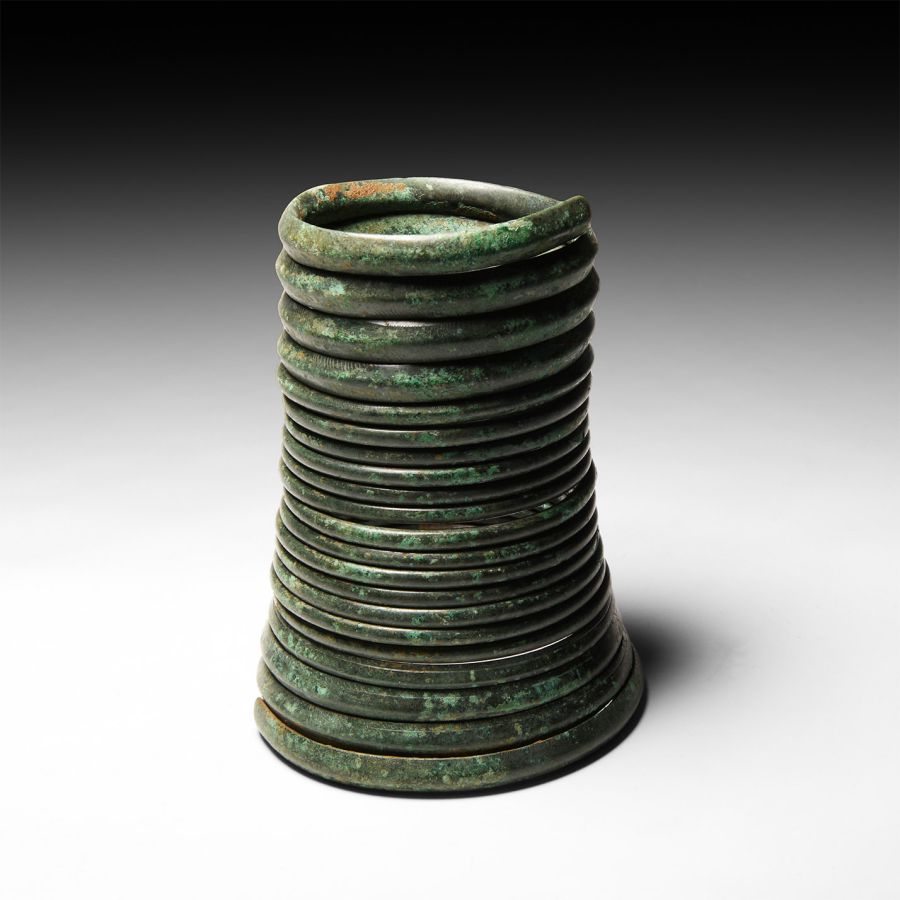
_900x900.jpg "Greek Decorated Spiral Bracelet")
_200x200.jpg "Greek Decorated Spiral Bracelet")
.jpg "Greek Decorated Spiral Bracelet")
LOT 0056
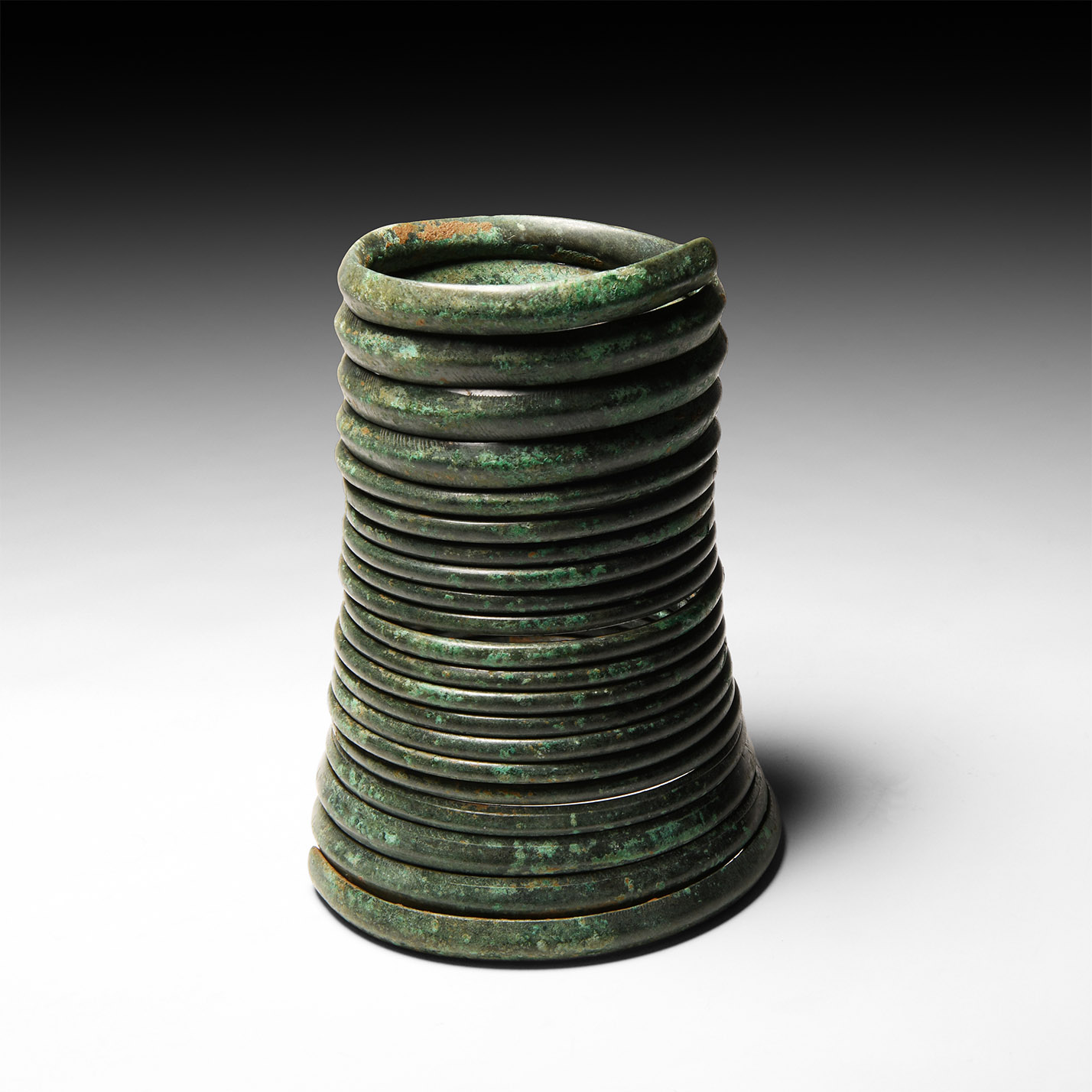
Greek Decorated Spiral Bracelet
8TH CENTURY B.C.
4 1/2 in. (685 grams, 11.5 cm).
A bronze bracelet formed as a spiral D-section rod with waisted profile, hatched and notched ornament to the edges.
ProvenancePrivate Swiss collection, acquired 2002.
LiteratureCf. similar item in the British Museum, London, under accession number 1856,1226.722.
CONDITIONTimeLine Auctions follows a vetting process to ensure the authenticity and legality of all items, reinforcing our commitment to integrity and responsible trading. Each antiquity, antique, and coin lot undergoes thorough examination by a vetting committee of at least ten external specialists, professional trade association members, scientists, and archaeologists: Our Vetting Process
AUCTIONS:
TimeLine is a leading auction house specialising in antiquities, ancient art, collectables, natural history, coins, medals, and books. Our auctions offer museums, collectors, historians, and enthusiasts the opportunity to acquire unique and historically significant pieces.
LOT 0056
Greek Decorated Spiral Bracelet
Estimate £700 - 900€810 - 1,040 (for guidance only)$950 - 1,220 (for guidance only)
-
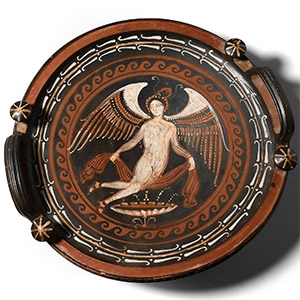
Large Greek Apulian Platter with Eros
4th century B.C.Estimate: £5,000 - 7,000 (+bp*)
Opening Bid: £2,500
A broad ceramic patera with raised rim and stepped foot, two strap handles to the rim each flanked by two domed studs; rim with reserved wave pattern band, studs with starburst motif; painted central scene with outer foliate bands and reserved wave pattern framing the tondo displaying Eros in flight with wings spread, holding a red cloth over an inverted shield; some repainting. 2.76 kg, 41 cm wide
Fine condition.
French collection, 1990s-early 2000s. Formerly in Patrick Declerck Auction, Douai, France, 2014, lot 72. From an important Paris gallery, France. Ex private Parisian collection. Accompanied by an original thermoluminescence analysis report no.N122j42 from Oxford Authentication. This lot has been checked against the Interpol Database of stolen works of art and is accompanied by search certificate no.11616-196567. -
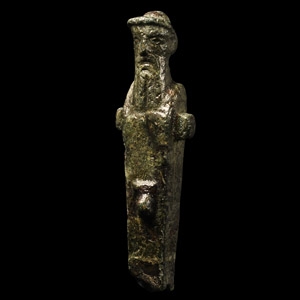
Greek Lock Plate Herm Figure
Circa 3rd century B.C.Sold for (Inc. bp): £130
A lock plate formed as a herm figure with tapering square-section body, stylised head and genitals, stub arms. 19.1 grams, 54 mm
German art market, 1990s. Mr A.H., a North American collector living in the UK. -
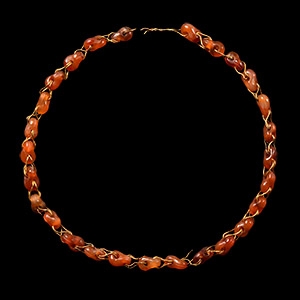
Greek Gold and Carnelian Necklace
1st century B.C.-1st century A.D.Estimate: £3,000 - 4,000 (‡+bp*)
Opening Bid: £1,500
A section of a necklace of carnelian drop-shaped beads, each pierced in two planes and linked loop-in-loop with thin twisted gold wires, possibly later. 8.16 grams, 26 cm long
The Gans collection, Hebling Dec, Berlin, 1929. with Christie's, New York, 8 December 1999, lot 51. Accompanied by a copy of the relevant Christie's catalogue pages. This lot has been checked against the Interpol Database of stolen works of art and is accompanied by search certificate no.11608-198969.
