
Loading, please wait...
LOT 0308
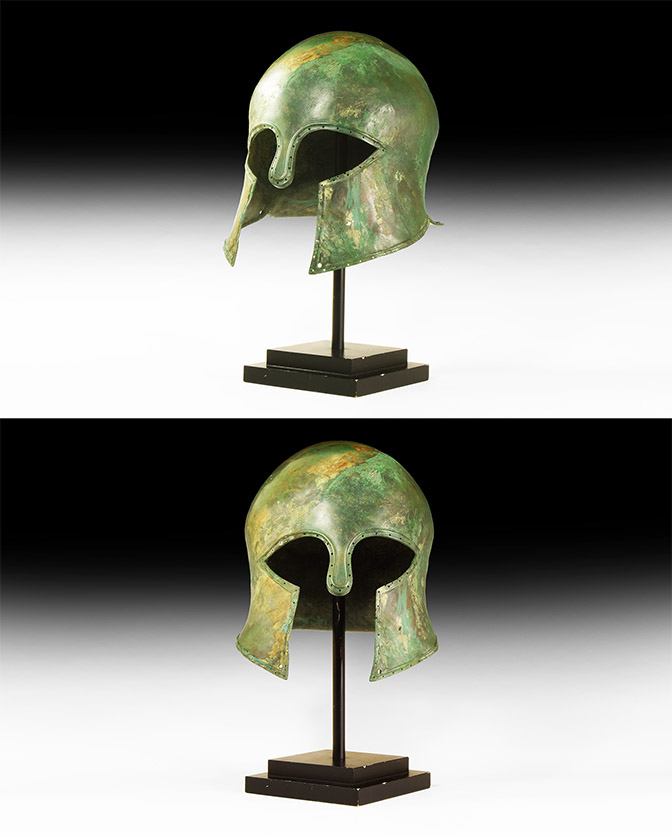
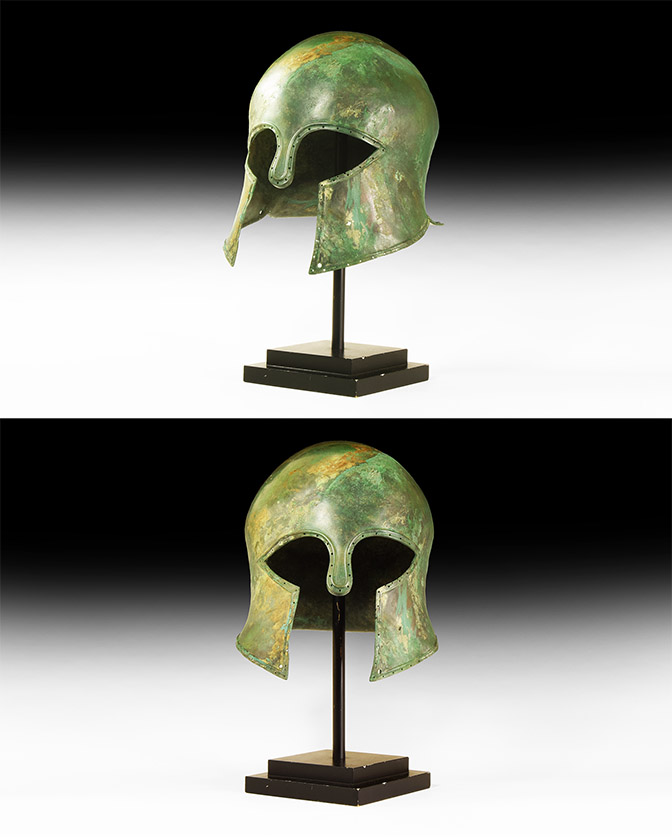
Greek Corinthian Helmet
7TH-6TH CENTURY BC
10 1/2" (1.14 kg, 26.5cm).
A bronze helmet of the Corinthian type, with curvilinear eye holes that taper to a point, wide nose guard, broad cheek pieces that leave a vertical opening for the mouth, curved projection to the nape of the neck; a border that has been drilled with holes to secure an interior lining, holes to the top for attachment of crest.
ProvenanceProperty of a London, UK collector; acquired London market, 1990s. Accompanied by X-Ray Fluorescence metal analysis certificate number 00933-2018GH.
LiteratureFor similar examples see the Olympia Archaeological Museum, Greece, inventory numbers B7977, B6127, B2603; cf. Born, H. Die Helme des Hephaistos: Handwerk und Technik Griechisher Bronzen in Olympia, Munich, 2009, for discussion.
FootnotesExtremely widespread in the seventh and sixth century BC, the Corinthian helmet provided maximum protection with its nasal and its broad cheek plates. Herodotus mentions the Corinthian helmet in his Histories (4.180) when writing of the Machlyes and Auseans, two tribes living along the River Triton in ancient Libya. The tribes chose annually two teams of the fairest maidens who fought each other ceremonially with sticks and stones. They were dressed in the finest Greek panoply topped off with a Corinthian helmet. The ritual fight was part of a festival honoring the virgin goddess Athena. Young women who succumbed to their wounds during the ordeal were thought to have been punished by the goddess for lying about their virginity.
The Corinthian helmet was the most popular during the Archaic and early Classical periods, with the style gradually giving way to the more open Thracian helmet, Chalcidian helmet and the much simpler pilos type, which was less expensive to manufacture and did not obstruct the wearer's critical senses of vision and hearing as the Corinthian helmet did. Numerous examples of Corinthian helmets have been excavated, and they are frequently depicted on pottery.
The Corinthian helmet was depicted on more sculpture than any other helmet; it seems the Greeks romantically associated it with glory and the past. The Romans also revered it, from copies of Greek originals to sculpture of their own. Based on the sparse pictorial evidence of the republican Roman army, in Italy the Corinthian helmet evolved into a jockey-cap style helmet called the Italo-Corinthian, Etrusco-Corinthian or Apulo-Corinthian helmet, with the characteristic nose guard and eye slits becoming mere decorations on its face. Given many Roman appropriations of ancient Greek ideas, this change was probably inspired by the "over-the-forehead" position common in Greek art. This helmet remained in use well into the 1st century AD.
TimeLine Auctions follows a vetting process to ensure the authenticity and legality of all items, reinforcing our commitment to integrity and responsible trading. Each antiquity, antique, and coin lot undergoes thorough examination by a vetting committee of at least ten external specialists, professional trade association members, scientists, and archaeologists: Our Vetting Process
AUCTIONS:
TimeLine is a leading auction house specialising in antiquities, ancient art, collectables, natural history, coins, medals, and books. Our auctions offer museums, collectors, historians, and enthusiasts the opportunity to acquire unique and historically significant pieces.
.jpg&width=120)
9th-11th century AD
Lot No. 2039
Sold for (Inc. premium): £500

6th-5th century BC
Lot No. 0309
Sold for (Inc. premium): £13,750

Copper Hoard Culture, Uttar Pradesh, Northern India, mid-2nd millennium BC
Lot No. 2048 Opening bid: £90
