
Loading, please wait...
LOT 0839
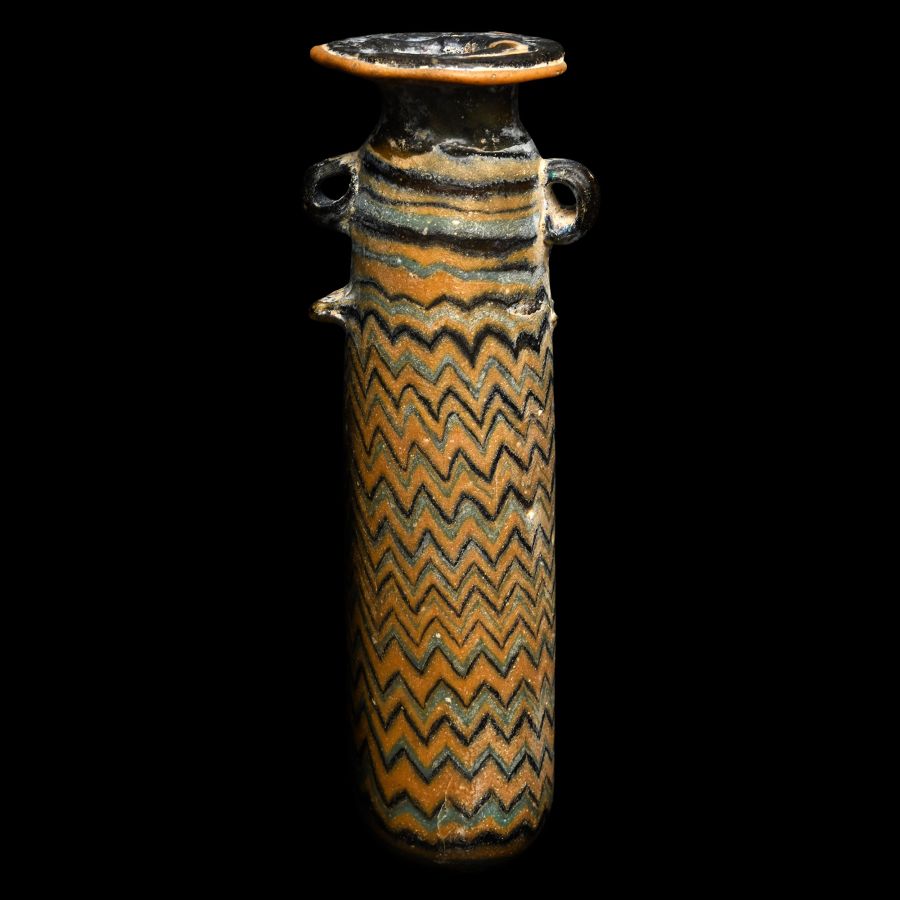
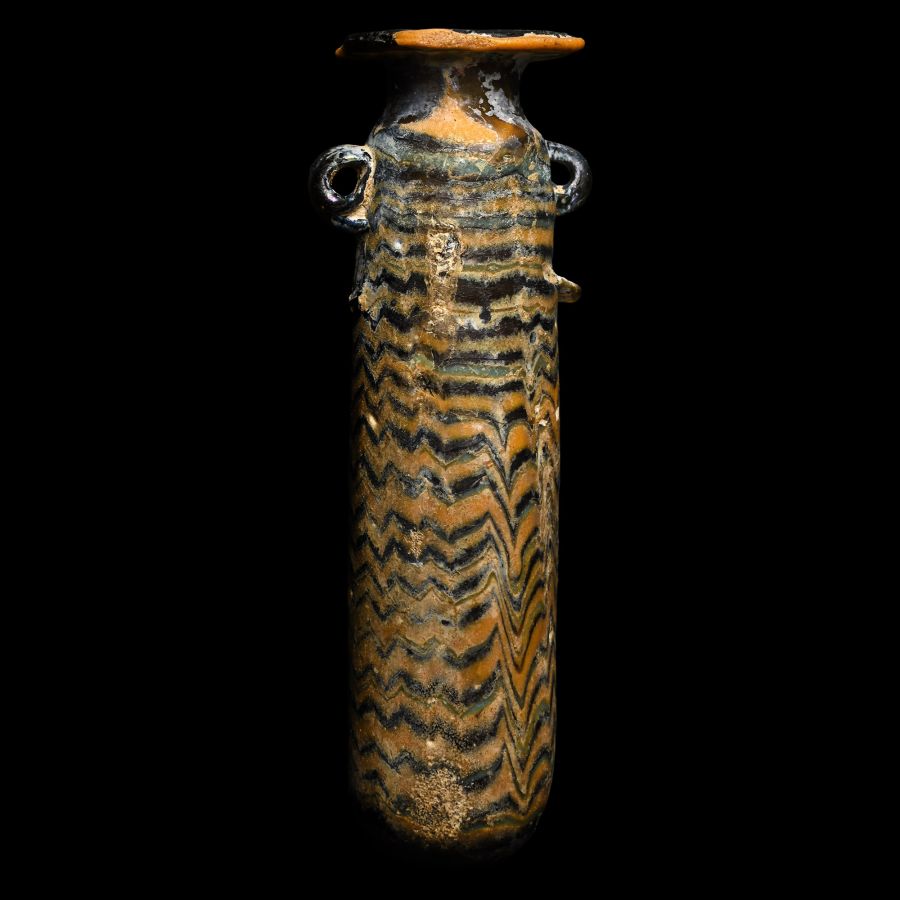
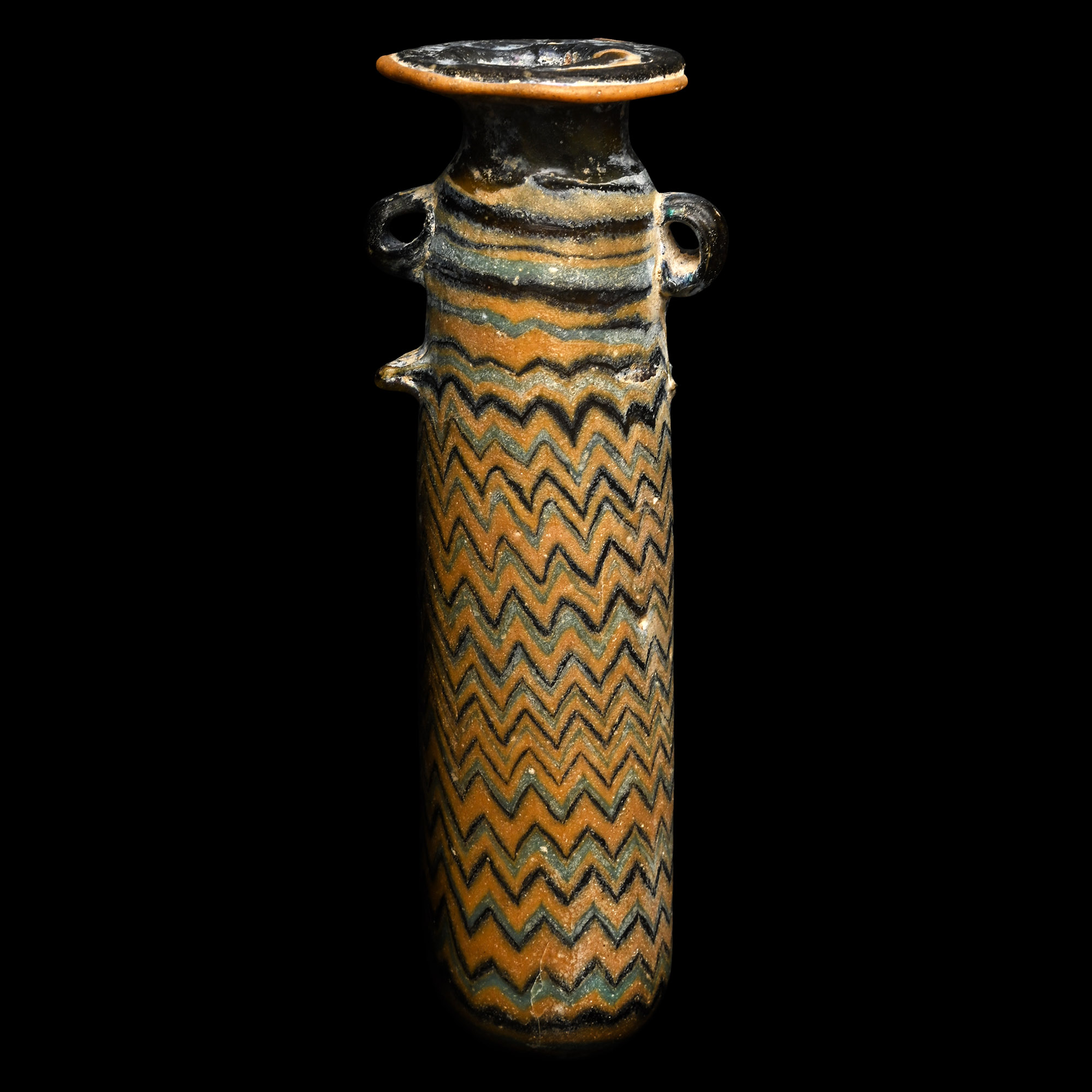
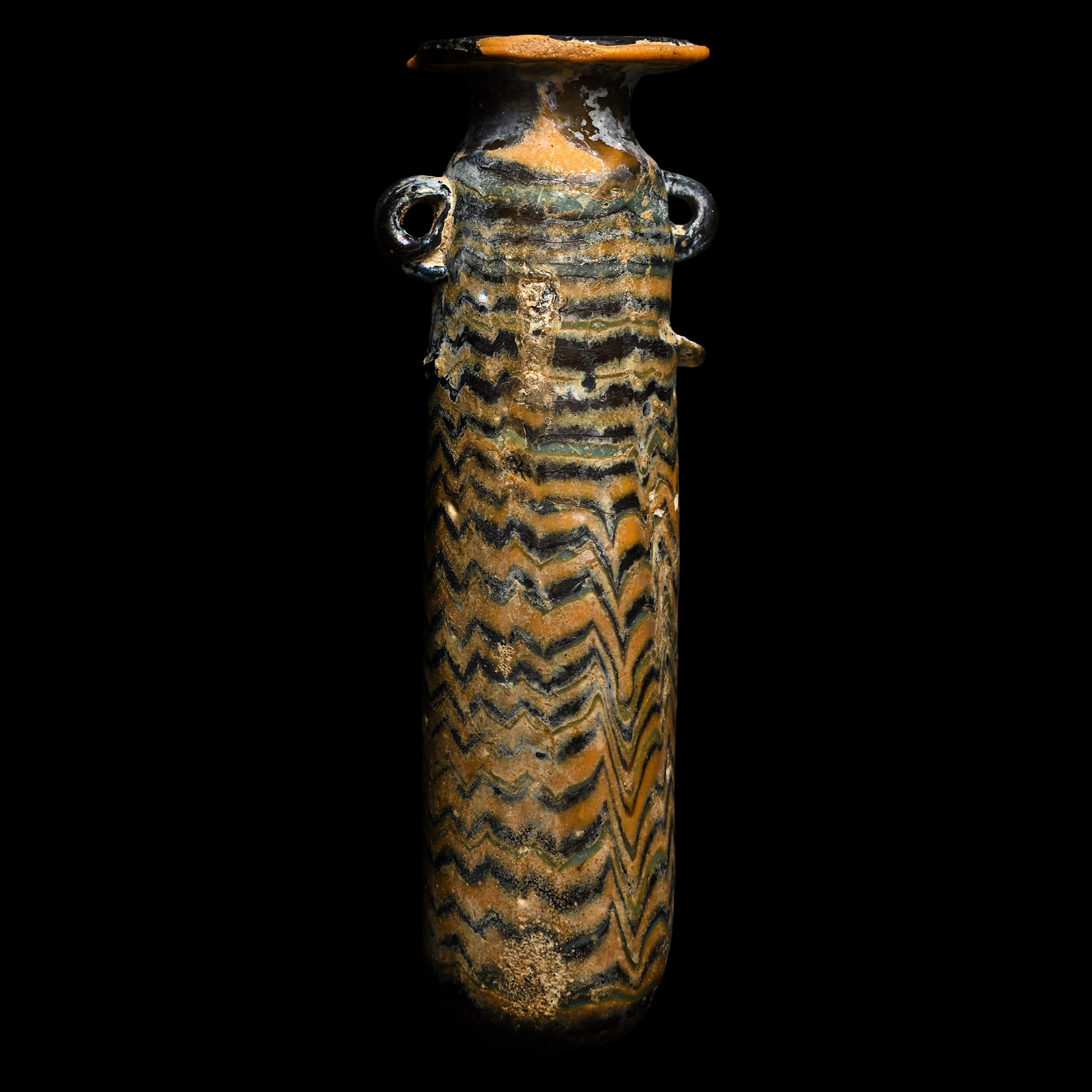
Greek Core-Formed Tall Glass Alabastron
6TH-5TH CENTURY B.C.
3 5/8 in. (36.69 grams, 91 mm).
With a fusiform body, slender neck and broad flange rim, decorated with marvered feathering and spiralling trails; two lateral loop handles and a pinched lateral lug.
ProvenanceAnonymous sale, Binoche & Giquello, Paris, 30th May 2012, no.124.
Private collection, Switzerland.
Accompanied by a copy of French passport no.0150269.
This lot has been checked against the Interpol Database of stolen works of art and is accompanied by search certificate number no.13188-249220.
Cf. The Corning Museum of Glass, accession number 50.1.5, for similar, in Goldstein, S.M., Pre-Roman and Early Roman Glass in the Corning Museum of Glass, Corning-New York, 1979, pp.124-125, no.257; cf. The Metropolitan Museum, accession number 30.115.33, for another similar alabastron.
FootnotesAlabastra of this typology, core-formed, trail-decorated and tooled, are typical of the Eastern Mediterranean. They were diminutive examples of a shape popularly produced for perfumed oils in the Greek world. Larger forms are known in both glass and ceramics.
CONDITIONTimeLine Auctions follows a vetting process to ensure the authenticity and legality of all items, reinforcing our commitment to integrity and responsible trading. Each antiquity, antique, and coin lot undergoes thorough examination by a vetting committee of at least ten external specialists, professional trade association members, scientists, and archaeologists: Our Vetting Process
AUCTIONS:
TimeLine is a leading auction house specialising in antiquities, ancient art, collectables, natural history, coins, medals, and books. Our auctions offer museums, collectors, historians, and enthusiasts the opportunity to acquire unique and historically significant pieces.
LOT 0839
Greek Core-Formed Tall Glass Alabastron
Estimate £3,500 - 4,500€4,060 - 5,220 (for guidance only)$4,730 - 6,080 (for guidance only)
Opening Bid
£1,750 (EUR 2,030; USD 2,363) ‡+BP*
-
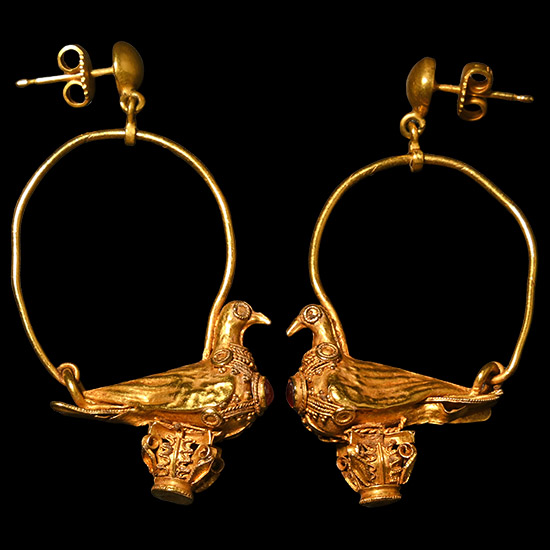
Greek Gold Earring Pair with a Dove above a Corinthian Capital
Hellenistic, circa 3rd-2nd century B.C.Estimate: £3,000 - 4,000 (‡+bp*)
Opening Bid: £1,000
Each a filigree hoop with free-running ring and articulated joint to the domed stud; hollow-formed sheet gold dove with applied filigree and granulation collar, cell to the chest with inset garnet cabochon, perching on the scrolled capital of a column; supplied in a presentation box. 10.08 grams total, 51-52 mm
Acquired from Derek Content, 8 July 1976 ($3,800). Private collection of Kal Noselson, New York, acquired between 1976 and the late 1990s; thence by descent. Accompanied by a handwritten invoice/letter with references from Derek Content for the piece, dated 8 July 1976. This lot has been checked against the Interpol Database of stolen works of art and is accompanied by search certificate no.13421-259832.
The earrings belong to the class of figure-pendant type, which was popular in Greece from the 4th century B.C. The Hellenistic period shows a distinctive spirit in the varied designs of these little earrings. One of the most employed motifs was that of the dove, which owed its popularity in close connection with the cult of Aphrodite. -
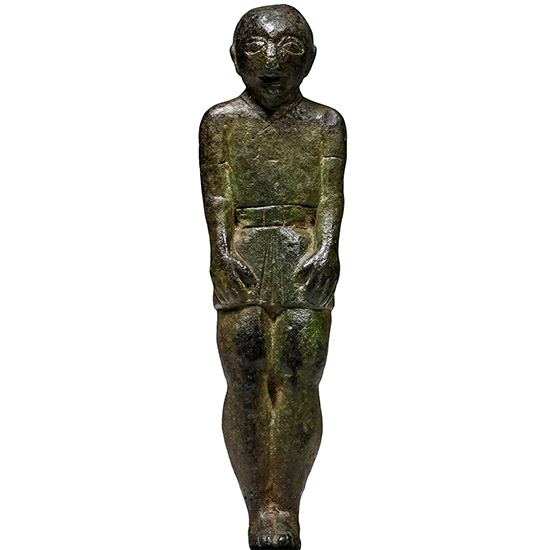
Iberian Bronze Figurine of a Man in Egyptianizing Dress
4th-2nd century B.C.Estimate: £2,000 - 3,000 (‡+bp*)
Opening Bid: £1,111
Standing with arms held straight at the sides, short hair with neck-ring to rear, short-sleeved tunic with pleats to centre-front and rear, wide belt; perhaps a monumental fitting; gas permeation to rear right leg; mounted on a custom-made stand. 77.8 grams total, 10 cm including stand
Private collection, Paris, France, assembled in the 1950s-1960s. with Tessier-Sarrou & Associés, Paris, 2015. European private collection. Accompanied by a copy of an Art Loss Register certificate, no.S00107108. Accompanied by a copy of French cultural export passport no.167803. This lot has been checked against the Interpol Database of stolen works of art and is accompanied by a search certificate no.12651-234613.
The youth’s broad shoulders are reminiscent of archaic Greek kouros figures, here in a specifically Iberian expression. The broad egg-shaped head has widely spaced, deep-set, flat oval eyes and lips of similar form. -
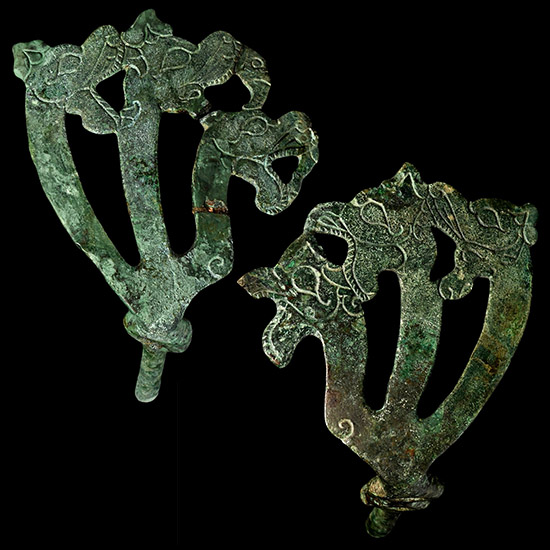
Scythian Bronze Horse Cheekpiece Pair Each with Three Dragons
Circa 5th-3rd century B.C.Estimate: £800 - 1,000 (+bp*)
Bids: 1 | Current Bid: £5
Matched pair, each comprising a round-section shank with two pierced bulbs and a perpendicular flange formed as three openwork profile beast-heads on long necks, each biting its neighbour. 183 grams total, 10.7-11.5 cm
Private collection formed in Europe in the 1980s. Westminster collection, central London, UK.
