
Loading, please wait...


LOT 0082
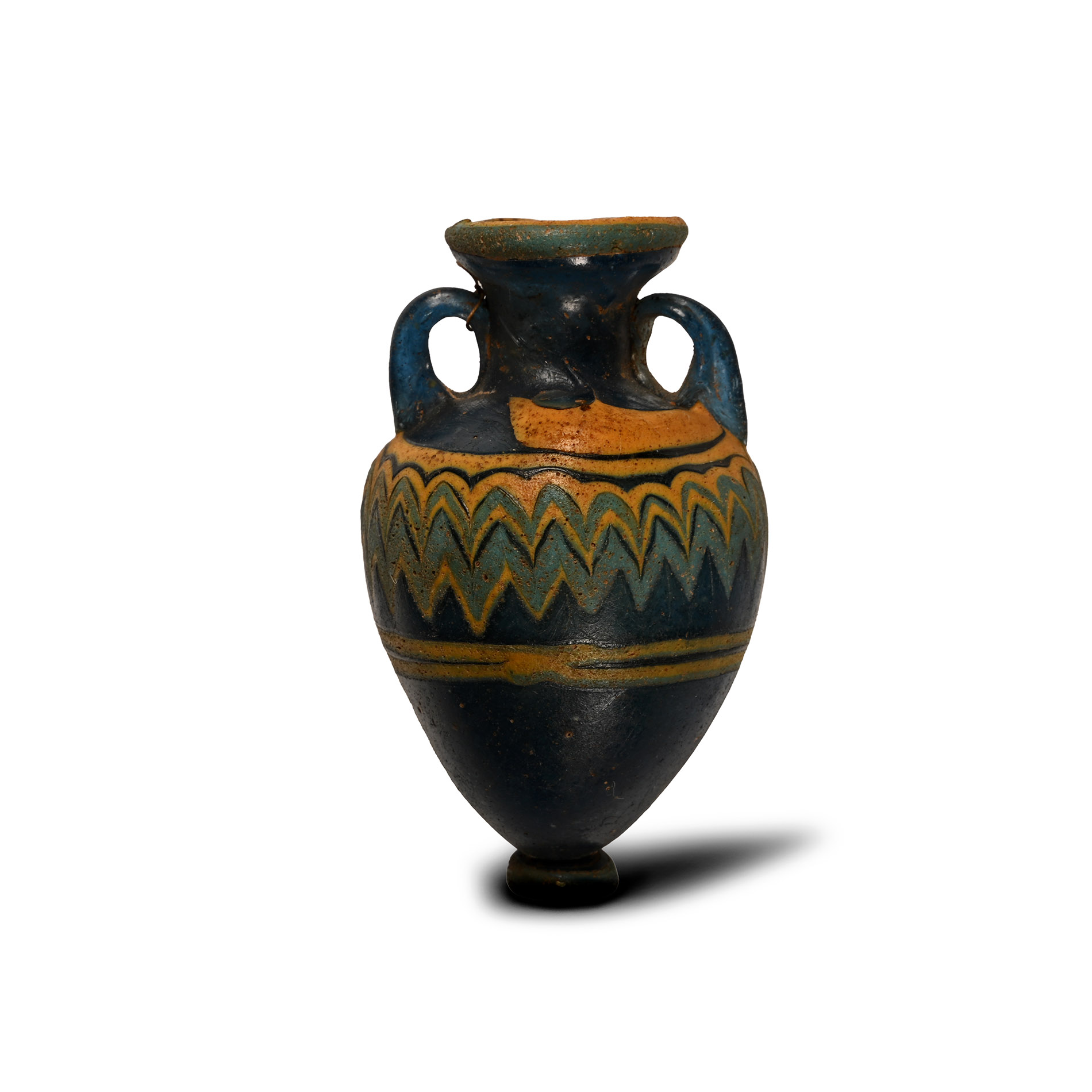
Greek Core-Formed Glass Aryballos
6TH-5TH CENTURY B.C.
2 1/8 in. (19.06 grams, 55 mm).
Of squat piriform profile with applied ring to the foot and rim of the mouth, applied strap handles to the shoulder; the equator with horizontal hoops and dragged marvered trail decoration.
ProvenanceFrancesc Cambó i Batlle (1876-1947) a prominent Spanish politician, art patron and philanthropist.
Gifted to his friend, the archaeologist, Josep Gilbert i Buch.
Acquired from Gilbert's family by the present owner's grandfather in the early 1980s.
Private collection of a European noble.
Cf. similar items in the British Museum under accession no. 1860,0201.57, and the Metropolitan Museum, New York, under accession no.1972.118.174.
FootnotesFrancesco Cambó i Batlle was a notable figure in early 20th-century Spain, best known for his role in politics as a leader of the Catalan nationalist movement and as a patron of the arts. He was a key benefactor of the Museo del Prado and left a significant legacy through his art collections. His deep connection to the cultural and artistic life of Spain makes items from his collection particularly valuable and historically significant.
CONDITIONTimeLine Auctions follows a vetting process to ensure the authenticity and legality of all items, reinforcing our commitment to integrity and responsible trading. Each antiquity, antique, and coin lot undergoes thorough examination by a vetting committee of at least ten external specialists, professional trade association members, scientists, and archaeologists: Our Vetting Process
AUCTIONS:
TimeLine is a leading auction house specialising in antiquities, ancient art, collectables, natural history, coins, medals, and books. Our auctions offer museums, collectors, historians, and enthusiasts the opportunity to acquire unique and historically significant pieces.
-
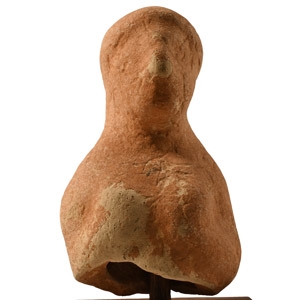
Greek Terracotta Bust of Goddess
4th-3rd century B.C.Sold for (Inc. bp): £59
Hollow-formed bust with arms drawn across the body and right hand cupping the breast; old collector's inked accession number to reverse 'SR.3590/65'; mounted on a custom-made stand. 232 grams total, 14.5 cm including stand
From a family collection mostly formed in the 1940s-1950s, thence by descent. -
.jpg)
Large Greek Apulian Red-Figure Skyphos with Maenad
4th century B.C.Sold for (Inc. bp): £9,100
With stepped foot and two loop handles to the rim, egg-and-dart border; Side A: female in loosely draped chiton holding a dish in her raised left hand and advancing towards an altar, looking to her rear and with her right arm extended; Side B: nude male in similar pose to the female, with mantle draped over his left elbow, gripping a thyrsus, the head wrapped in a band or taenia; volute scroll beneath each handle. 1.74 kg, 34 cm wide
Acquired in the mid 1980s-1990s. Private collection, Switzerland, thence by descent. Private collection, since the late 1990s. This lot has been checked against the Interpol Database of stolen works of art and is accompanied by search certificate number no.12364-226707.
The thyrsus in the hand of the male figure implies that he is a worshipper of Dionysus, and this impression is strengthened by the casual discarding of his clothing which is draped over his arm. The female may then be interpreted as a Maenad, a member of the group of devotees who accompanied the god and led the celebrations in his worship. A combination of protracted and vigorous dancing combined with wine-drinking led to an ecstatic frenzy in which the god was honoured. -
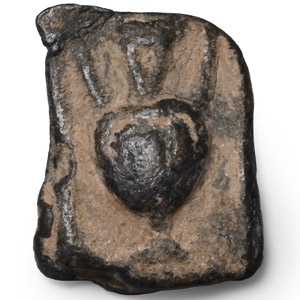
Greek Lead Token with Amphora
Circa 4th-2nd century B.C.Sold for (Inc. bp): £26
Rectangular with low-relief amphora image to obverse. 2.9 grams, 16 mm
From the collection of a gentleman, acquired on the London art market in the 1990s.
