
Loading, please wait...
_900x900.jpg "Greek Core-Formed Glass Aryballos")
_200x200.jpg "Greek Core-Formed Glass Aryballos")
.jpg "Greek Core-Formed Glass Aryballos")
LOT 0551
Greek Core-Formed Glass Aryballos
CIRCA 5TH-3RD CENTURY B.C.
3 in. (70 grams, 78 mm).
In opaque blue glass, flask shaped with shallow vertical channelling and polychrome feathering, trails to the neck and broad everted rim; iridescent surfaces; restored.
ProvenanceEx Maurice Mathieu.
Acquired from Asfar, Lebanon, 1960s.
Art Auction, Rémy Le Fur & Associés, 10 October 2012, lot 130.
Accompanied by a copy of a French cultural passport no.116789.
Cf. The Metropolitan Museum, New York, accession number 91.1.1348, for a comparable example.
CONDITIONTimeLine Auctions follows a vetting process to ensure the authenticity and legality of all items, reinforcing our commitment to integrity and responsible trading. Each antiquity, antique, and coin lot undergoes thorough examination by a vetting committee of at least ten external specialists, professional trade association members, scientists, and archaeologists: Our Vetting Process
AUCTIONS:
TimeLine is a leading auction house specialising in antiquities, ancient art, collectables, natural history, coins, medals, and books. Our auctions offer museums, collectors, historians, and enthusiasts the opportunity to acquire unique and historically significant pieces.
LOT 0551
Greek Core-Formed Glass Aryballos
Estimate £800 - 1,000€930 - 1,160 (for guidance only)$1,080 - 1,350 (for guidance only)
-
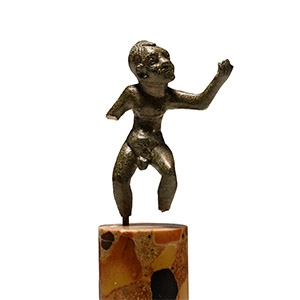
Hellenistic Bronze Statuette of an Alexandrian Dancing Dwarf
1st century B.C.-1st century A.D.Estimate: £3,000 - 4,000 (+bp*)
Opening Bid: £1,500
In an active pose with both legs bent and left arm raised dramatically, head tilted to the left; exaggerated facial features, short trimmed hair, slim body with developed pectoral muscles and pronounced kyphosis; mounted on a columnar stand. 299 grams,14.5 cm including stand
Belgian private art collection of M.A., Brussels, Belgium, 1995. with Gorny and Mosch, 14 December 2011, lot 82. This lot has been checked against the Interpol Database of stolen works of art and is accompanied by search certificate number no.11886-206399. -
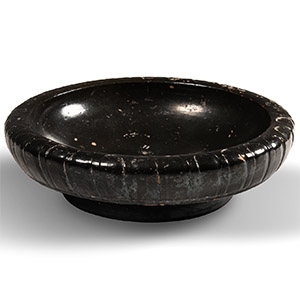
Greek Black-Glazed Plate
5th-4th century B.C.Estimate: £500 - 700 (‡+bp*)
Opening Bid: £250
Shallow-bodied with broad foot; incised fluting around the exterior body and rim. 216 grams, 12 cm wide
Acquired in the 1960s-1970s. Ex European private collection. -
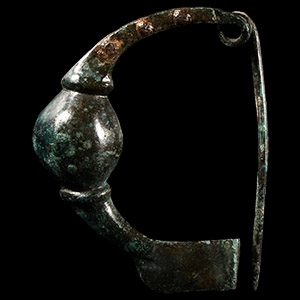
Greek Bronze Bow Brooch
8th-7th century B.C.Sold for (Inc. bp): £156
The keeled bow with a large central boss, integral pin and rectangular footplate. 55.9 grams, 72 mm
From the family collection of a Surrey gentleman since before 1960.
The distinctive form of this fibula seems to be an Italic variant of characteristic Geometric period examples from Thessaly that have been discovered in large numbers, for example in the sanctuary of Zeus Thaulios near Pharos. It belongs to the category of Greek catch plate brooches, although the rectangular footplate is substantially reduced compared to the Greek prototypes.
