
Loading, please wait...
LOT 0863
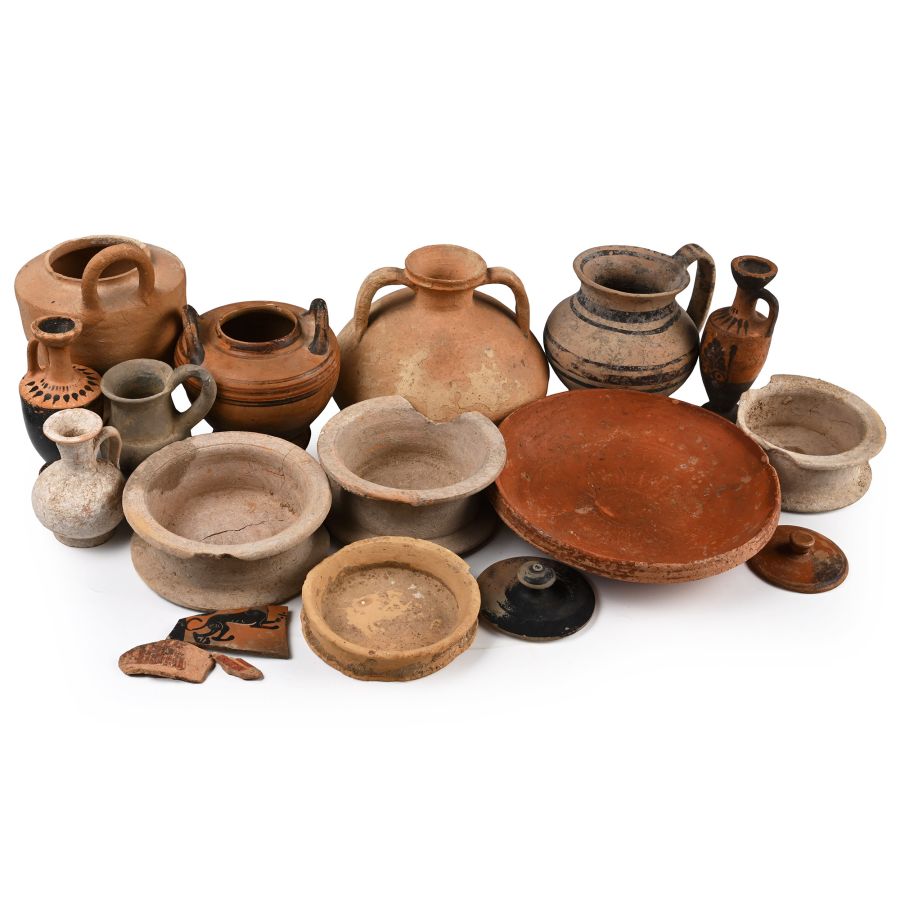
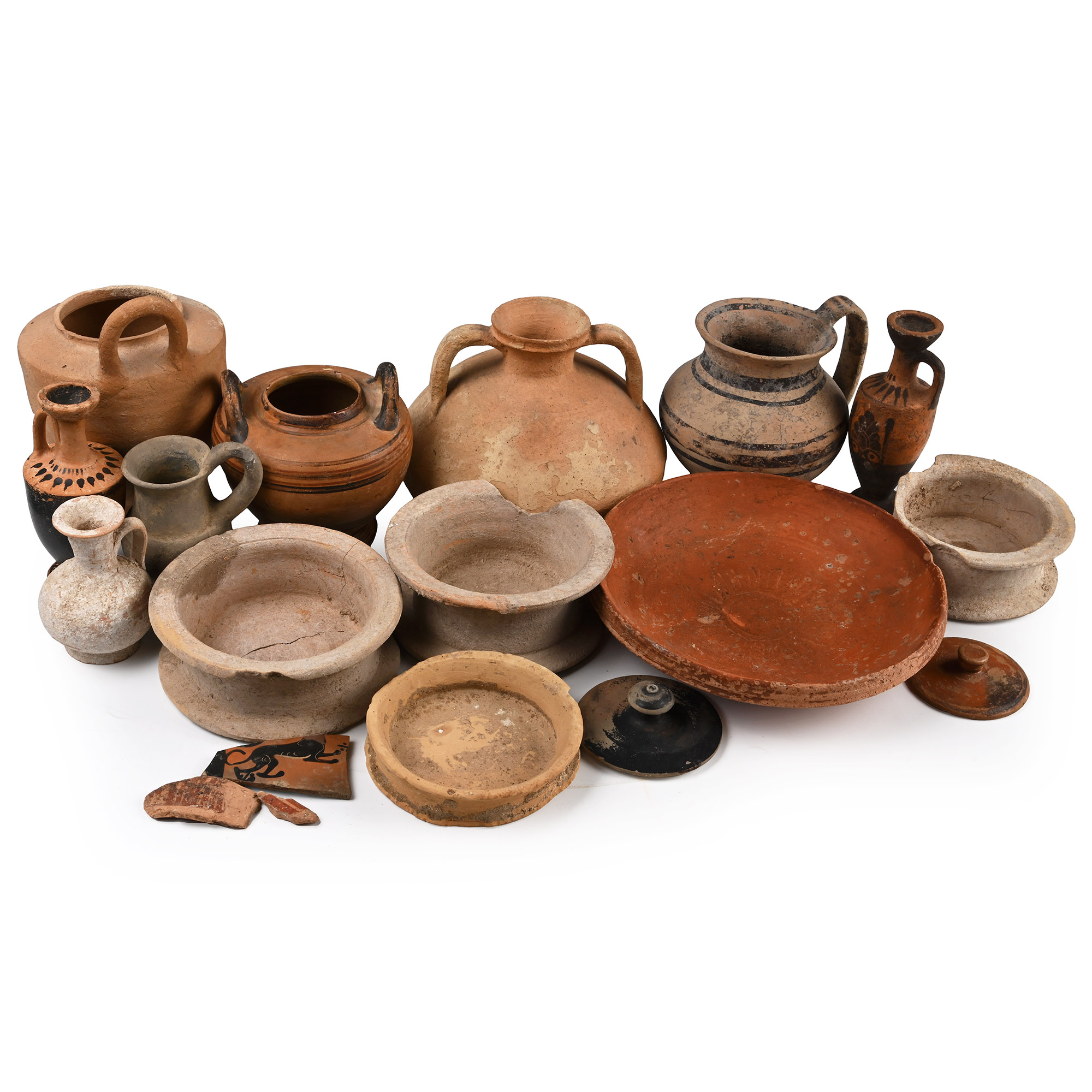
Greek Collection of Terracotta Vessels and Bases
5TH-3RD CENTURY B.C.
1 1/4 - 6 7/8 in. (2.6 kg total, 3-17.5 cm).
Mixed group of artefacts, including: a vessel fragment with a panther; a single-handled jug with painted circumferential bands; a low redware dish with an incised sunburst motif; a small lekythos with palmette design; a small lekythos with painted decoration; a squat vessel with two strap handles and a short neck, low relief spiral decoration on the base. [18]
ProvenanceEx Prof. Kurt Alder, Riehen; thence by descent.
1. two clay vessels and clay dish: ex Jacob Hirsch; with Galerie Fischer, Lucerne, Auction 17 November 1976, no.1493.
2. Apulian lekythos with palmettes: with Galerie Fischer, Lucerne, Auction 17 November 1976, no.1542.
3. Apulian lekythos: with Galerie Fischer, Lucerne, Auction 16–20, 1976, no.1542.
4. Daunian handled jug: with Galerie Koller, Zurich, Auction 34, no.2532.
5. potsherd fragment: with Münzen und Medaillen AG, Basel.
6. lebes with lid: acquired in September 1975.
TimeLine Auctions follows a vetting process to ensure the authenticity and legality of all items, reinforcing our commitment to integrity and responsible trading. Each antiquity, antique, and coin lot undergoes thorough examination by a vetting committee of at least ten external specialists, professional trade association members, scientists, and archaeologists: Our Vetting Process
AUCTIONS:
TimeLine is a leading auction house specialising in antiquities, ancient art, collectables, natural history, coins, medals, and books. Our auctions offer museums, collectors, historians, and enthusiasts the opportunity to acquire unique and historically significant pieces.
LOT 0863
Greek Collection of Terracotta Vessels and Bases
Estimate £700 - 900€810 - 1,040 (for guidance only)$950 - 1,220 (for guidance only)
Opening Bid
£365 (EUR 423; USD 493) ‡+BP*
-
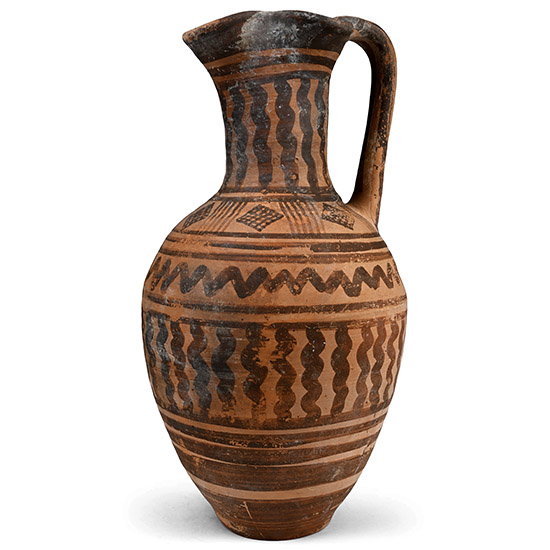
Boeotian Late Geometric Oinochoe
Late 8th century B.C.Estimate: £2,000 - 3,000 (‡+bp*)
Opening Bid: £1,000
Ovoid body with tall neck and trefoil mouth, ribbed strap handle; body decorated with broad parallel bands and vertical zig-zags, with hatched lozenges along the shoulder. 1.23 kg, 34 cm
Ex Prof. Kurt Alder, Riehen, November 1978, from his uncle Dr Werner Alder, Lugano; thence by descent. This lot has been checked against the Interpol Database of stolen works of art and is accompanied by search certificate no.13531-263113.
Vessels of the Geometric period (900-700 BCE) are easily recognisable by their abstract decorative designs, which originate from woven textiles and baskets. While early period pottery typically had sparse geometric motifs on a black background, the amount of decoration increased progressively to the point that the objects from the late Geometric period are often entirely covered - in this example, even the strap handle is decorated. -

Greek Solid Gold Earring Pair
4th-2nd century B.C.Estimate: £2,500 - 3,500 (‡+bp*)
Opening Bid: £1,389
Each a thick braided hoop with a collar of twisted filigree and a lion's mask finial. 18.43 grams total, 27 mm each
Private London collection, 1980s. Private collection, acquired on the British art market in 1993. This lot has been checked against the Interpol Database of stolen works of art and is accompanied by search certificate no.13185-249263.
The earrings belong to the hoop-type earrings, in which animal and human heads form the terminals as small miniature sculptures modelled in the round. The heads were attached to collars made from a single piece of gold. The group is characterised by lion heads. -
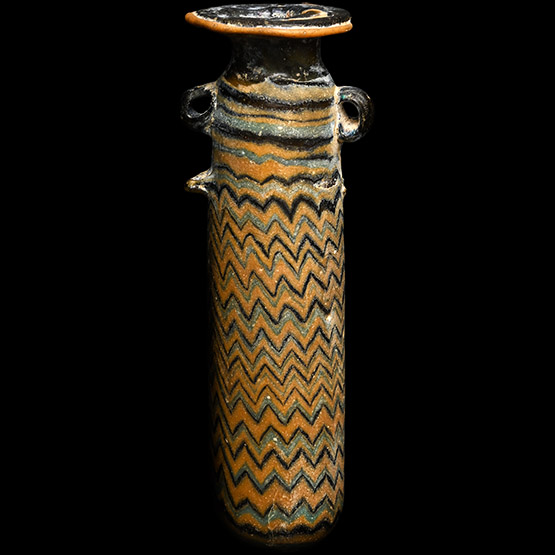
Greek Core-Formed Tall Glass Alabastron
6th-5th century B.C.Estimate: £3,500 - 4,500 (‡+bp*)
Opening Bid: £1,750
With a fusiform body, slender neck and broad flange rim, decorated with marvered feathering and spiralling trails; two lateral loop handles and a pinched lateral lug. 36.69 grams, 91 mm
Anonymous sale, Binoche & Giquello, Paris, 30th May 2012, no.124. Private collection, Switzerland. Accompanied by a copy of French passport no.0150269. This lot has been checked against the Interpol Database of stolen works of art and is accompanied by search certificate number no.13188-249220.
Alabastra of this typology, core-formed, trail-decorated and tooled, are typical of the Eastern Mediterranean. They were diminutive examples of a shape popularly produced for perfumed oils in the Greek world. Larger forms are known in both glass and ceramics.
