
Loading, please wait...
_900x900.jpg "Greek Carnelian Onyx Gemstone with Horseman")
_200x200.jpg "Greek Carnelian Onyx Gemstone with Horseman")
_900x900.jpg "Greek Carnelian Onyx Gemstone with Horseman")
_200x200.jpg "Greek Carnelian Onyx Gemstone with Horseman")
.jpg "Greek Carnelian Onyx Gemstone with Horseman")
.jpg "Greek Carnelian Onyx Gemstone with Horseman")
LOT 0077
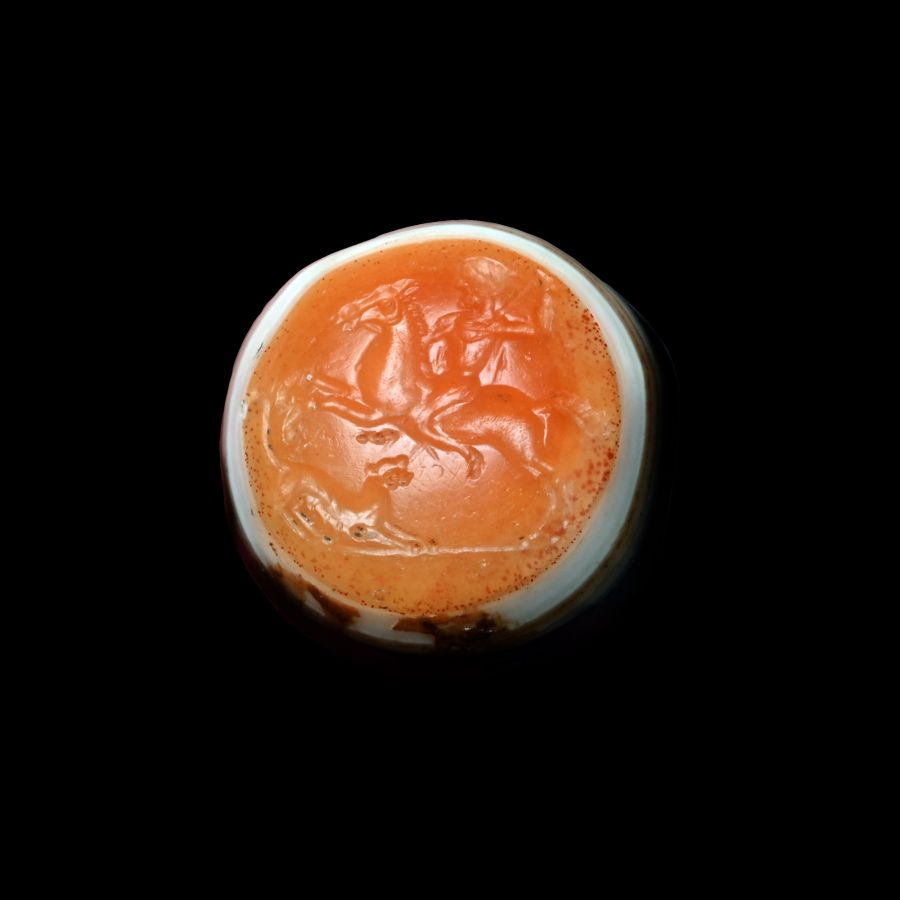
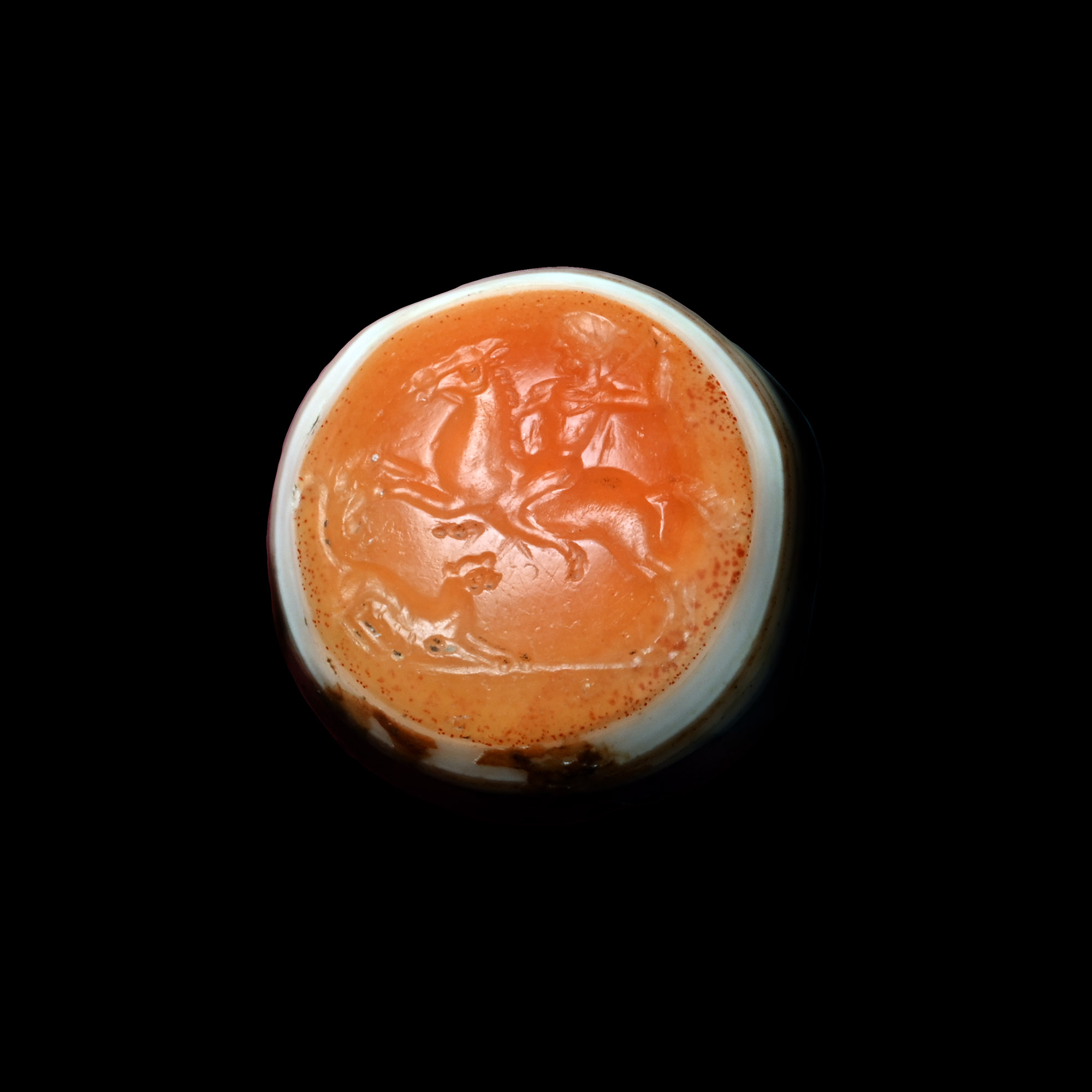
Greek Carnelian Onyx Gemstone with Horseman
1ST CENTURY B.C.
5/8 in. (4.14 grams, 17 mm).
Plano-convex 'eye' type with incuse design to the upper face of a huntsman on a rearing horse attacking a lion; supplied with a museum-quality impression. [No Reserve]
ProvenanceFrom the private collection of a European gentleman (1942-2024), formed since the 1970s.
CONDITIONTimeLine Auctions follows a vetting process to ensure the authenticity and legality of all items, reinforcing our commitment to integrity and responsible trading. Each antiquity, antique, and coin lot undergoes thorough examination by a vetting committee of at least ten external specialists, professional trade association members, scientists, and archaeologists: Our Vetting Process
AUCTIONS:
TimeLine is a leading auction house specialising in antiquities, ancient art, collectables, natural history, coins, medals, and books. Our auctions offer museums, collectors, historians, and enthusiasts the opportunity to acquire unique and historically significant pieces.
-
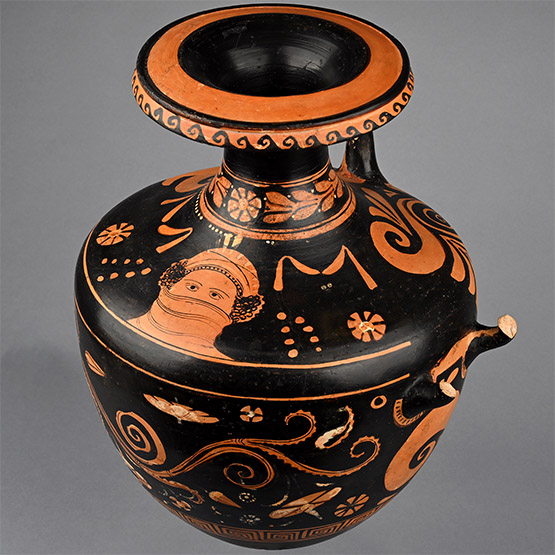
Greek Fragmentary Terracotta Red-Figure Hydria
Paestan or Apulian, 4th century B.C.Estimate: £4,000 - 6,000 (‡+bp*)
Opening Bid: £2,200
Comprising the upper two thirds of the vessel; on the shoulder a facing woman's head with diadem and half-veiled face; rosettes to left and right, with suspended ribbons and dots; vine motif around the body with floral ornaments; to the reverse, palmettes and vines; band of laurel with rosettes around the neck and wavy band at the mouth; reassembled from various fragments with three large areas of restoration, only the beginnings of the handles preserved; mounted on a custom-made stand. 1.95 kg, 31 cm (2.6 kg total, 47.5 cm high including stand)
Ex Herbert A. Cahn, Basel, 1990s. This lot has been checked against the Interpol Database of stolen works of art and is accompanied by search certificate number no.12475-228738.
The face-veiling gesture is a known marriage rite; the diadem may suggest that she is intended to represent Persephone. Alternatively, the veiled woman might be a dancer as many terracotta figurines of dancing women are shown with face-coverings. However, the floral ornaments could indicate a funeral or sepulchral context. -
.jpg)
Minoan Facetted Carnelian Stamp Seal
Circa 20th-15th century B.C.Sold for (Inc. bp): £44,200
Four-sided bead with an oval panel on each side: panel 1: reclining feline with frontal head with apotropaic eyes; panel 2: three-leaved plant opposite a goblet(?) with four pellets and two crosses; panel 3: a plant and a big frontal apotropaic eye; panel 4: three segments, a plant, a butterfly or a bird; accompanied by museum-quality impressions. 4.21 grams, 21 mm
From the collection of the late Mr Priday, Hertfordshire, UK, thence by descent. This lot has been checked against the Interpol Database of stolen works of art and is accompanied by search certificate number no.13339-258812.
Four-sided prisms are usually fashioned in jasper, light-coloured chalcedony and lightly banded carnelian. The workmanship is usually excellent. Largely on stylistic grounds, these seals are datable mostly to MMII (c. 2100–1875 B.C.), although they occur both slightly earlier and later. -
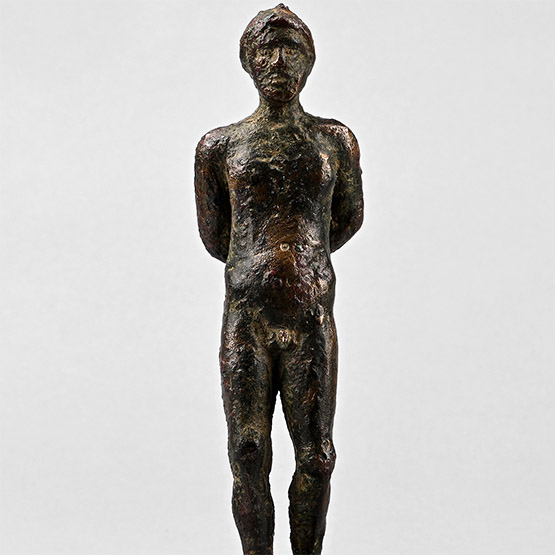
Greek Bronze Figure of a Bound Captive
Hellenistic, 2nd century B.C.Sold for (Inc. bp): £2,860
Modelled in the round nude male standing with hands bound behind his back; with short cropped hair and slender figure; left foot absent; mounted on a custom-made stand. 491 grams, 17 cm including stand
Ex S.K. collection. Acquired on the German art market, July 1995. Accompanied by an academic report by Dr Raffaele D'Amato. This lot has been checked against the Interpol Database of stolen works of art and is accompanied by a search certificate number no.12518-232076.
The character's hairstyle of the statuette is simple, and his hair is short, not treated with chalk like that of the famous ‘dying Galatian’ from Pergamon. The gaze is fixed on the distance, while the bony, beardless, long-limbed figure conveys the prisoner's energy. The nose here takes on a strong characteristic together with the broad jaw, which is also recognisable in later statuettes of Roman age. These characteristics, combined with those of nudity, allow us to recognise the figure of the prisoner as a Celtic warrior.
