
Loading, please wait...
LOT 0073
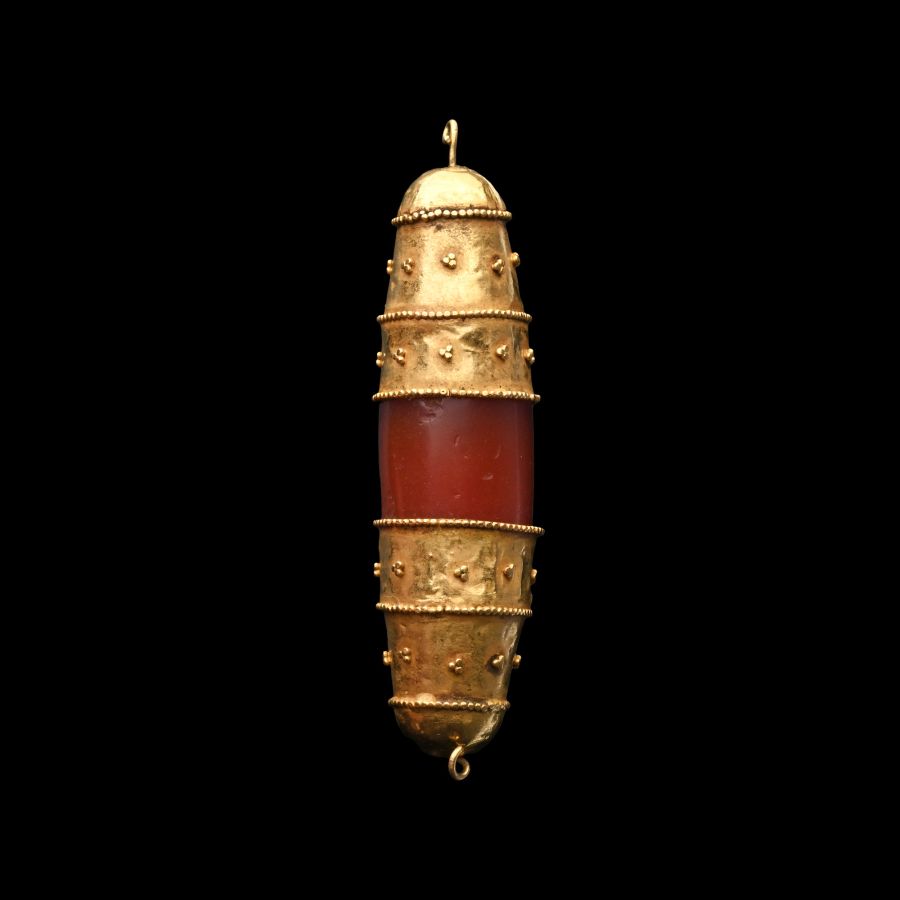
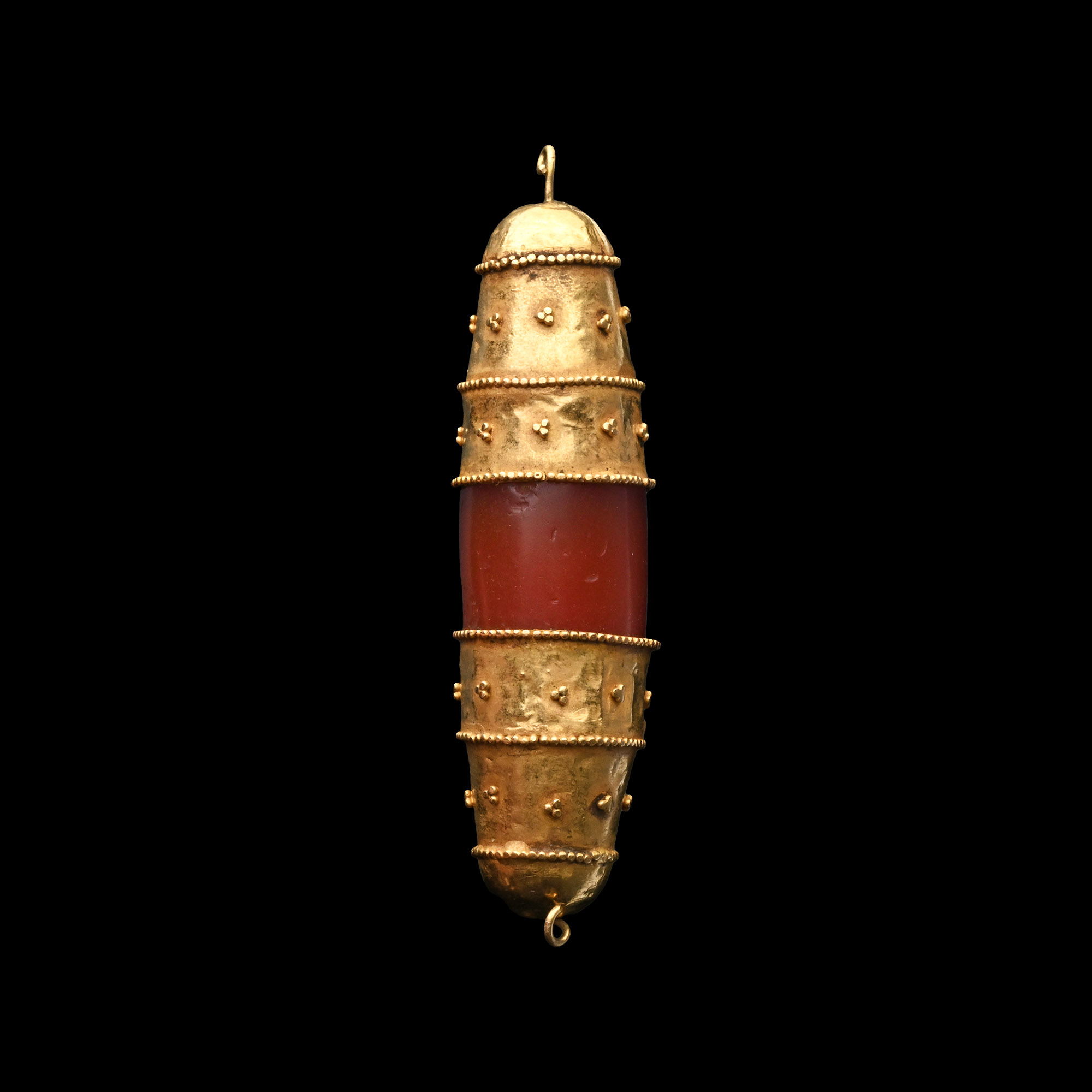
Greek Carnelian Bead with Gold End Caps
HELLENISTIC, 1ST CENTURY B.C.-1ST CENTURY A.D.
2 3/8 in. (17.44 grams, 60 mm).
Columnar bead with sheet-gold cap to each end, each with beaded circlets and applied granule clusters, domed end with loop; possibly assembled.
ProvenanceAcquired in the mid 1980s-1990s.
Private collection, Switzerland, thence by descent.
Private collection, since the late 1990s.
Cf. a pair of gold disc and sphere-drop earrings of the Late Hellenistic Period in a similar style and decoration, in Ogden, J., Gold Jewellery in Ptolemaic, Roman and Byzantine Egypt, in two volumes, Volume 2 – figures, Durham, 1990, fig.268.
FootnotesThe very elaborate versions of earrings with large domes and pendants composed of clusters of hollow spheres and granulation are most typically Romano-Syrian, but they begin to be produced in the Late Hellenistic Age. They were diffused in the Levant, Egypt and on the frontier area between the Roman and the Arsacid Empire.
CONDITIONTimeLine Auctions follows a vetting process to ensure the authenticity and legality of all items, reinforcing our commitment to integrity and responsible trading. Each antiquity, antique, and coin lot undergoes thorough examination by a vetting committee of at least ten external specialists, professional trade association members, scientists, and archaeologists: Our Vetting Process
AUCTIONS:
TimeLine is a leading auction house specialising in antiquities, ancient art, collectables, natural history, coins, medals, and books. Our auctions offer museums, collectors, historians, and enthusiasts the opportunity to acquire unique and historically significant pieces.
-
.jpg)
Etruscan Carnelian Scarab with Bust of a Warrior in Later Victorian Gold Brooch
5th-4th century B.C. and laterSold for (Inc. bp): £2,860
The scarab with anatomical detailing on the carapace, underside with a profile bust of a helmetted warrior; set in a later brooch frame with swivel mount for the scarab. 10.35 grams, 55 mm
Acquired on the European art market. This lot has been checked against the Interpol Database of stolen works of art and is accompanied by search certificate number no.13358- 257891.
Egyptian-style scarabs and scaraboids were characteristic of Etruscan art from the 8th century B.C. Originally made in Phoenicia, Cyprus or Rhodes, these objects were made of faience, blue paste, glass paste, bone, or semi-precious stones of varying hardness, from steatite to quartz, onyx and jasper. Mounted in settings on revolving pendants of precious metal, later imitated by Etruscan goldsmiths, these Egyptianising items performed prophylactic-religious functions. -
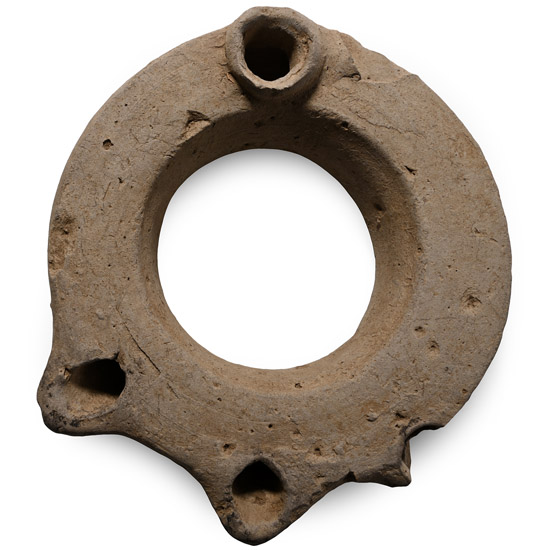
Greek Terracotta Multi-Spouted Oil Lamp
Circa 2nd-1st century B.C.Sold for (Inc. bp): £143
An annular oil lamp with three nozzles and a filler hole to the rear, an inked collector's note '423' on the underside. 513 grams, 16.6 cm
From an important collection of lamps, Germany, 1970s. -
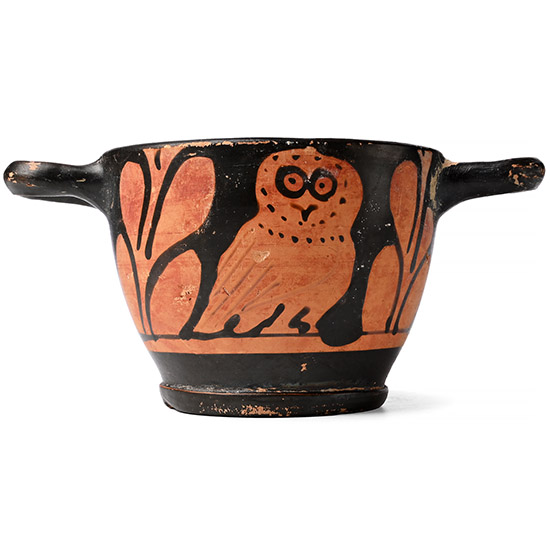
Greek Red-Figure Skyphos with Owl
Attic, 5th-4th century B.C.Sold for (Inc. bp): £1,560
Mammiform body with flared pedestal base and two loop handles to the rim; each side with a facing image of an owl between laurel fronds; concentric circles to the base, Attic workmanship. 115 grams, 14.1 cm wide
Bonhams, Knightsbridge, London, 20 1994, no.39. Private collection, Suffolk.
