
Loading, please wait...
LOT 0114
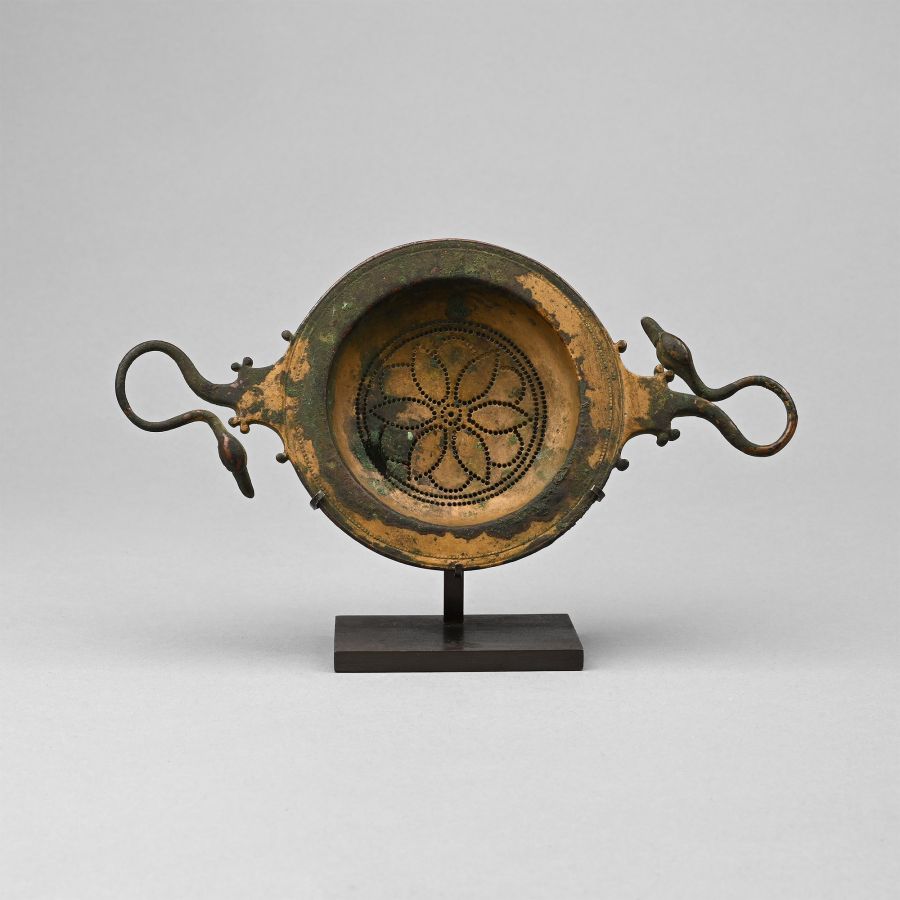
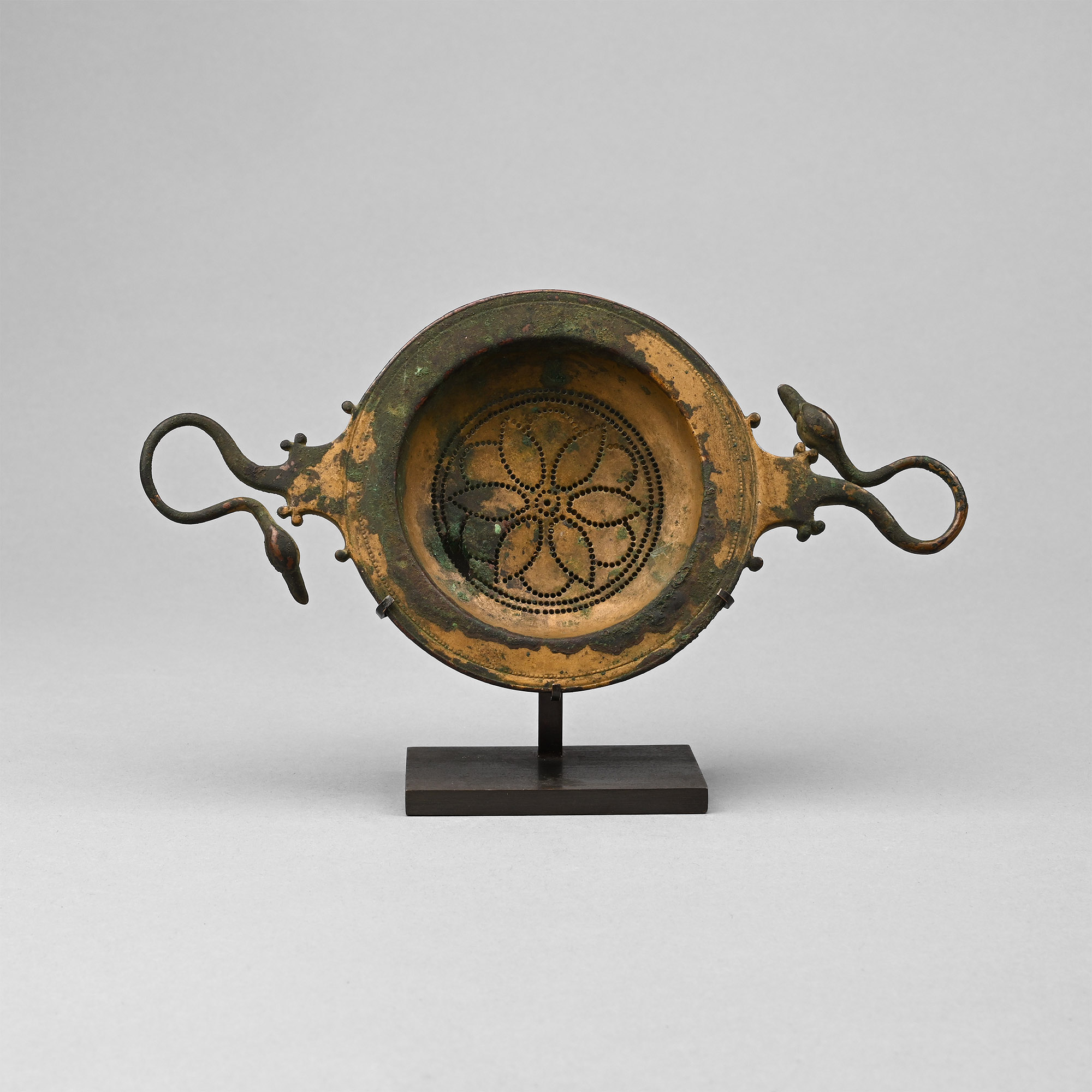
Greek Bronze Wine Strainer with Swan-Head Handles
4TH-3RD CENTURY B.C.
7 3/4 in. (402 grams total, 19.7 cm including stand).
Comprising a shallow bowl and broad flange rim, two integral scalloped handles with lateral scrolled flourishes, each tapering to a S-curved handle with swan-head terminals with incised eye and beak detailing; perforated whirl within roundel to interior base; accompanied by a custom-made display stand with mirror.
Provenancewith Hôtel des ventes de Belfort Sarl, October 2011, no.16.
Acquired by the present owner at the above sale.
Accompanied by an academic report by Dr Raffaele D'Amato.
This lot has been checked against the Interpol Database of stolen works of art and is accompanied by search certificate number no.12209-222140.
Cf. Reeder, Ellen D., Hellenistic Art in the Walters Art Gallery, Baltimore, 1988, p.125, no.130, for similar examples and a general discussion of type; A Passion for Antiquities, Ancient Art from the collection of Barbera and Lawrence Fleischman, The J. Paul Getty Museum, Malibu, 1994, pp.77-78, no.31D; and The Search for Alexander, exhibition catalogue, 1980, p.167, no.130; the Metropolitan Museum of Art, accession number 1972.118.88, for a group containing a strainer with similar looped handle and bird head terminal; a similar specimen in the Walters Art Museum, accession number 57.910; a similar example in shape and quality can be seen in the ‘Tomb of the Prince’, in Pella, cf. Touratsoglou, I., Macedonia, History, Monuments, Museums, Athens, 1996, p.240, fig.312.
FootnotesElaborate gilded strainers, such as this present example, were used at symposia and festive occasions for the purpose of preventing the dregs of wine from entering the wine cup. This and other related silver utensils became popular in the late 4th and 3rd century B.C. These highly decorated wine strainers were fitted with dual handles forming loops in the shape of twisting animals, here a swan. Usually, they took the form of a shallow dish complete with four rings of perforations in the centre in order to drain the wine. Strainers of this type were used to separate out sediments found in the thick Greek wine. Examples similar to this one have been found in royal tombs in northern Greece, as well as the tomb of a monarch in Sudan.
CONDITIONTimeLine Auctions follows a vetting process to ensure the authenticity and legality of all items, reinforcing our commitment to integrity and responsible trading. Each antiquity, antique, and coin lot undergoes thorough examination by a vetting committee of at least ten external specialists, professional trade association members, scientists, and archaeologists: Our Vetting Process
AUCTIONS:
TimeLine is a leading auction house specialising in antiquities, ancient art, collectables, natural history, coins, medals, and books. Our auctions offer museums, collectors, historians, and enthusiasts the opportunity to acquire unique and historically significant pieces.
LOT 0114
Greek Bronze Wine Strainer with Swan-Head Handles
Estimate £10,000 - 14,000€11,600 - 16,240 (for guidance only)$13,500 - 18,900 (for guidance only)
-
.jpg)
Italic Carnelian Scarab with Satyr Mounted in a Gold Swivel Ring
4th-3rd century B.C.Sold for (Inc. bp): £1,404
Carved scarab with detailed carapace, legs and mouth; underside with intaglio standing figure holding an amphora; set into a later gold swivel ring. 5.30 grams, 23.85 mm overall, 14.56 x 17.70 mm internal diameter (approximate size British J 1/2, USA 5, Europe 9.32, Japan 9)
Private collection, Europe. Acquired on the English art market.
It is clear that the sculptor devoted more care and attention to carving the scarab itself rather than its intaglio. -
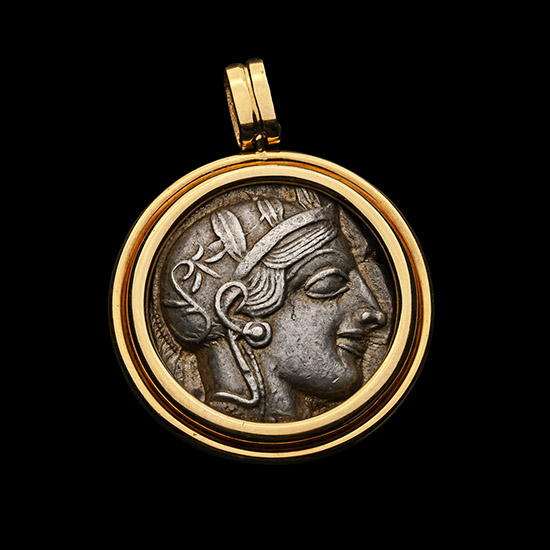
Greek Silver Tetradrachm of Athens in Gold Pendant
Circa 454-404 B.C.Sold for (Inc. bp): £2,340
Obv: head of Athena with profile eye to right, wearing disc earring, pearl necklace and a crested Attic helmet adorned with three olive leaves and a pi-style palmette. Rev: ΑΘΕ, owl standing to right, head facing the viewer, olive sprig with berry and crescent moon in upper left field, all within incuse square. Kroll 8; Dewing 1591-8; SNG Copenhagen 31; HGC 4, 1597; the coin enclosed inside a modern gold medallion pendant stamped '750' with double border. 24.36 grams, 37 mm
Roma Numismatics, E-LIVE Auction 4, 29 November 2018, no.155. Private collection of Mr K.A., France. with Kallos Gallery, London. This lot has been checked against the Interpol Database of stolen works of art and is accompanied by search certificate number no. 13024-246751.
The Athenian components of several of the hoards in which these tetradrachms were found, together with other published and unpublished tetradrachms, make it clear that this coinage of c.400/390 to 353 was not only substantial, but was one of the most prolific Greek coinages of the period. -
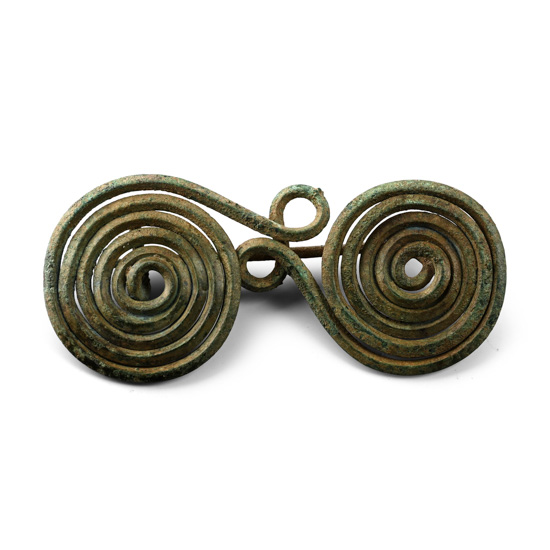
Greek Bronze Spiral Fibula
Geometric, 8th-6th century B.C.Sold for (Inc. bp): £416
Formed from a single filament rolled into two 'spectacle' discs; one of the spirals terminating in a long pin, the other in a hook serving as the catch; openwork figure-of-eight at the centre. 25.8 grams, 80 mm
Ex collection Mr. K.H., Germany, Private collection, acquired in 2012.
