
Loading, please wait...
LOT 0108
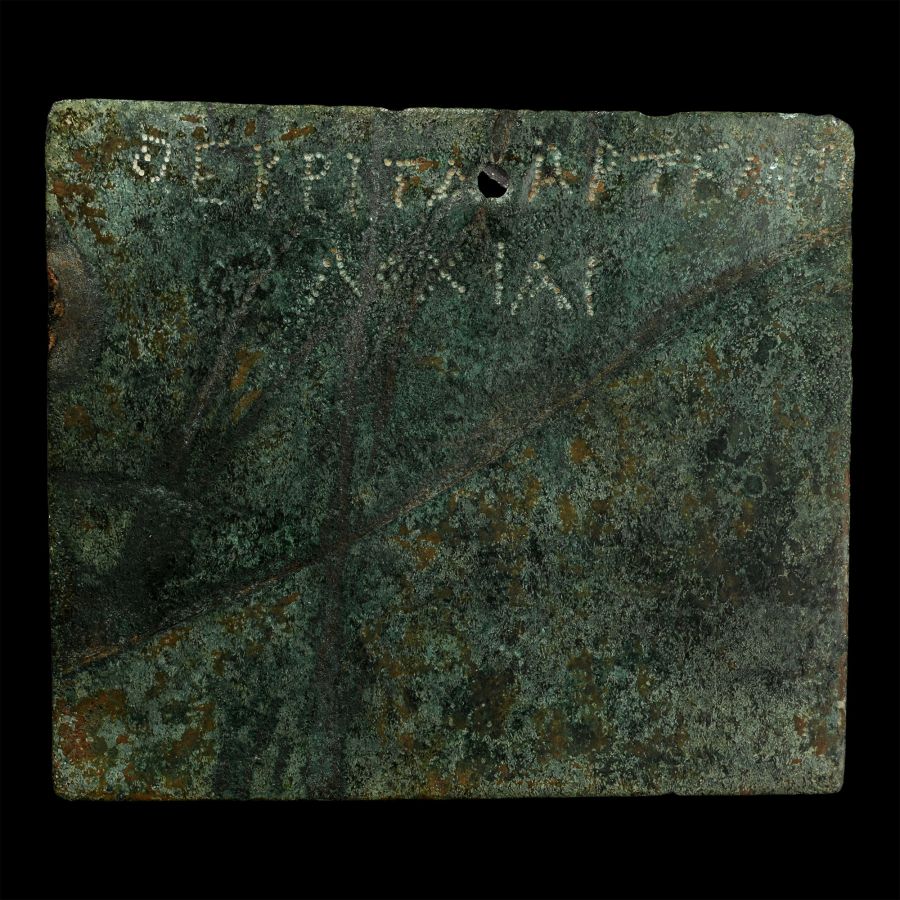
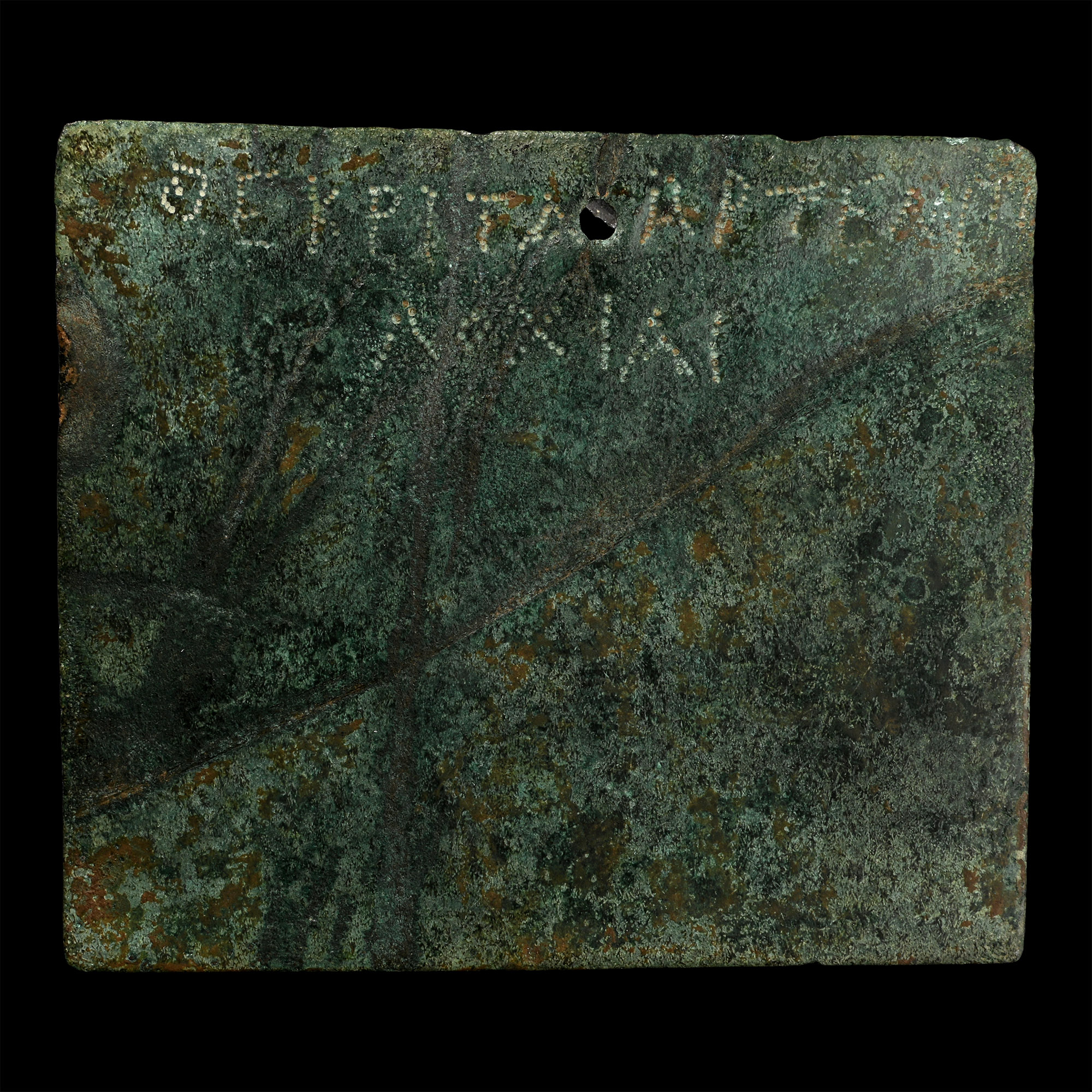
Greek Bronze Votive Plaque with Inscription for Artemis Lochia
4TH-3RD CENTURY B.C.
4 3/4 in. (107 grams, 12.2 cm).
A flat rectangular plaque with a punched dotted inscription 'ΘΕΚΡΙΤΑ ΑΡΤΕΜΙ… ΛΟΧΙΑΙ' to one face, pierced to the top for suspension; an inked inscription to the reverse 'Afort 3024'.
ProvenanceCollection J.R., New York, 1981.
with Artemis Gallery Auction, USA, 14 October 2015, no.55.
The inscription at the top of the plaque, ΘΕΚΡΙΤΑ ΑΡΤΕΜΙ… ΛΟΧΙΑΙ, identifies it as a votive pinax dedicated to the goddess Artemis Lochia, the protector of pregnant women and women giving birth. Sanctuaries of Artemis Lochia are attested in Brauron and Pergamon. The plaque was folded several times in Antiquity. On the reverse, a ledge at the edge, indicating that the plaque was soldered onto something in antiquity.
CONDITIONTimeLine Auctions follows a vetting process to ensure the authenticity and legality of all items, reinforcing our commitment to integrity and responsible trading. Each antiquity, antique, and coin lot undergoes thorough examination by a vetting committee of at least ten external specialists, professional trade association members, scientists, and archaeologists: Our Vetting Process
AUCTIONS:
TimeLine is a leading auction house specialising in antiquities, ancient art, collectables, natural history, coins, medals, and books. Our auctions offer museums, collectors, historians, and enthusiasts the opportunity to acquire unique and historically significant pieces.
LOT 0108
Greek Bronze Votive Plaque with Inscription for Artemis Lochia
Estimate £1,000 - 1,400€1,160 - 1,620 (for guidance only)$1,350 - 1,890 (for guidance only)
Opening Bid
£550 (EUR 638; USD 743) ‡+BP*
-
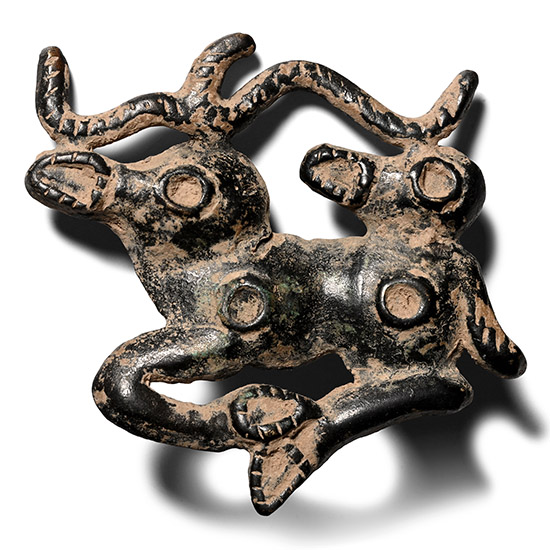
Scythian Bronze Galloping Stag Strap Decoration
Circa 5th-3rd century B.C.Estimate: £150 - 200 (+bp*)
Opening Bid: £75
Modelled as a stylised quadruped with its legs folded beneath the body, long curving horns and circular cells on the body and eye, two lugs on the reverse. 24.3 grams, 51 mm
Ex Abelita collection, 1990s. -
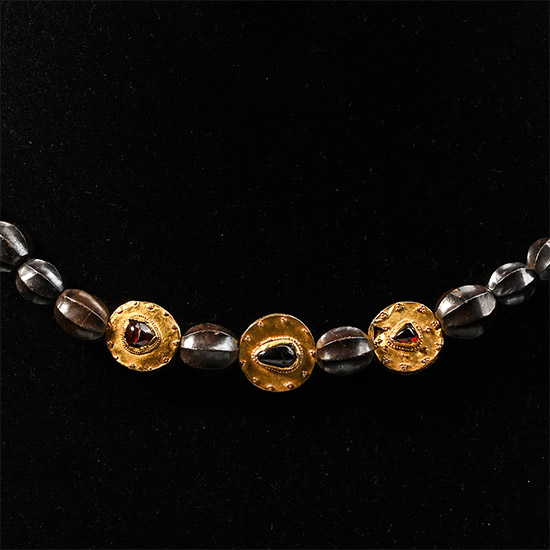
Graeco-Roman Necklace with Gold Beads
1st century B.C. and laterEstimate: £2,500 - 3,500 (‡+bp*)
Opening Bid: £1,250
Restrung group of fluted melon and other beads with three later hollow-formed gold drum-shaped panels, each with an inset cabochon garnet to the upper face, and granule clusters. 46.45 grams, 34 cm
Private collection, Jerusalem, assembled in the 1960s. with Holy Land Antiquities, Jerusalem. European private collection, acquired 2001. This lot has been checked against the Interpol Database of stolen works of art and is accompanied by search certificate number no.13141-246774.
In the Hellenistic and Roman periods there was a strong formal and chromatic diversity of glass beads used for necklaces and bracelets. The most common beads in forms were small biconical (lenticular), barrel-shaped, spherical and annular; the most common colours were dark blue, followed by green and yellow, and red. The succession of glass beads often imitates jewellery made of costly materials (gold, silver, semi-precious and precious stones). -
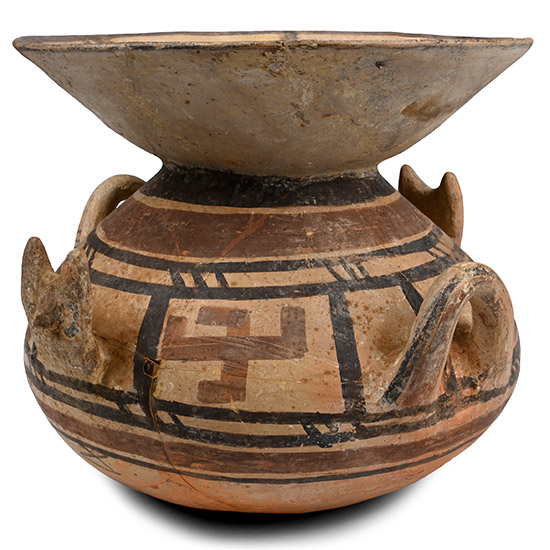
Large Daunian Olla with Flaring Mouth
5th century B.C.Estimate: £1,000 - 1,400 (‡+bp*)
Opening Bid: £550
With squat body on a flat base, two short loop handles to the equator and two animal-head protomes; painted pendant circle segments above concentric circles to the interior of the mouth; shoulder and body decorated with metopes, horizontal bands and vertical lines of differing colour and width; rectangle and swastika motifs in the metopes; pendant hourglass motifs in the lowest band; the vessel reassembled and some fragments replaced; bichrome ware. 1.74 kg, 20.3 cm high
From the estate of Hans-Ulrich Rutschmann, Switzerland, circa 1950s-1970s.
