
Loading, please wait...
_900x900.jpg "Greek Bronze Swan-Headed Wine Strainer")
_200x200.jpg "Greek Bronze Swan-Headed Wine Strainer")
.jpg "Greek Bronze Swan-Headed Wine Strainer")
LOT 0557
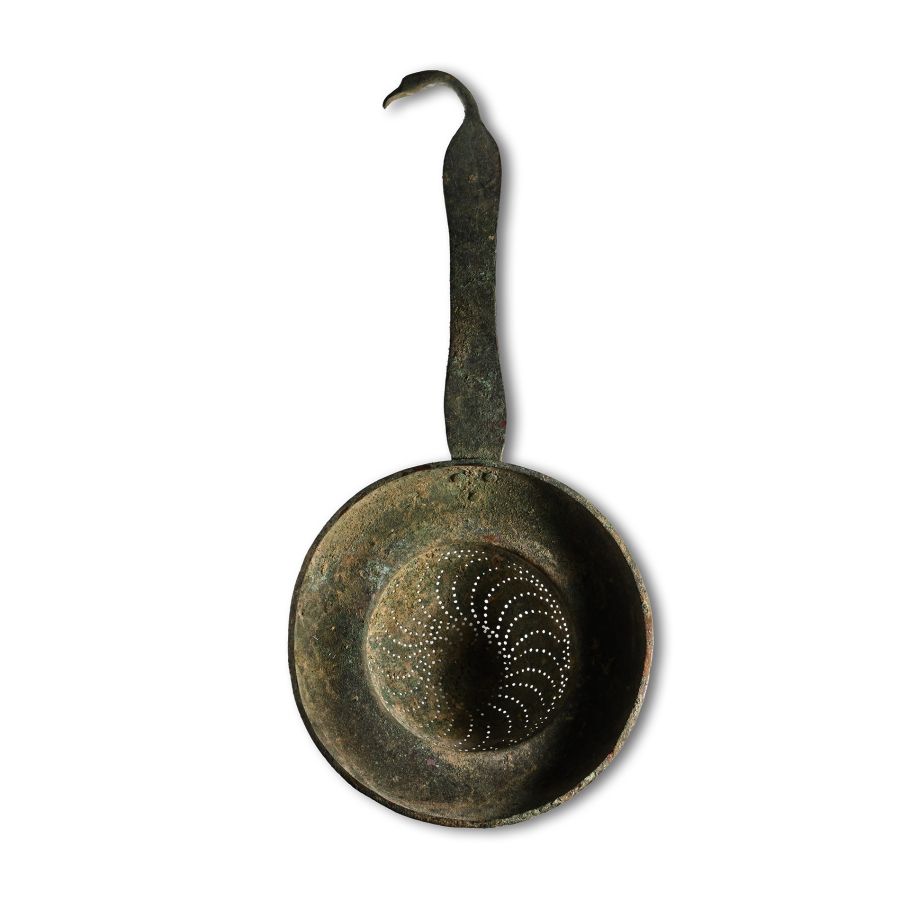
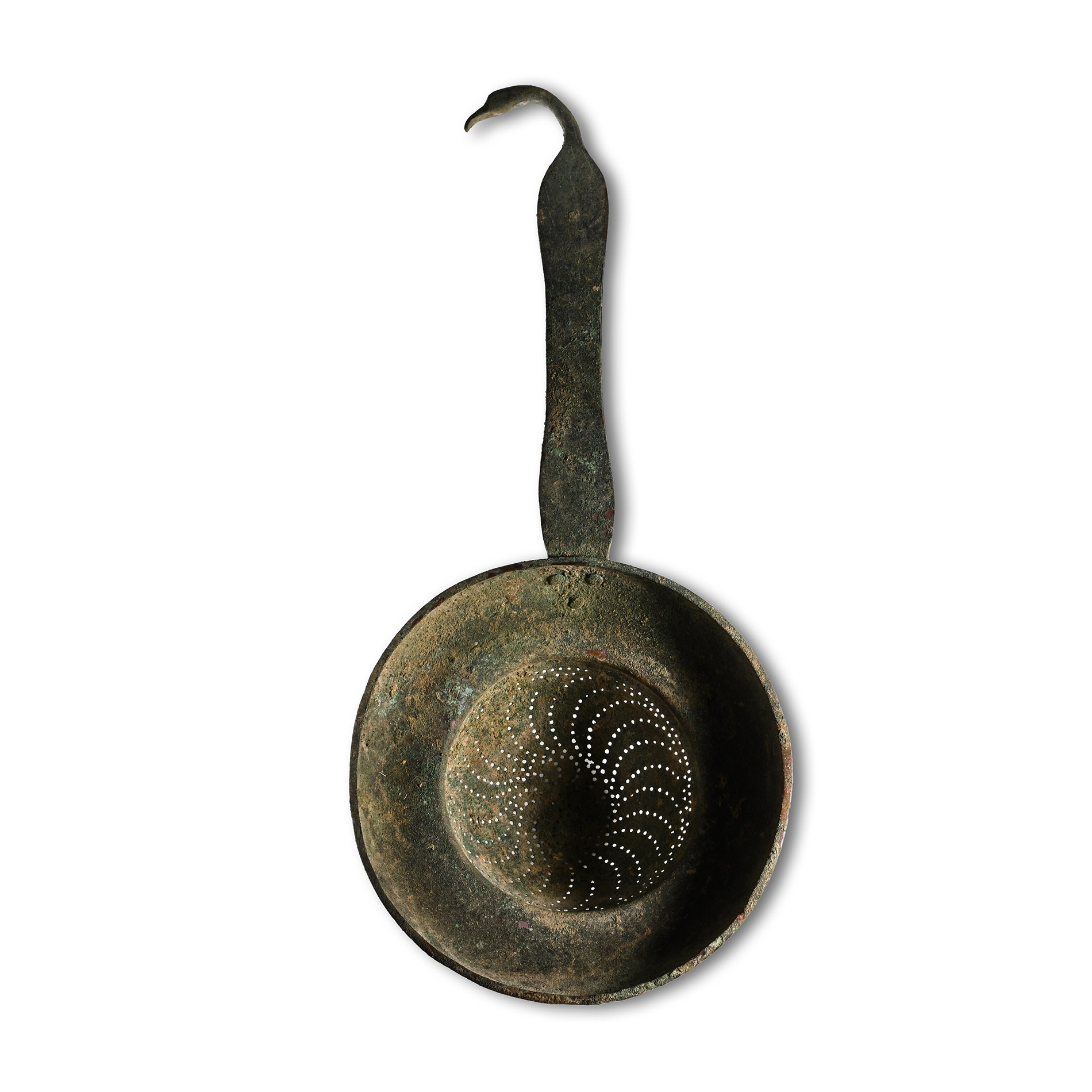
Greek Bronze Swan-Headed Wine Strainer
5TH CENTURY B.C.
10 3/4 in. (159 grams, 27.4 cm).
Cup-shaped body with flared and curved rim, flat-section handle with swan-head finial; the body with pierced rosette pattern.
ProvenanceAcquired in the mid 1980s-1990s.
Private collection, Switzerland, thence by descent.
Private collection, since the late 1990s.
This lot has been checked against the Interpol Database of stolen works of art and is accompanied by search certificate number no.12233-222331.
Cf. similar item in the British Museum, London, under accession no.1878,1012.24, excavated in Galaxidi.
FootnotesThe Agora excavations in Athens have yielded a large number of funnels, Hellenistic and Roman, which tend to be of a basically similar type, though of course with variations. Perhaps the most important feature of all these funnels is that they were made for use and not for show. The bronze specimen found in Galaxidi is very similar to our strainer.
CONDITIONTimeLine Auctions follows a vetting process to ensure the authenticity and legality of all items, reinforcing our commitment to integrity and responsible trading. Each antiquity, antique, and coin lot undergoes thorough examination by a vetting committee of at least ten external specialists, professional trade association members, scientists, and archaeologists: Our Vetting Process
AUCTIONS:
TimeLine is a leading auction house specialising in antiquities, ancient art, collectables, natural history, coins, medals, and books. Our auctions offer museums, collectors, historians, and enthusiasts the opportunity to acquire unique and historically significant pieces.
LOT 0557
Greek Bronze Swan-Headed Wine Strainer
Estimate £2,500 - 3,500€2,900 - 4,060 (for guidance only)$3,380 - 4,730 (for guidance only)
-
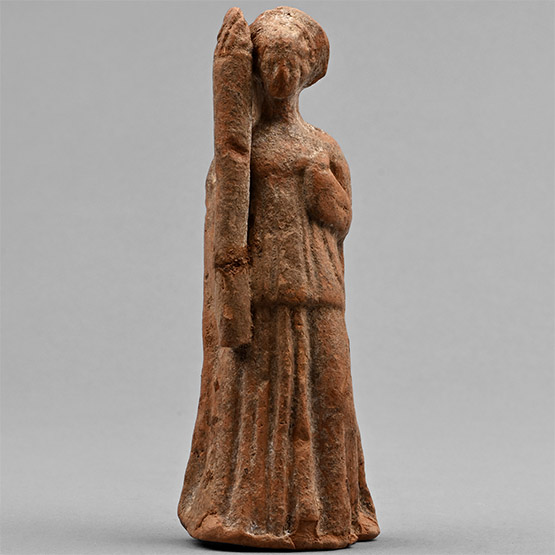
Greek Terracotta Goddess Figure
4th-3rd century B.C.Sold for (Inc. bp): £338
Tanagra type, hollow-formed with a void to the reverse, standing female in tiered robe wearing a diadem and with her hair drawn back, applied torch in her right hand. 18 grams, 12 cm
European art market. Acquired in Münich in 2012. European private collection. -
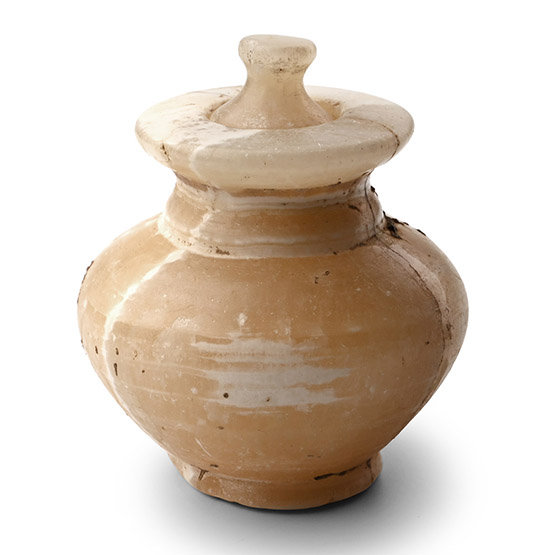
Greek Alabaster Pyxis
Mid 1st millennium B.C.Estimate: £350 - 450 (‡+bp*)
Opening Bid: £175
Barrel-shaped in profile with flared foot, broad shoulder and gusseted neck, flange to the mouth; knop handle to lid. 168 grams, 68 mm
Collection Mr. K. Ex collection Mr. H, acquired in Switzerland in the early 2000. Private collection, 2010. -
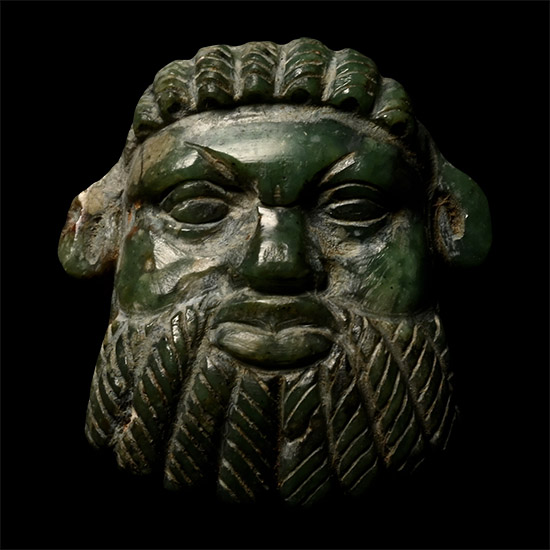
Greek Green Stone Bearded Face Amulet
400-300 B.C.Sold for (Inc. bp): £338
Finely carved head, featuring narrow eyes, a snub nose, full lips, a broad, stranded beard, and tightly curled hair rows; with a suspension loop behind the head. 4.16 grams, 20 mm
Private collection, England.
The facial features closely resemble those of Bes; the absence of Bes's characteristic plumed headdress is also evident in other amulets (Cf. Reisner, G.A., Catalogue général des antiquités égyptiennes du Musée du Caire, Nos.12528-13595, Vol. II, Amulets, Cairo, 1958, p. 16 (CG12649), pl. IV).
