
Loading, please wait...
LOT 0545
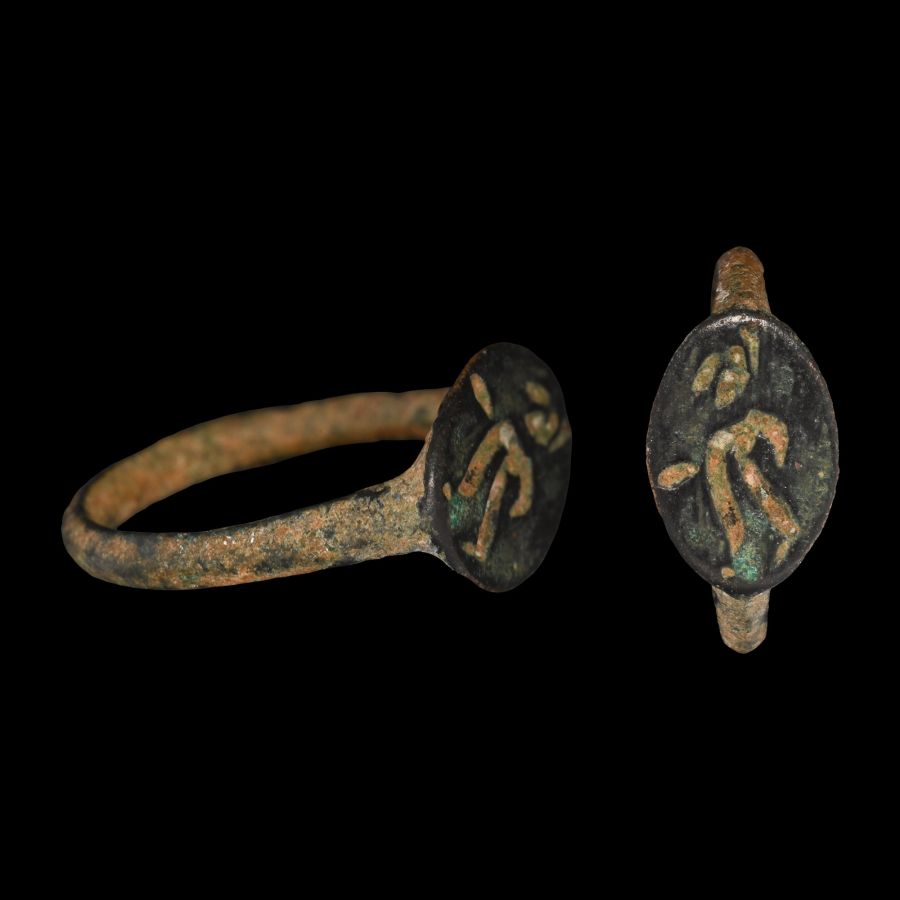
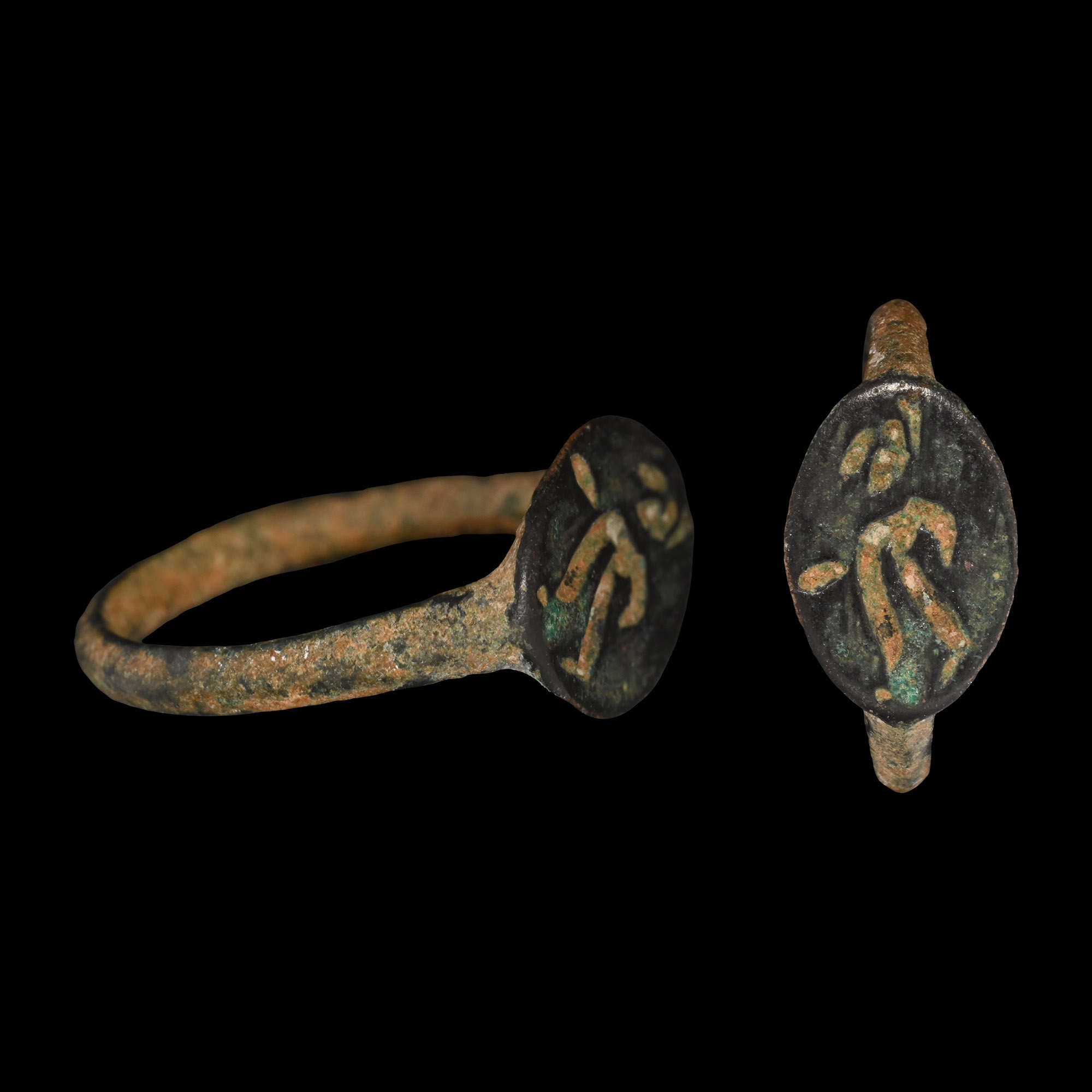
Greek Bronze Ring with Standing Figure
CIRCA 3RD-2ND CENTURY B.C.
3/4 in. (1.58 grams, 18.07 mm overall, 14.74 mm internal diameter (approximate size British H, USA 3 3/4, Europe 6.18, Japan 6)).
Featuring a D-section hoop and an oval bezel with a stylised figure facing left. [No Reserve]
ProvenanceFrom the private collection of a European gentleman (1942-2024), formed since the 1970s.
CONDITIONTimeLine Auctions follows a vetting process to ensure the authenticity and legality of all items, reinforcing our commitment to integrity and responsible trading. Each antiquity, antique, and coin lot undergoes thorough examination by a vetting committee of at least ten external specialists, professional trade association members, scientists, and archaeologists: Our Vetting Process
AUCTIONS:
TimeLine is a leading auction house specialising in antiquities, ancient art, collectables, natural history, coins, medals, and books. Our auctions offer museums, collectors, historians, and enthusiasts the opportunity to acquire unique and historically significant pieces.
-
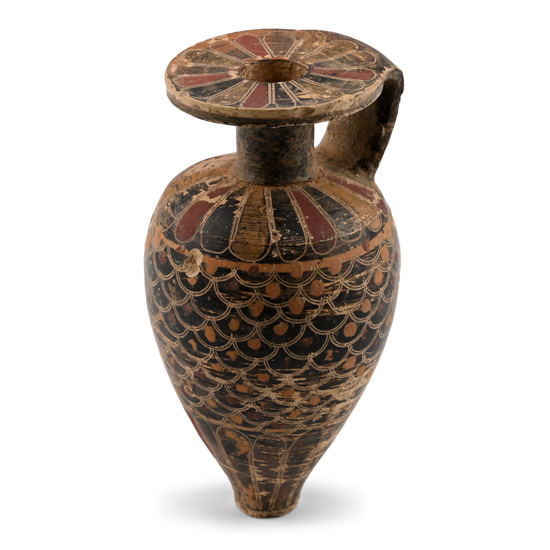
Proto-Corinthian Painted Terracotta Aryballos
7th century B.C.Sold for (Inc. bp): £2,080
Comprising a piriform body and a tubular neck with a wide rim, a strap handle to the rear, the rim with painted polychrome petals, the pattern repeating beneath the neck and on the base of the vessel; the body decorated with fishscale decoration. 79 grams, 10.5 cm
Swiss private collection, assembled in the 1960s and 1970s. Acquired by the present owner in 2004. Accompanied by an academic report by Dr Raffaele D’Amato. This lot has been checked against the Interpol Database of stolen works of art and is accompanied by search certificate number no.30017-246794.
The aryballoi were used to hold perfumed oil, an essential item for the wealthy middle classes of the time. Similar piriform vases are fairly common in Corinthian contexts. There is utmost precision in both the potting and the execution of the incised scale pattern of the present example. The fish-scale decoration was realised with the incision technique, by executing the scales neatly with their ends meeting. -
.jpg)
Greek Carnelian Onyx Gemstone with Horseman
1st century B.C.Sold for (Inc. bp): £546
Plano-convex 'eye' type with incuse design to the upper face of a huntsman on a rearing horse attacking a lion; supplied with a museum-quality impression. 4.14 grams, 17 mm
From the private collection of a European gentleman (1942-2024), formed since the 1970s. -
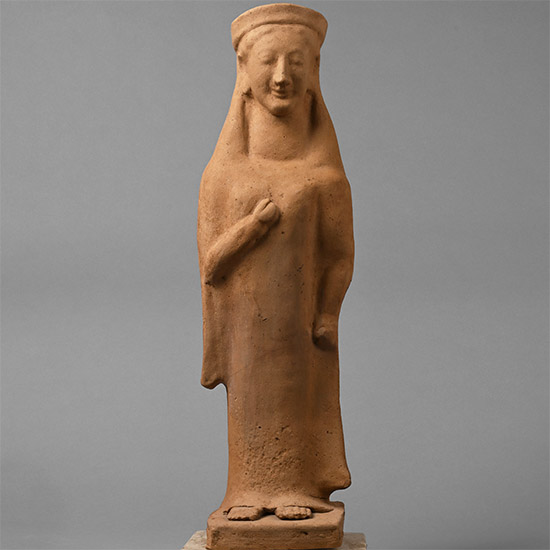
Large Greek Terracotta Figure of a Kore
6th century B.C.Estimate: £4,000 - 6,000 (‡+bp*)
Opening Bid: £2,222
Hollow-formed with scaphoid headdress, long hair hanging behind the shoulders, heavy peplos dress extending to the floor with splayed hem and feet visible beneath; left hand held straight at the thigh, right hand in a fist between the breasts; mounted on a custom-made stand. 6.7 kg total, 57 cm including stand
Swiss private collection, assembled in the 1970s-1980s. with Galerie Serodine, Ascona, Switzerland, 1993. Collection of Dr E.N., Zug, acquired in 1995. This lot has been checked against the Interpol Database of stolen works of art and is accompanied by a search certificate number no.12858-241755.
One of the most typical 6th-century B.C. terracotta female figurines was that of a standing or seated woman wearing a chiton tunic and a himation over it. It was a votive figure offered to the shrines or temples, usually representing the goddess Demeter. The headgear, polos, was an element usually identifying the goddess Demeter or her daughter Persephone. Attica was one of the principal centres of figurine production, but Corinth continued to produce solid standing or seated females with moulded fronts and flat backs.
