
Loading, please wait...


LOT 0488
Greek Bronze Ring with Standing Figure
CIRCA 3RD-2ND CENTURY B.C.
1 in. (2.52 grams, 24.36 mm overall, 19.83 x 18.11 mm internal diameter (approximate size British S, USA 9, Europe 20, Japan 19)).
Featuring a round-section hoop and a lentoid bezel with a stylised standing figure facing left, leaning on a short staff. [No Reserve]
ProvenanceFrom the private collection of a European gentleman (1942-2024), formed since the 1970s.
CONDITIONTimeLine Auctions follows a vetting process to ensure the authenticity and legality of all items, reinforcing our commitment to integrity and responsible trading. Each antiquity, antique, and coin lot undergoes thorough examination by a vetting committee of at least ten external specialists, professional trade association members, scientists, and archaeologists: Our Vetting Process
AUCTIONS:
TimeLine is a leading auction house specialising in antiquities, ancient art, collectables, natural history, coins, medals, and books. Our auctions offer museums, collectors, historians, and enthusiasts the opportunity to acquire unique and historically significant pieces.
-
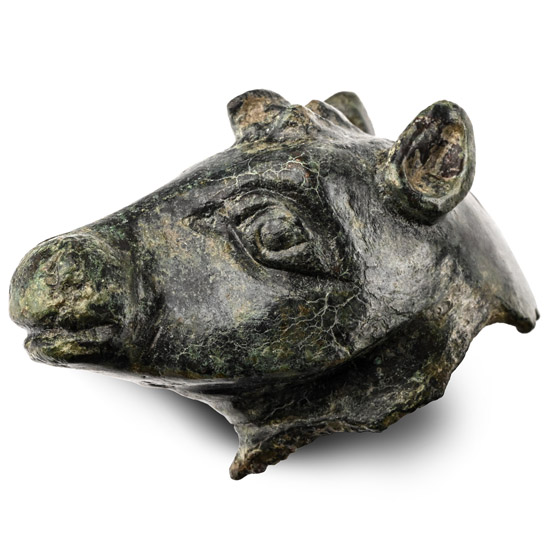
Greek Bronze Horse Head Mount
Circa 4th-3rd century B.C.Sold for (Inc. bp): £208
Modelled in the round with large almond-shaped eyes and pricked ears. 34.8 grams, 38 mm
Ex German art market, 2000s. Acquired from an EU collector living in London. From the collection of a Surrey, UK, gentleman. -

Greek Miniature Bronze Hydria
Geometric Period, 6th century B.C.Sold for (Inc. bp): £845
With a bulbous body, flared foot, lateral loop handles to the shoulder and a strap handle to the rear. 23.5 grams, 37 mm
Acquired by a Swiss family in the mid-1980s to late 1990s, thence by descent. Private collection, Switzerland, since the late 1990s.
The earliest Archaic Greek bronze hydriai enter the archaeological record in the last quarter of the seventh century. Although the appearance of bronze marks the first significant period of production in the Iron Age, these vessels represent a reawakening of an illustrious tradition dating back at least to the Helladic Bronze Age, if not considerably earlier. -

Minoan Facetted Carnelian Stamp Seal
Circa 20th-15th century B.C.Sold for (Inc. bp): £44,200
Four-sided bead with an oval panel on each side: panel 1: reclining feline with frontal head with apotropaic eyes; panel 2: three-leaved plant opposite a goblet(?) with four pellets and two crosses; panel 3: a plant and a big frontal apotropaic eye; panel 4: three segments, a plant, a butterfly or a bird; accompanied by museum-quality impressions. 4.21 grams, 21 mm
From the collection of the late Mr Priday, Hertfordshire, UK, thence by descent. This lot has been checked against the Interpol Database of stolen works of art and is accompanied by search certificate number no.13339-258812.
Four-sided prisms are usually fashioned in jasper, light-coloured chalcedony and lightly banded carnelian. The workmanship is usually excellent. Largely on stylistic grounds, these seals are datable mostly to MMII (c. 2100–1875 B.C.), although they occur both slightly earlier and later.
