
Loading, please wait...
LOT 0089
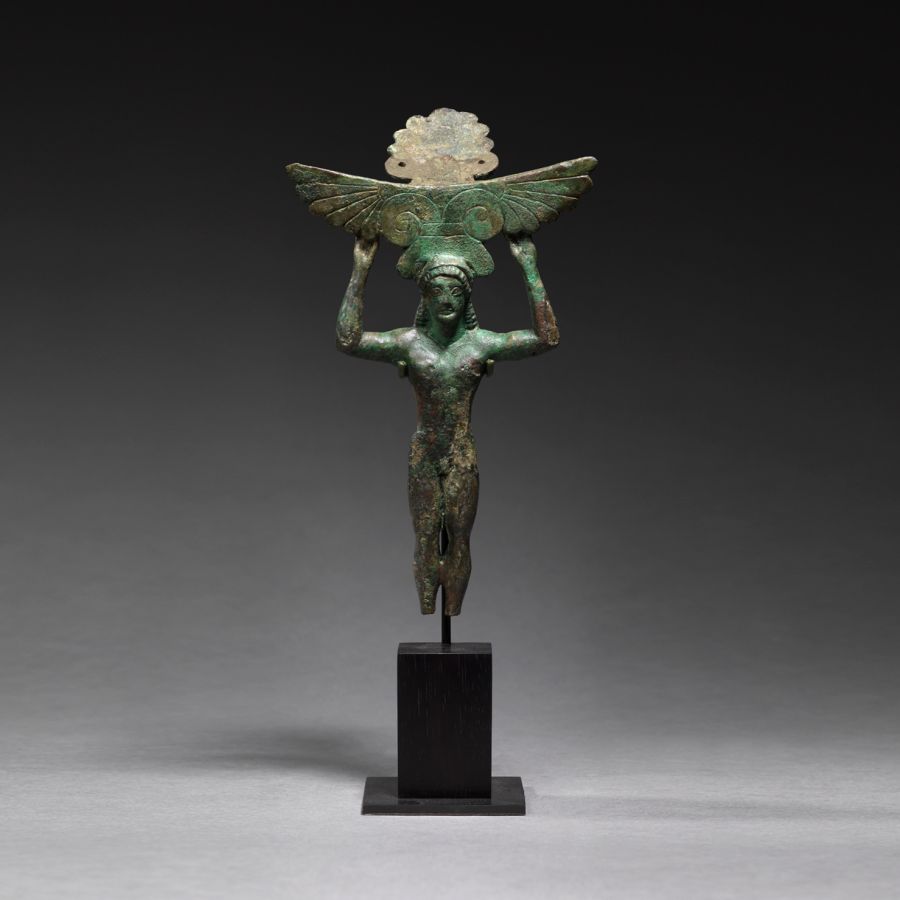
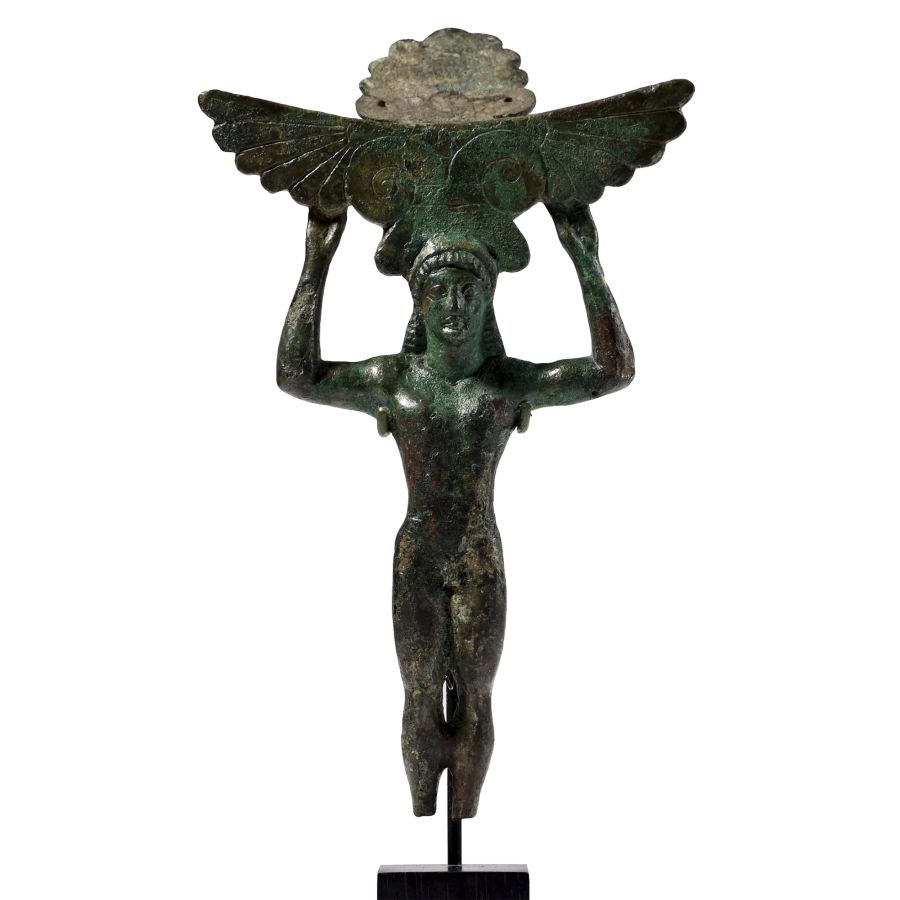
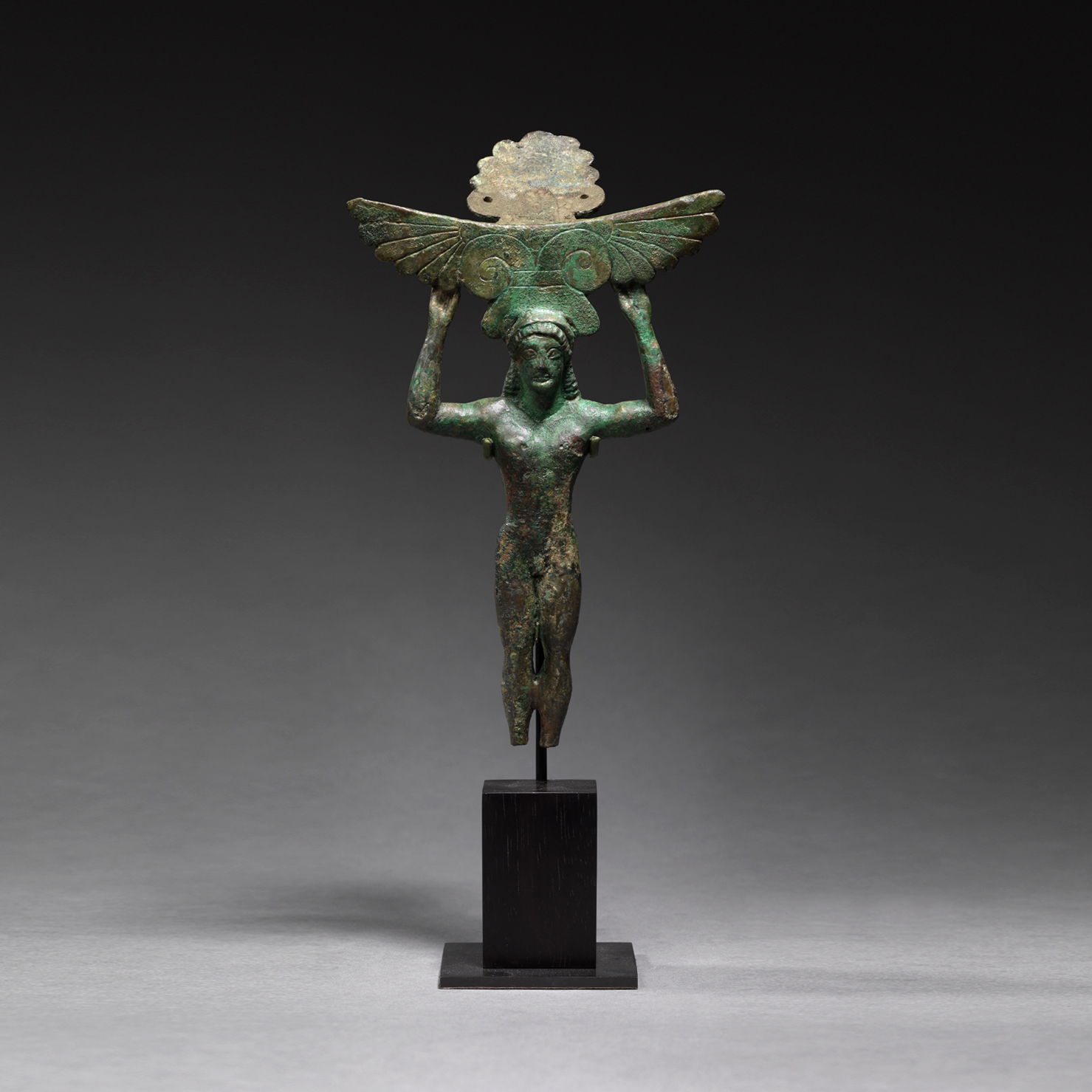
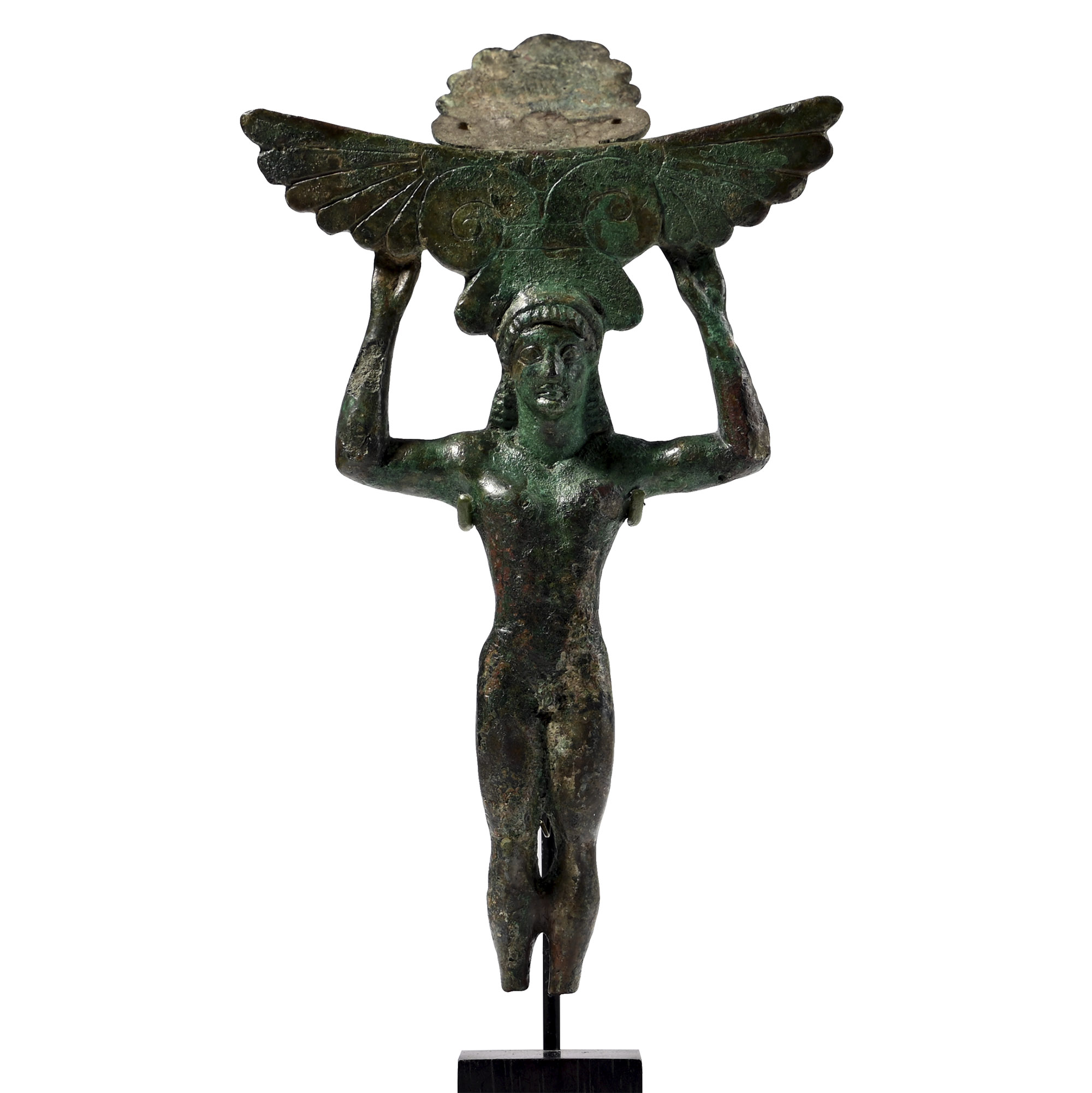
Greek Bronze Patera Handle in the form of a Naked Youth
5TH CENTURY B.C.
6 3/4 in. (9 1/4 in.) (178 grams total, handle: 17.3 cm high, 23.5 cm high including stand).
Formed as a nude kouros, hands raised to touch the elaborate palmette sitting atop the boy's head, his face framed by a thick fringe, his hair, held by a band, falling down his back in serpentine waves; the figure standing with legs held close together, broken at mid-shin; a palmette-shaped fixing plate projecting at the back with two holes for rivets to attach to the broad, shallow dish which would have been used for libations.
ProvenancePrivate collection UK (N.E.), acquired prior to 1970, and thence by descent.
Accompanied by an Art Loss Register certificate, no.S00058231
This lot has been checked against the Interpol Database of stolen works of art and is accompanied by search certificate no.13550-263433.
For a complete patera with a similar handle, see Mitten, D.G., Doeringer, S.F., Master Bronzes from the Classical World, Cambridge, 1967, pp. 82-83, no.76; see also the exhibition catalogue 'Master Bronzes from the Classical World', Fogg Art Museum, USA, 1968, no.76; for a further bronze patera handle in the form of a youth, in Various, Small Bronze Sculpture from the Ancient World, Malibu, 1990, fig.3, p.88; Kunze, M., Meisterwerke Antiker Bronzen und Metallarbeiten aus der Sammlung Borowski, Bd. 1, Griechische und romische Bronzen, Mainz, 2007, p.118, fig.46; cf. a similar patera handle in the Metropolitan Museum, accession number 2005.457; for another similar handle but with a female see the Metropolitan Museum of Art, accession no.46.11.6; Berlin, Antiken-Sammlung, Staatliche Museen zu Berlin, inv. M.I.10.162.
FootnotesAnthropomorphic handles with images of young naked boys connected with animals were widespread and used for mirrors. The object, in particular, is part of the group of mirrors and paterae with standing youths (male and female, probably symbolising athletes) and nude female mirror caryatids (Mitten-Doeringer, 1968, figs.87-88) serving as vertical handles.
CONDITIONTimeLine Auctions follows a vetting process to ensure the authenticity and legality of all items, reinforcing our commitment to integrity and responsible trading. Each antiquity, antique, and coin lot undergoes thorough examination by a vetting committee of at least ten external specialists, professional trade association members, scientists, and archaeologists: Our Vetting Process
AUCTIONS:
TimeLine is a leading auction house specialising in antiquities, ancient art, collectables, natural history, coins, medals, and books. Our auctions offer museums, collectors, historians, and enthusiasts the opportunity to acquire unique and historically significant pieces.
LOT 0089
Greek Bronze Patera Handle in the form of a Naked Youth
Estimate £4,000 - 6,000€4,640 - 6,960 (for guidance only)$5,400 - 8,100 (for guidance only)
Opening Bid
£2,000 (EUR 2,320; USD 2,700) +BP*
-
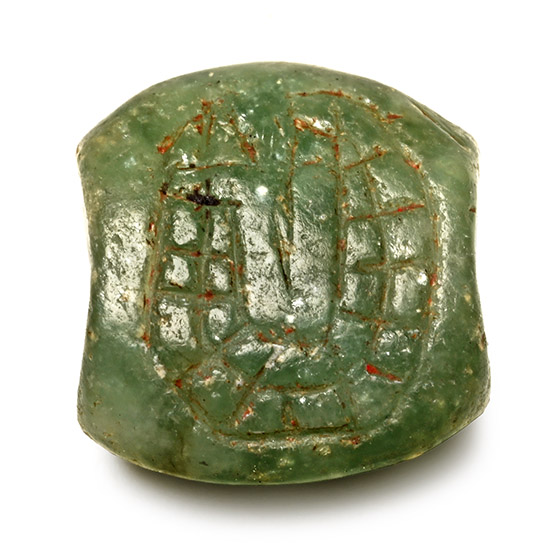
Post Minoan Bifacial Green Stone Stamp Seal with Segmented Snake
Early 1st millennium B.C.Estimate: £400 - 600 (+bp*)
Opening Bid: £5
Lentoid in section with reticulated arch to one face, sitting figure to the other; supplied with a museum-quality impression. 1.61 grams, 12 mm
From the private collection of a European gentleman (1942-2024), formed since the 1970s. -

Greek Painted Pottery Aryballos
Corinthian, circa 6th century B.C.Estimate: £250 - 350 (‡+bp*)
Opening Bid: £125
With a narrow neck and a broad rim to the mouth, a short strap handle to the rear; painted concentric rings around the mouth. 212 grams, 75 mm
Private collection, acquired in 1994; thence by descent.
From the 8th century B.C., Corinthian pottery vessels were exported to Greek colonies in South Italy and the coast of Asia Minor. They were used to hold perfumed oil, an essential item for the wealthy middle classes of the time. In Italy, especially in Etruria, local workshops produced imitations of Corinthian vessel types for a clientele of Greek settlers and local populations with a taste for Greek fashions. -
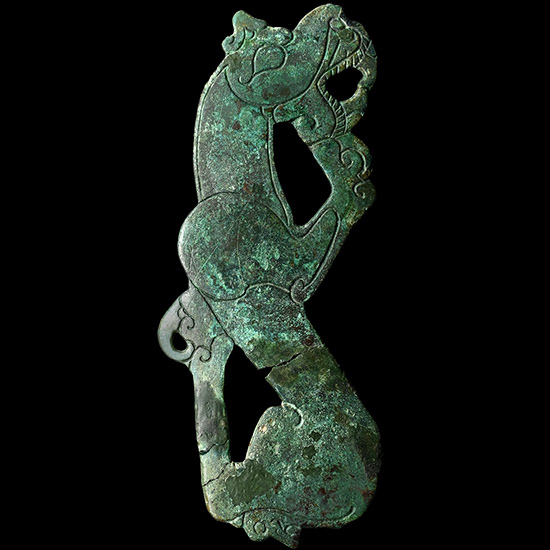
Large Scythian Bronze Contorted Beast Mount
Circa 5th-3rd century B.C.Estimate: £500 - 700 (+bp*)
Bids: 3 | Current Bid: £15
Of openwork construction with flat-section loop to the reverse; a monstrous pouncing carnivore in profile with gaping mouth, its teeth and fangs emphasised; the forelimb with powerful muscles to the shoulder; the hind leg shown rotated so that the foot connects at the rear of the shoulder; small profile beast-head beneath the rump. 72 grams, 13.2 cm
Private collection formed in Europe in the 1980s. Westminster collection, central London, UK.
