
Loading, please wait...
LOT 0578
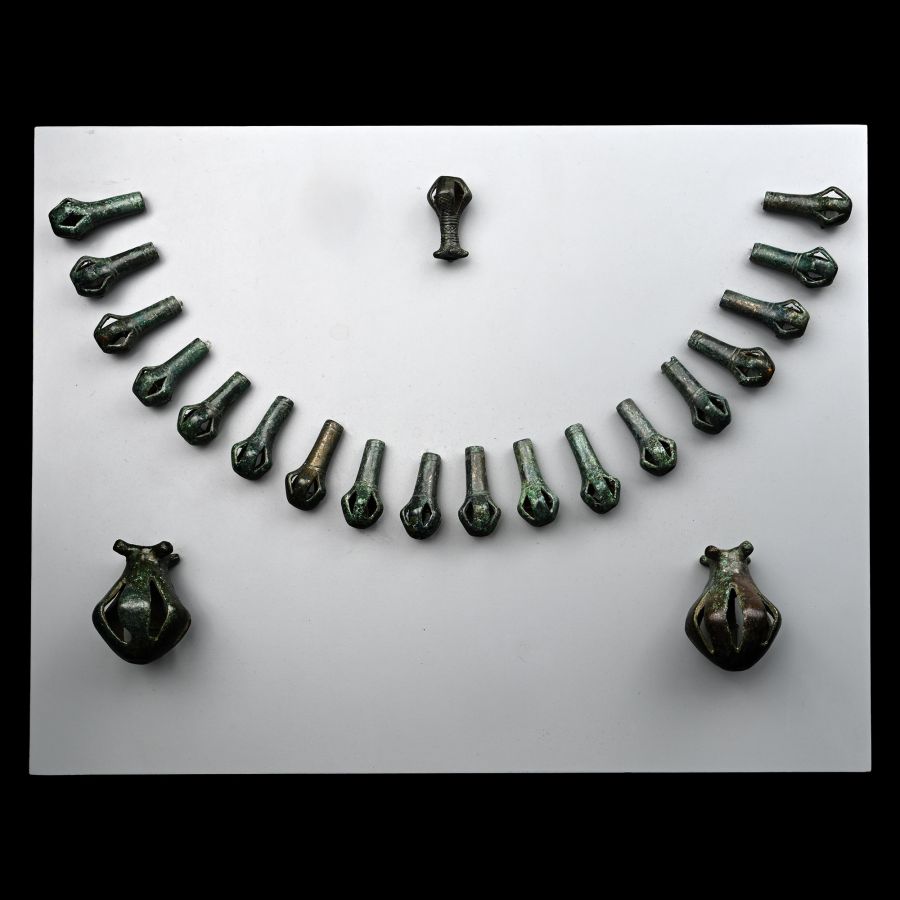
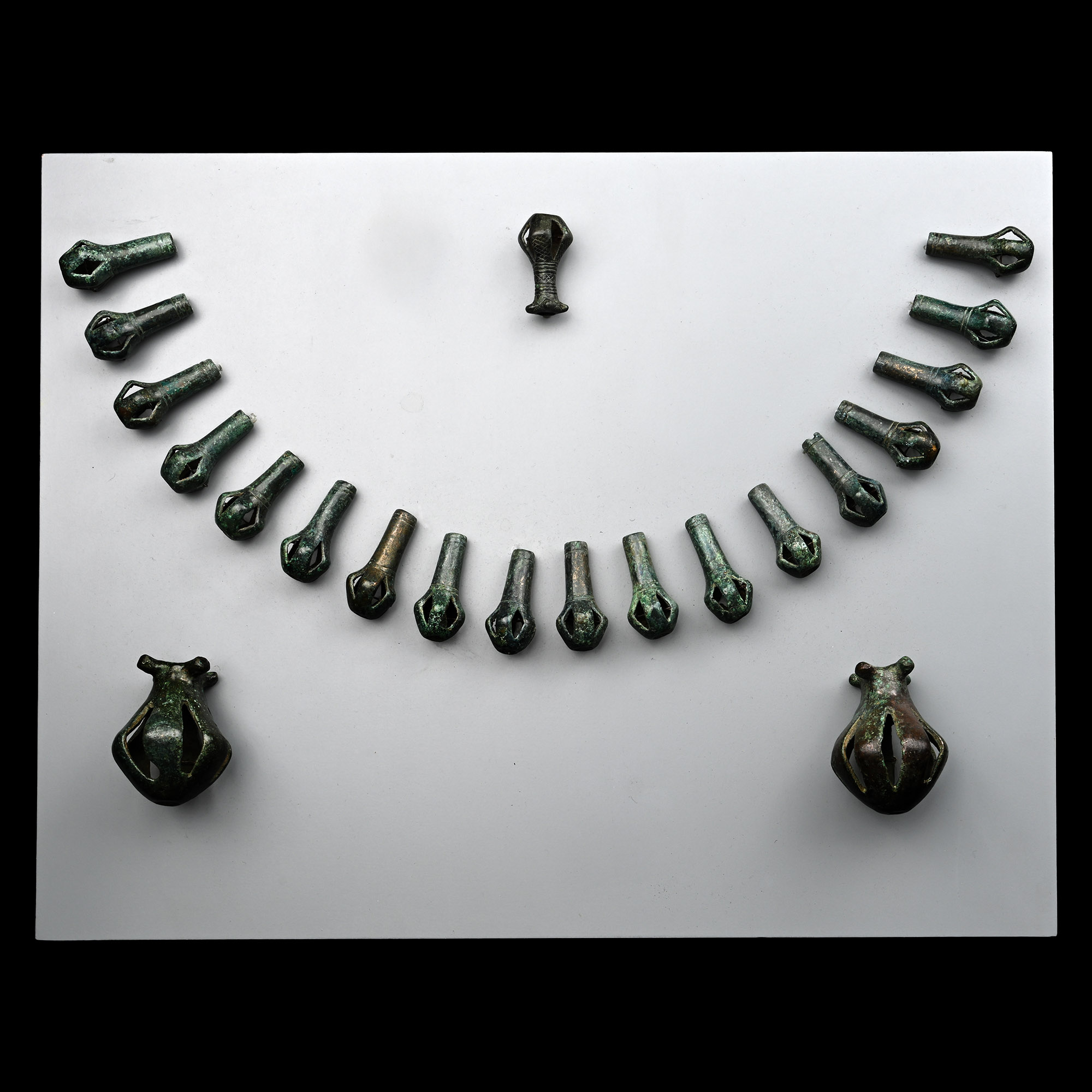
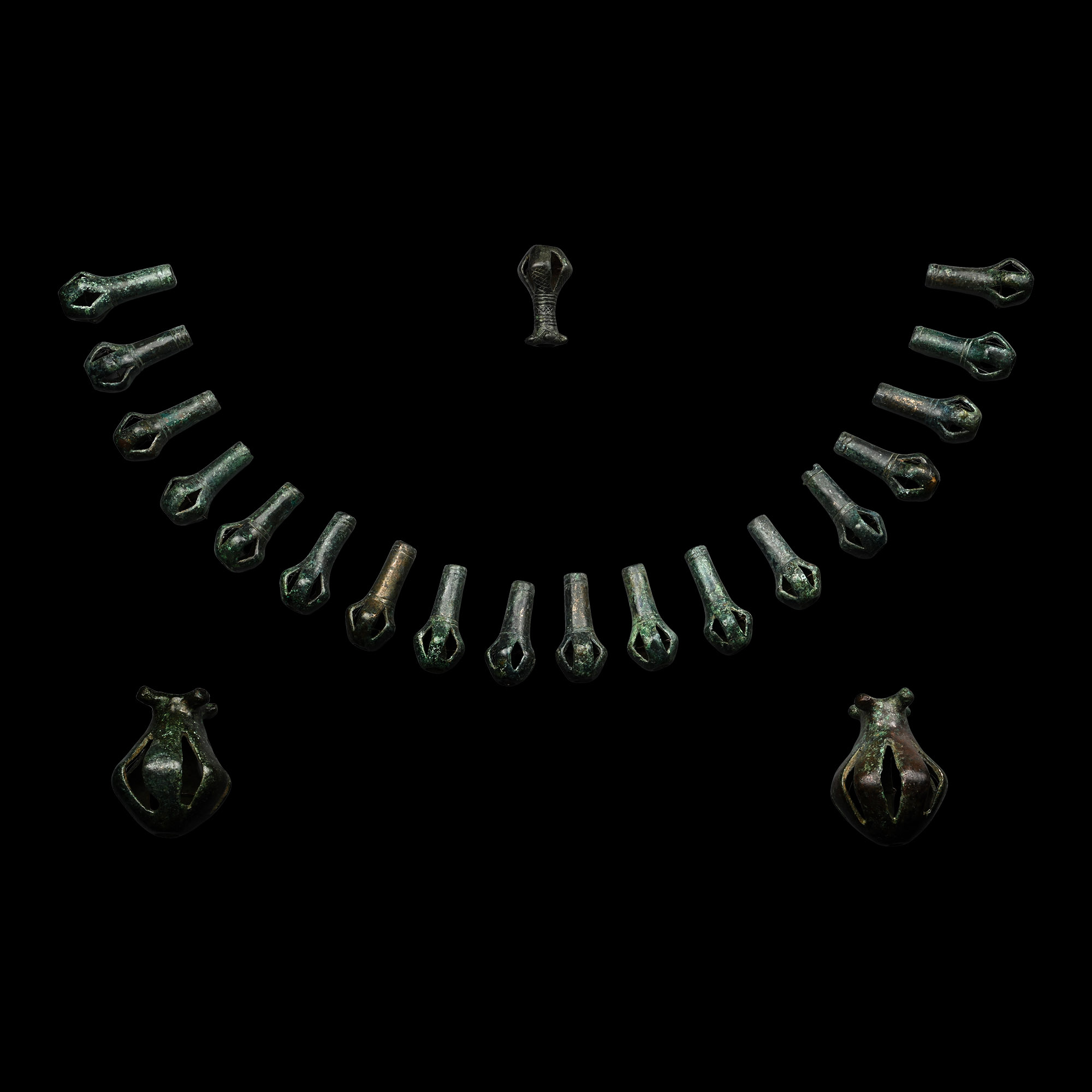
Greek Bronze Openwork Pendant Collection
GEOMETRIC PERIOD, CIRCA 9TH-7TH CENTURY B.C.
16 7/8 x 13 in. (2.16 kg total, 43 x 33 cm).
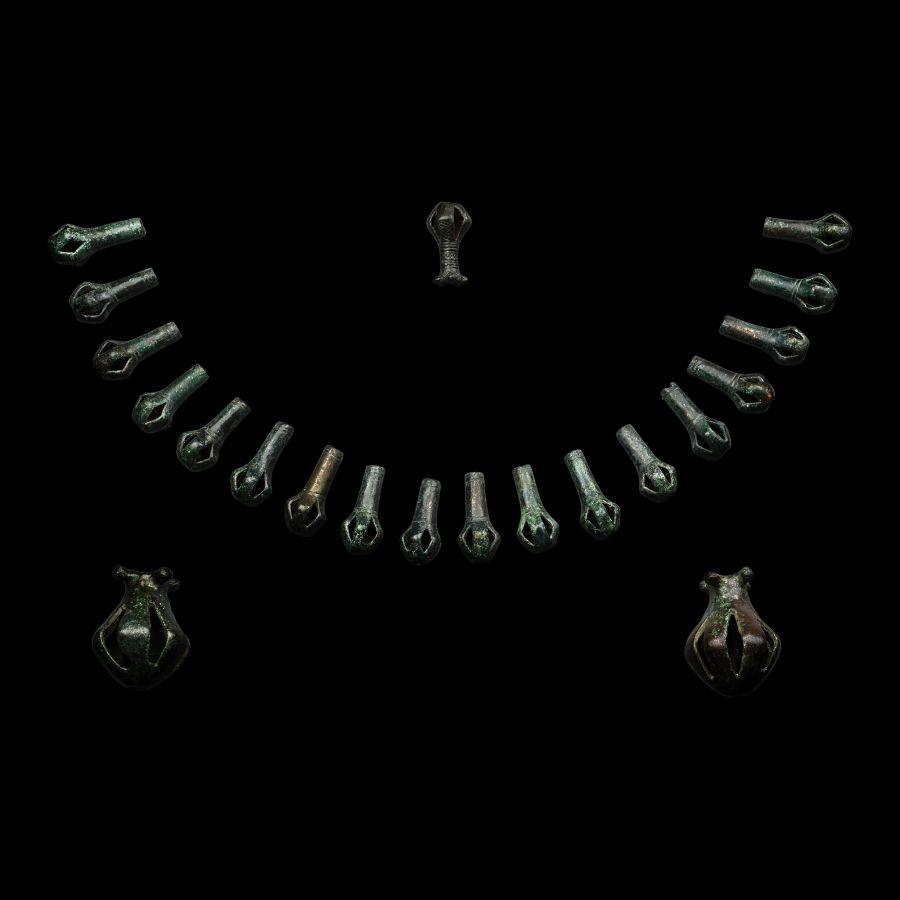
Comprising: eighteen pendants, each with tubular shank and open-ended bulb finial with five lateral vents, some with incised circumferential bands; one similar with dense crosshatching to the shank and bulb, four radiating spurs to the mouth; two larger pendants of similar form, one with six slots to the bulb and the other with seven; all mounted on a felt-backed display board.
ProvenanceA.de Munter collection, Brussels, acquired in the 1970s.
with Jürgen Haering, Freiburg.
Private collection, Europe, acquired from the above 2018.
Cf. Bouzek, J., Graeco-Macedonian Bronzes, Prague, 1974, p. 87, fig. 26, 5-12, 50.
FootnotesThese pendants may have been part of horse harness decoration.
CONDITIONTimeLine Auctions follows a vetting process to ensure the authenticity and legality of all items, reinforcing our commitment to integrity and responsible trading. Each antiquity, antique, and coin lot undergoes thorough examination by a vetting committee of at least ten external specialists, professional trade association members, scientists, and archaeologists: Our Vetting Process
AUCTIONS:
TimeLine is a leading auction house specialising in antiquities, ancient art, collectables, natural history, coins, medals, and books. Our auctions offer museums, collectors, historians, and enthusiasts the opportunity to acquire unique and historically significant pieces.
LOT 0578
Greek Bronze Openwork Pendant Collection
Estimate £400 - 600€460 - 700 (for guidance only)$540 - 810 (for guidance only)
-
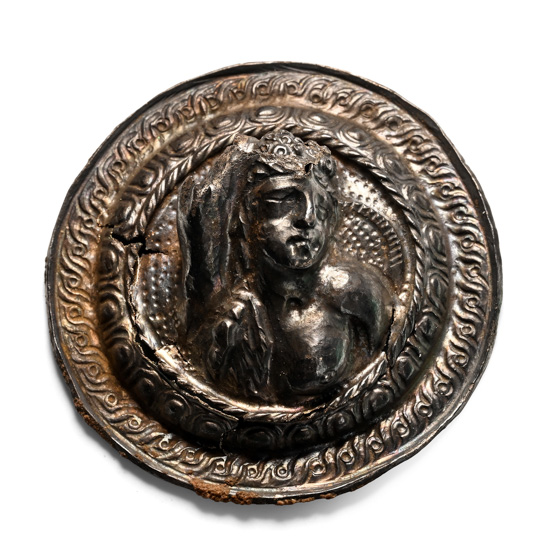
Greek Silver Phalera with Dionysus
3rd-2nd century B.C.Sold for (Inc. bp): £1,560
Discoid in plan with returned rim, guilloche to the outer field and egg-and-dart to the dome; central bust of Dionysus modelled in high-relief with garland in his hair. 5.28 grams, 41 mm
Private collection, assembled in the 1950s-1970s, thence by descent. -
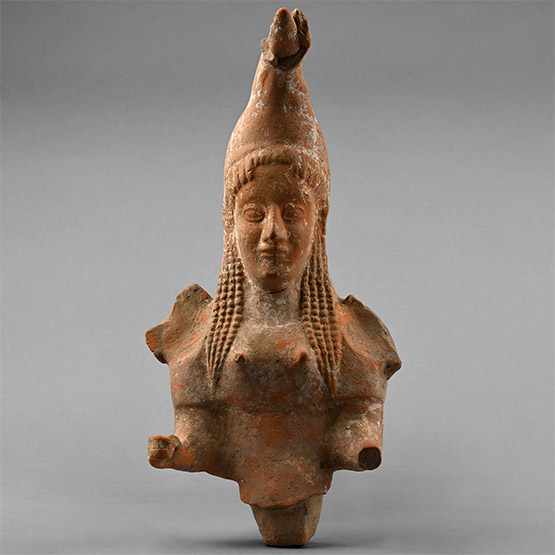
Greek Terracotta Female Antefix
Archaic, 6th-5th century B.C.Estimate: £1,800 - 2,400 (‡+bp*)
Opening Bid: £1,000
Mould-made figure of a female upper body with tall curved and conical headdress, hair dressed in braids falling to her shoulders and flanking her breasts, arms spread and right hand curled to grip a handle or sword-hilt; beneath, a tapering mounting peg for attachment to a roof. 411 grams, 26 cm
Acquired in the mid 1980s-1990s. Private collection, Switzerland, thence by descent. Private collection, since the late 1990s. Accompanied by an academic report by Dr Raffaele D'Amato. This lot has been checked against the Interpol Database of stolen works of art and is accompanied by search certificate number no.12207-222349.
The antefix belongs to the typical decorative scheme of alternating figures decorating the tiles at the ends of the eaves of the roof, constituting a serial decoration. It has the form of a female head, the details of which were defined through finely detailed plastic and polychrome painting, now lost. The head is crowned with a helmet, which can help identify her with the warrior goddess Athena. -
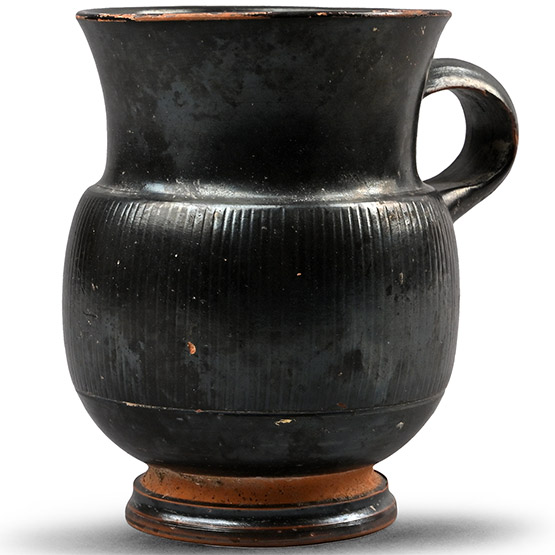
Greek Black-Glazed Thistle Mug
Apulian, 4th century B.C.Sold for (Inc. bp): £364
In black glaze with a single looped handle, expanding neck, ribbed belly and stepped foot with red ochre band. 109 grams, 96 mm
Acquired on the art market between the late 1990s and mid-2000s. Estate of the late Barry Paul Buxton (1944–2024), Oakham, Rutland. Acquired on the UK art market, 2025.
