
Loading, please wait...
LOT 0489
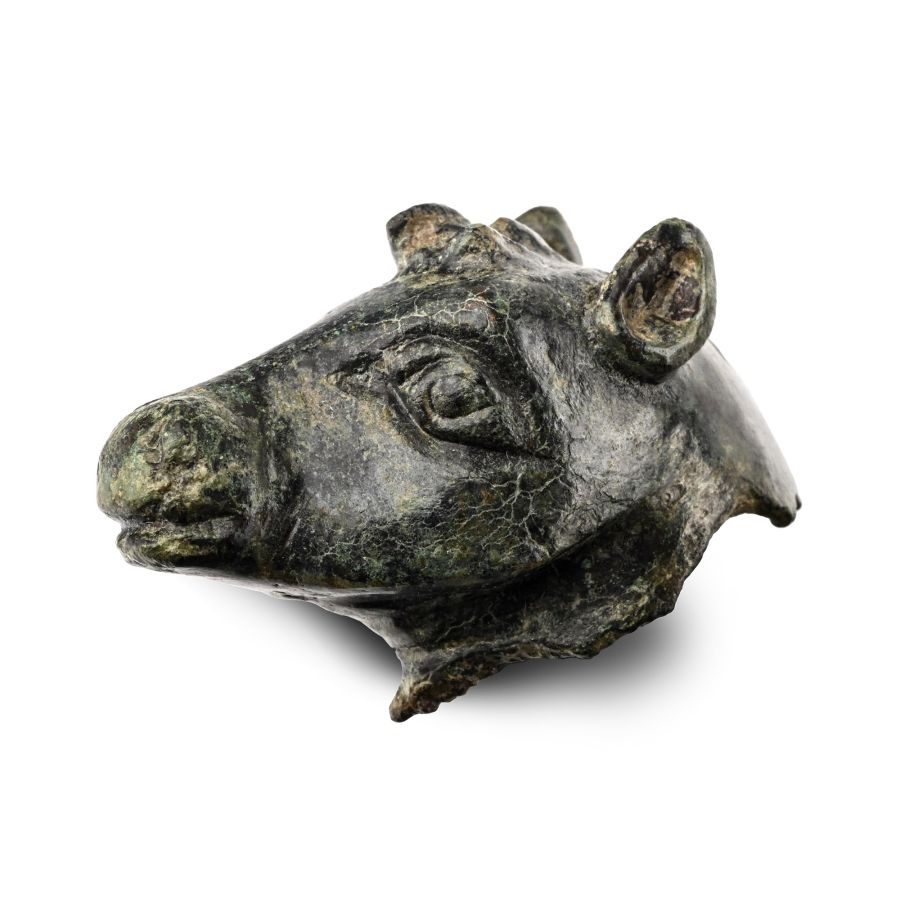
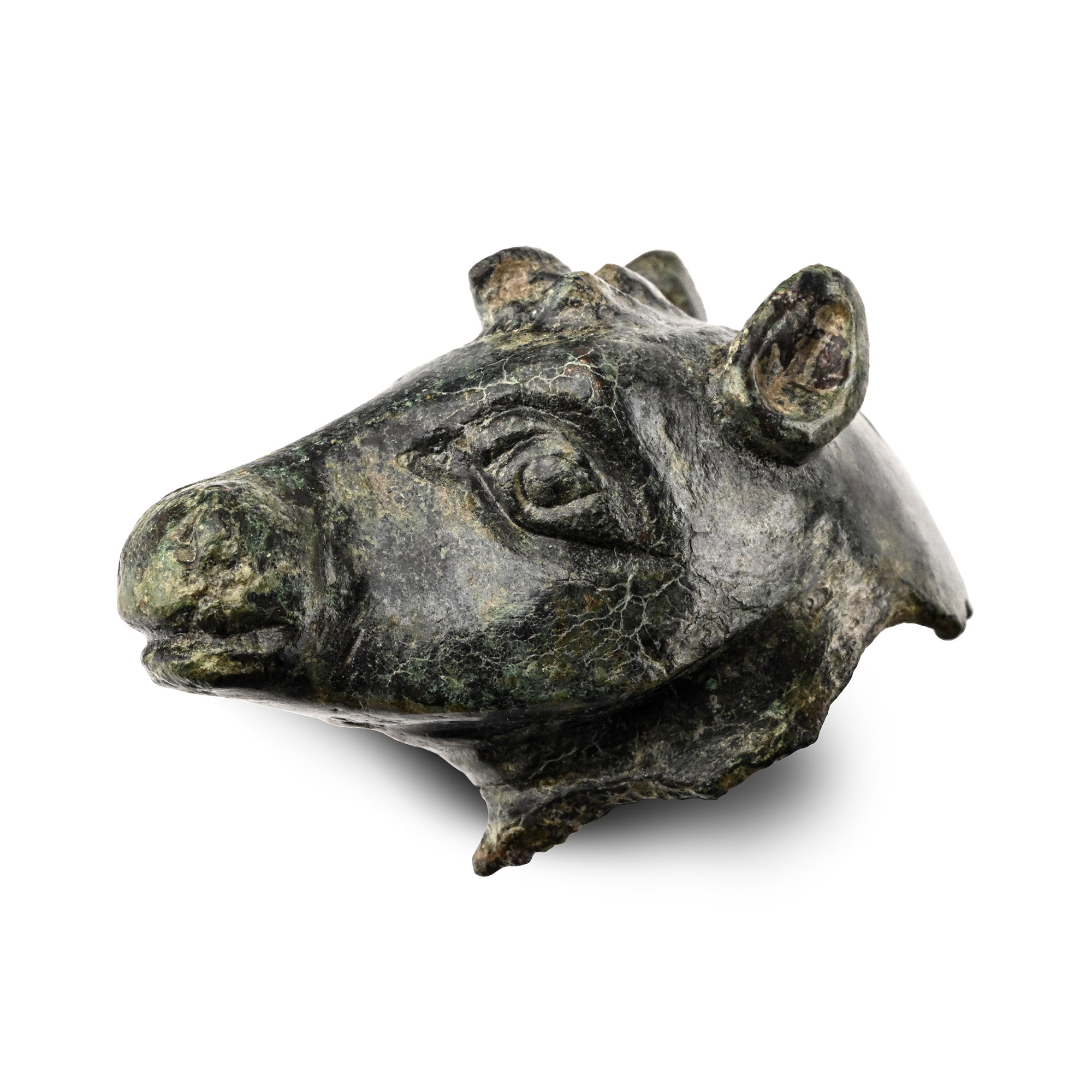
Greek Bronze Horse Head Mount
CIRCA 4TH-3RD CENTURY B.C.
1 1/2 in. (34.8 grams, 38 mm).
Modelled in the round with large almond-shaped eyes and pricked ears.
ProvenanceEx German art market, 2000s.
Acquired from an EU collector living in London.
From the collection of a Surrey, UK, gentleman.
TimeLine Auctions follows a vetting process to ensure the authenticity and legality of all items, reinforcing our commitment to integrity and responsible trading. Each antiquity, antique, and coin lot undergoes thorough examination by a vetting committee of at least ten external specialists, professional trade association members, scientists, and archaeologists: Our Vetting Process
AUCTIONS:
TimeLine is a leading auction house specialising in antiquities, ancient art, collectables, natural history, coins, medals, and books. Our auctions offer museums, collectors, historians, and enthusiasts the opportunity to acquire unique and historically significant pieces.
-
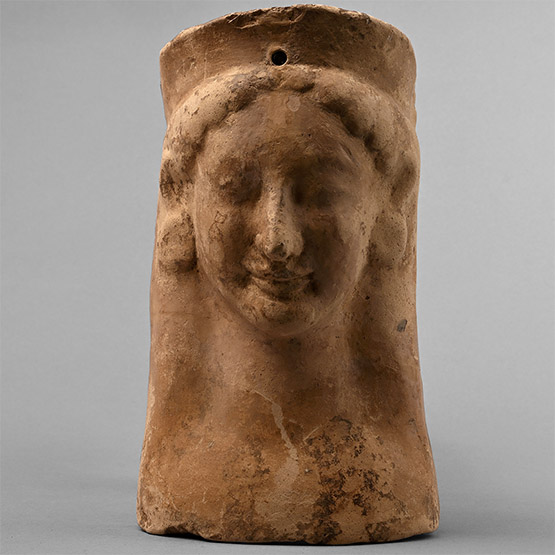
Greek Terracotta Female Protome
Early 5th century B.C.Estimate: £1,200 - 1,700 (‡+bp*)
Opening Bid: £650
Mould-made female protome with oval face, graceful nose and typical "archaic" smile; forehead framed by snail-shell curls descending to shoulder-height; with a low polos with a central perforation and large disc earrings. 606 grams, 19.5 cm
Ex Herbert A. Cahn, Kunst der Antike, Basel, 1997. with Paul and Vreny Vosseler-Studer, Riehen. Accompanied by a copy of an Art Loss Register certificate no.S00057826. This lot has been checked against the Interpol Database of stolen works of art and is accompanied by search certificate number no.12474-228714.
The presence of cults in Magna Graecia, although they fell within a well-established pantheon, in which the deity representing the Great Mother or Mother Earth, protector of fertility, natural and human fecundity, as well as health, was the most ancient, traces back to the figure of Demeter. In terracotta statuary, especially in Lucania, the goddess became the prevalent subject of votive or propitiatory offerings, reproduced in numerous variations of pose. The most common is the seated position, a distant tradition and widespread in the ancient world, the so-called 'goddess enthroned' with its multiple meanings, which allowed it to be adapted to various forms of worship. Demeter is a female deity connected to the earthly world and fertility, and therefore also present in Lucanian religiosity. The theme of the archaic protome—a head severed just below the neck—was transformed and expanded between the 5th and 4th centuries B.C., into that of the bust, finished just above the waist. -
.jpg)
Etruscan Amber Head Pendant
Etruria, 5th century B.C.Sold for (Inc. bp): £2,210
Carved from translucent red-brown amber as a profile head with stylised Archaic features, large almond eye beneath a defined brow ridge, a softly smiling mouth, and carefully delineated hair arranged in striated bands sweeping back from the face; a drilled perforation at the crown indicates its original function as a suspended ornament; accompanied by a display stand. 23 grams, 50 mm (242 grams total, 81 mm including stand)
Sotheby's, London, 14-15 December 1981, no.206. American private collection; acquired at the above sale. This lot has been checked against the Interpol Database of stolen works of art and is accompanied by search certificate number no.13329-257968.
Amber was a prestigious imported material in Etruria, highly prized for its rarity, colour, and perceived apotropaic power. From the late 6th century B.C. onwards, figured amber pendants appear in elite tombs, particularly those of women, reflecting both personal identity and a protective role within funerary belief systems. The prominent, wide-open eye here may have served as a talismanic motif, thought to ward off malign forces and ensure the wearer’s vigilance and well-being in life and beyond the grave. This piece reflects the distinctive aesthetic of Etruscan amber carving, in which Mediterranean influences are reinterpreted with a locally expressive sculptural style. -
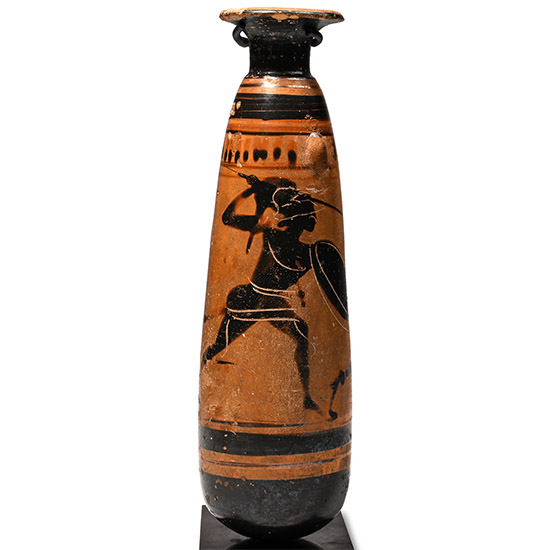
Greek Black-Figure Alabastron with Fighting Warriors
Attic, 500-480 B.C.Sold for (Inc. bp): £13,000
Of ovoid shape, short neck and expanded flat rim; painted in horizontal bands with black vertical strokes the shoulder, ovules in the upper part, the central scene representing a Greek Ekdromos fighting a Scythian archer; the Greek warrior, wearing a light sleeveless chiton, and a crested Corinthian helmet, carrying a wide hoplon shield, and a long spear with which he is slashing his opponent; the Scythian archer is wearing a typical tall cap flowing backwards and his long coat-suit, carrying a gorytos, (quiver) and composite bow with arrow; horizontal black stripes below; accompanied by a custom-made display stand. 262 grams total, 16 cm high including stand
Louis-Gabriel Bellon (1819-1899) collection, France. European private collection, 2009. Accompanied by an academic report by Dr Raffaele D’Amato. This lot has been checked against the Interpol Database of stolen works of art and is accompanied by a search certificate number no.13019-246753.
The importance of this alabastron is linked to its iconography, which represents episodes of the Persian Wars, fought 490-480 B.C. Such alabastra are part of a series realised during the period of the conflict and after, and they are an important source of information on the Persian and Greek armies. Here, the two opponents evoke the Greek victories, with a light-armed Greek ekdromos (hoplite fighting in light equipment) killing a Scythian archer, who formed part of the Persian army. The representation of Scythian costume in vase-painting reached its height of popularity between c. 530 and 490 B.C., and went out of fashion after the Graeco-Persian wars, when these clothes began to be associated with the Persian ethnic identity rather than the original Scythian.
