
Loading, please wait...
_900x900.jpg "Greek Bronze Head of Alexander 'The Great'")
_200x200.jpg "Greek Bronze Head of Alexander 'The Great'")
_900x900.jpg "Greek Bronze Head of Alexander 'The Great'")
_200x200.jpg "Greek Bronze Head of Alexander 'The Great'")
.jpg "Greek Bronze Head of Alexander 'The Great'")
.jpg "Greek Bronze Head of Alexander 'The Great'")
LOT 0073
Greek Bronze Head of Alexander 'The Great'
3RD-2ND CENTURY B.C.
4 in. (142 grams total, 10.2 cm including stand).
Modelled in the round with wavy hair brushed forwards, large lentoid eyes in low-relief, angular nose and small mouth; attachment lug to underside; mounted on a custom-made stand.
ProvenanceCollection of Mr C., Geneva, Switzerland (1936-2016), assembled between 1985 and 2010.
This lot has been checked against the Interpol Database of stolen works of art and is accompanied by a search certificate number no.12857-241703.
This lot has been cleared against the Art Loss Register database, and is accompanied by an illustrated lot declaration signed by the Head of the Antiquities Department, Dr Raffaele D'Amato.
Cf. Moreno, P., ‘L’immagine di Alessandro Magno nell’opera di Lisippo e di altri artisti’ in Alexander the Great, 1993, pp.101-136; Moreno, P. (ed.), Lisippo, l’arte e la fortuna, catalogo della mostra, Roma-Milano, 1995; Alfano, C. (ed.),
TimeLine Auctions follows a vetting process to ensure the authenticity and legality of all items, reinforcing our commitment to integrity and responsible trading. Each antiquity, antique, and coin lot undergoes thorough examination by a vetting committee of at least ten external specialists, professional trade association members, scientists, and archaeologists: Our Vetting Process
AUCTIONS:
TimeLine is a leading auction house specialising in antiquities, ancient art, collectables, natural history, coins, medals, and books. Our auctions offer museums, collectors, historians, and enthusiasts the opportunity to acquire unique and historically significant pieces.
LOT 0073
Greek Bronze Head of Alexander 'The Great'
Estimate £8,000 - 10,000€9,280 - 11,600 (for guidance only)$10,800 - 13,500 (for guidance only)
-
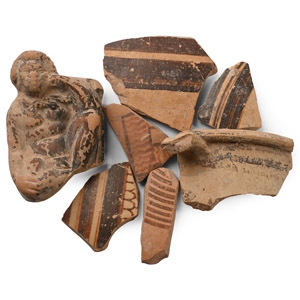
Greek Pottery Collection
5th-3rd century B.C.Sold for (Inc. bp): £78
Comprising various vessel fragments with decoration, including a figural fragment of a pygmy carrying a dead crane, some with old pencil inscriptions. 120 grams total, 41-83 mm
From a deceased estate, UK. Acquired on the UK art market. This lot is accompanied by an illustrated lot declaration signed by the Head of the Antiquities Department, Dr Raffaele D'Amato.
The small statuette of a naked man, who rests his head on his left arm, shows African features, and most likely belongs to the terracotta statuettes of Hellenistic or Alexandrian production of the 3rd-2nd century BC. -
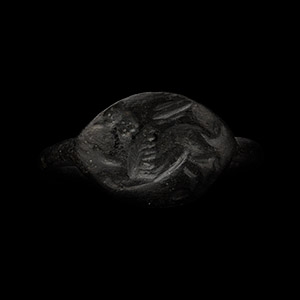
Eastern Greek Bronze Ring with Gryphon
4th-3rd century B.C.Sold for (Inc. bp): £195
Narrow hoop, scaphoid bezel with intaglio advancing gryphon motif. 1.40 grams, 21.04 mm overall, 18.91 mm internal diameter (approximate size British P, USA 7 1/2, Europe 16.23, Japan 15)
Ex German art market, 2000s. Acquired from an EU collector living in London. From the collection of a Surrey, UK, gentleman. This lot is accompanied by an illustrated lot declaration signed by the Head of the Antiquities Department, Dr Raffaele D'Amato. -
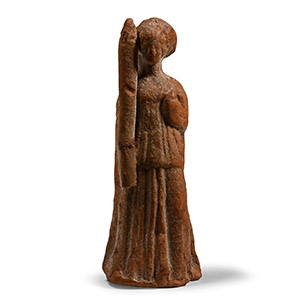
Greek Terracotta Goddess Figure
4th-3rd century B.C.Estimate: £500 - 700 (‡+bp*)
Opening Bid: £278
Tanagra type, hollow-formed with a void to the reverse, standing female in tiered robe wearing a diadem and with her hair drawn back, applied torch in her right hand. 18 grams, 12 cm
European art market. Acquired in Münich in 2012. European private collection. This lot is accompanied by an illustrated lot declaration signed by the Head of the Antiquities Department, Dr Raffaele D’Amato. This lot is accompanied by an illustrated lot declaration signed by the Head of the Antiquities Department, Dr Raffaele D'Amato.
