
Loading, please wait...
LOT 0064
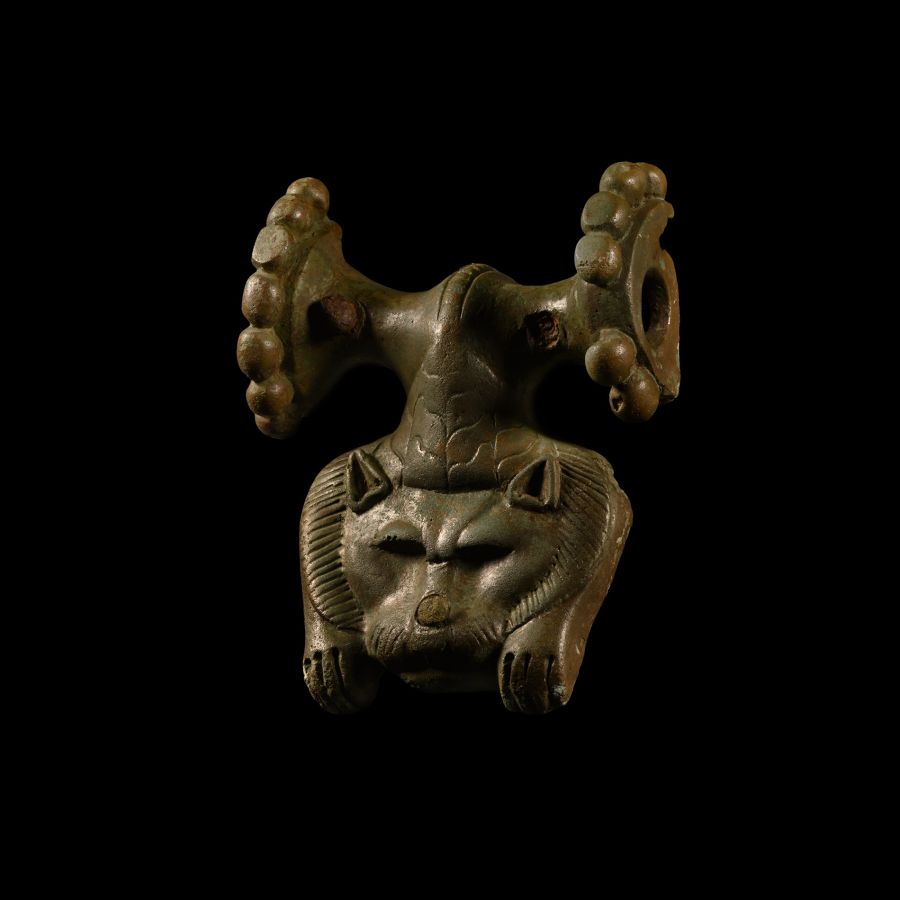
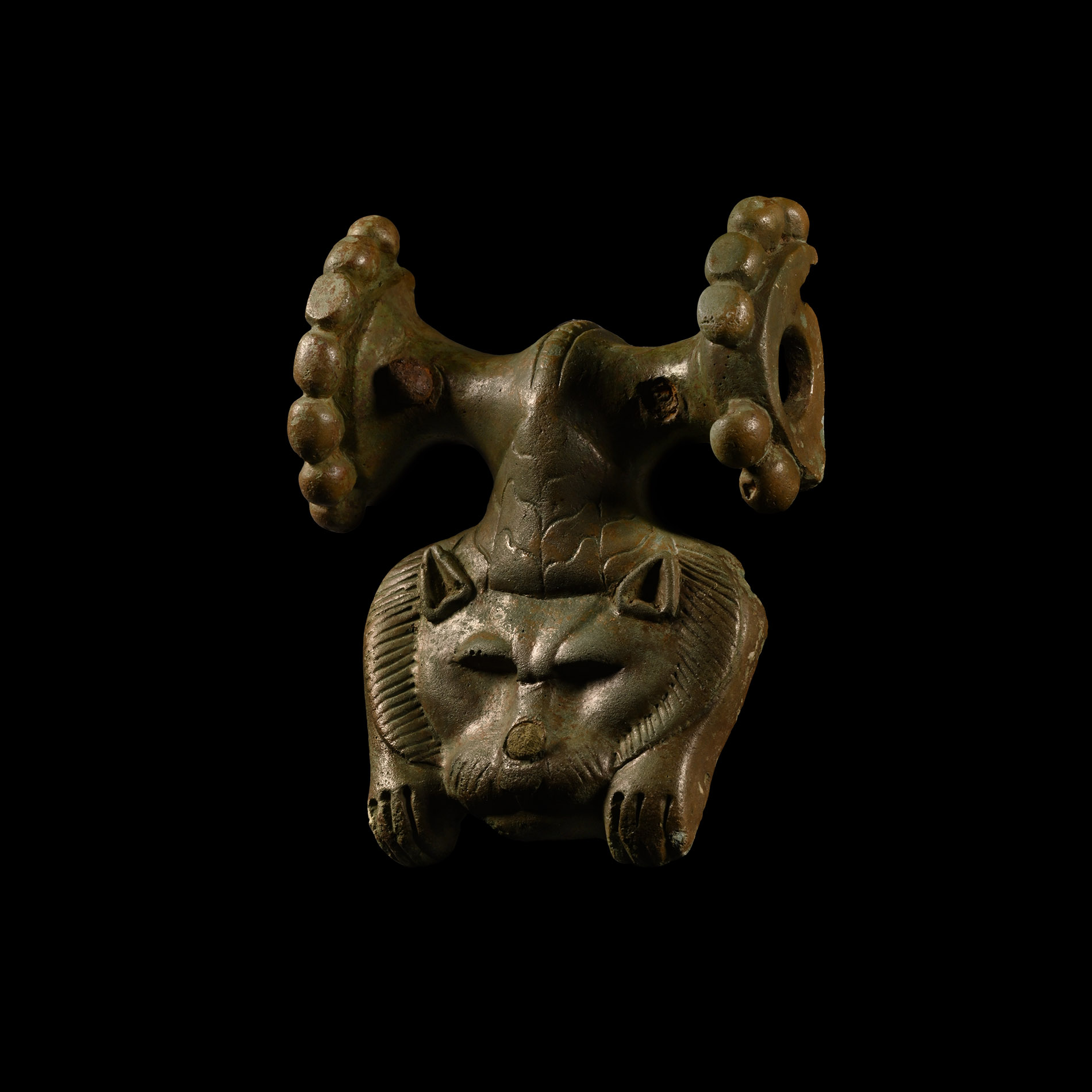
Greek Bronze Handle with Lion-Skin Head
CIRCA 5TH-4TH CENTURY B.C.
3 1/8 in. (159 grams, 80 mm).
Formed as the skinned head and forepaws of a lion, together with two lateral handles with fastening holes surmounted by a pearled edge.
ProvenanceAcquired on the UK art market 2000s.
LiteratureCf. Furtwängler, A., Olympia. Die Ergebnisse der von dem Deutschen Reich veranstalteten Ausgrabung Band 4. 2 Bände (Textband, Tafelband), Asher, Berlin, 1890, pl.TLV, nos.923-924, for similar handles.
FootnotesThe handle appears to be a device once attached to a wine vessel or pan-like vessels. The vessel handles were usually formed as divinities or animals linked with gods (ie. lions for Herakles). The lion's skin is hanging down as in representations of Herakles resting and drinking after his labours.
CONDITIONTimeLine Auctions follows a vetting process to ensure the authenticity and legality of all items, reinforcing our commitment to integrity and responsible trading. Each antiquity, antique, and coin lot undergoes thorough examination by a vetting committee of at least ten external specialists, professional trade association members, scientists, and archaeologists: Our Vetting Process
AUCTIONS:
TimeLine is a leading auction house specialising in antiquities, ancient art, collectables, natural history, coins, medals, and books. Our auctions offer museums, collectors, historians, and enthusiasts the opportunity to acquire unique and historically significant pieces.
-
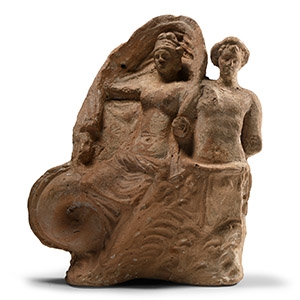
Greek Terracotta Venus and Triton Group
1st century B.C.Sold for (Inc. bp): £910
Both figures represented facing with bare chests, Aphrodite sitting next to the triton and holding himation over her head with her right hand, her right leg raised and the left extended, the lower part of her himation covering the lower half of her body; the lower part of Triton’s body covered by marine foliage, from which the long serpentine tail emerges on the opposite side next to Aphrodite's right leg; possibly from Asia Minor; repaired. 688 grams, 18 cm high
Ex French Sorbonne archaeology professor (deceased); 1960s-2000s. Accompanied by an original thermoluminescence analysis report no.QED2323/FG-0201 from the QED Laboratory, Marseille, France.
Many of the Smyrna and Myrina figures are feminine, the heads modelled in late Hellenistic style. The bodies are often either draped in Tanagra-style robes, or represented as figures of Aphrodite, draped, semi-nude or naked. The association with Triton is linked with the Greek myth of Aphrodite born from sea foam. -
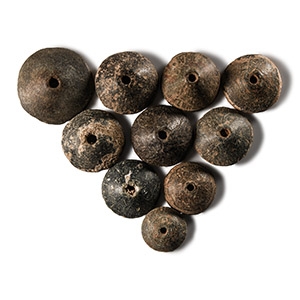
Greek Stone Spindle Whorl Collection
3rd-2nd century B.C.Sold for (Inc. bp): £111
Group of plano-convex schist spindle whorls, each with a central vertical hole. 106 grams total, 21-36 mm
Private collection formed in the 1990s. Acquired from a central London gallery. Property of an Essex gentleman. Accompanied by an old Coincraft certificate of authenticity. -
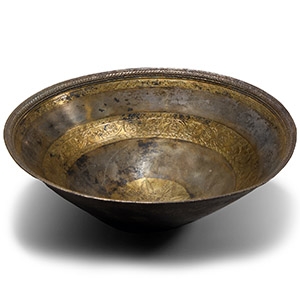
Hellenistic Decorated Silver-Gilt Bowl
Late 2nd-early 1st century B.C.Estimate: £15,000 - 20,000 (+bp*)
Opening Bid: £7,500
The bell-shaped bowl with everted flaring rim, raised from a single sheet with parcel-gilding; the inner rim with raised wreath ornament, a band of geometric motifs below; central band composed of an elaborate garland of leaves and flowers flanked by bands of volutes; the base with an eight-petalled flower with radiating large leaves; small repair. 246 grams, 20.2 wide (1.58 kg total, 28.5 x 28 cm including case)
From the collection of George Ortiz (1927-2013). with Mansour Gallery, early 2000s. Subsequently in a French collection. Accompanied by an academic report by Dr Raffaele D’Amato. This lot has been checked against the Interpol Database of stolen works of art and is accompanied by search certificate number no.11936-210132.
Similar segment-shaped silver bowls with partial gilding, decorated on the inside with friezes in the form of garlands or wickerwork on the bottom, have been found in many nomad mounds of the Caucasus and in the territories once dominated by the Arsacid Empire. They are attributed to Parthian workshops by Pfrommer and M. Treister.
