
Loading, please wait...


LOT 0514
Greek Bronze Bracelet with Animal Heads
HELLENISTIC, CIRCA 3RD-2ND CENTURY B.C.
2 3/8 in. (33.52 grams, 60 mm).
Penannular bracelet with D-section body and the finials formed as stylised animal heads. [No Reserve]
ProvenanceFrom a UK collection formed in the 1980s.
Property of an Essex, UK, gentleman.
TimeLine Auctions follows a vetting process to ensure the authenticity and legality of all items, reinforcing our commitment to integrity and responsible trading. Each antiquity, antique, and coin lot undergoes thorough examination by a vetting committee of at least ten external specialists, professional trade association members, scientists, and archaeologists: Our Vetting Process
AUCTIONS:
TimeLine is a leading auction house specialising in antiquities, ancient art, collectables, natural history, coins, medals, and books. Our auctions offer museums, collectors, historians, and enthusiasts the opportunity to acquire unique and historically significant pieces.
-

Greek Bronze Ring with Centaur
3rd-2nd century A.D.Sold for (Inc. bp): £286
With a slender hoop and an oval bezel with a galloping centaur facing back with his arms raised. 3.40 grams, 22.48 mm overall, 18.34 mm internal diameter (approximate size British Q, USA 8, Europe 17.49, Japan 16)
Ex German art market, 2000s. Acquired from an EU collector living in London. From the collection of a Surrey, UK, gentleman. -
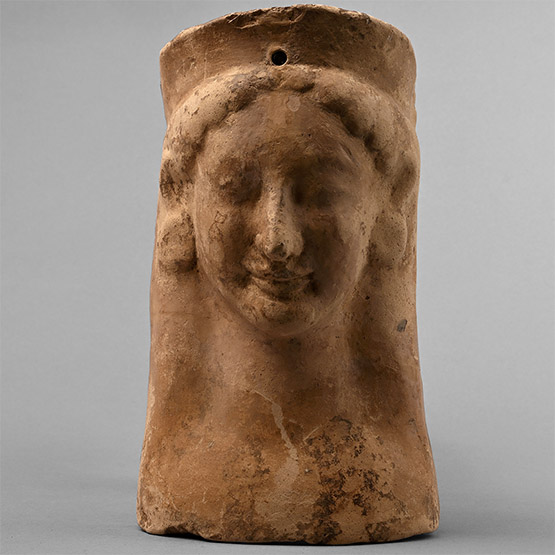
Greek Terracotta Female Protome
Early 5th century B.C.Estimate: £1,200 - 1,700 (‡+bp*)
Opening Bid: £650
Mould-made female protome with oval face, graceful nose and typical "archaic" smile; forehead framed by snail-shell curls descending to shoulder-height; with a low polos with a central perforation and large disc earrings. 606 grams, 19.5 cm
Ex Herbert A. Cahn, Kunst der Antike, Basel, 1997. with Paul and Vreny Vosseler-Studer, Riehen. Accompanied by a copy of an Art Loss Register certificate no.S00057826. This lot has been checked against the Interpol Database of stolen works of art and is accompanied by search certificate number no.12474-228714.
The presence of cults in Magna Graecia, although they fell within a well-established pantheon, in which the deity representing the Great Mother or Mother Earth, protector of fertility, natural and human fecundity, as well as health, was the most ancient, traces back to the figure of Demeter. In terracotta statuary, especially in Lucania, the goddess became the prevalent subject of votive or propitiatory offerings, reproduced in numerous variations of pose. The most common is the seated position, a distant tradition and widespread in the ancient world, the so-called 'goddess enthroned' with its multiple meanings, which allowed it to be adapted to various forms of worship. Demeter is a female deity connected to the earthly world and fertility, and therefore also present in Lucanian religiosity. The theme of the archaic protome—a head severed just below the neck—was transformed and expanded between the 5th and 4th centuries B.C., into that of the bust, finished just above the waist. -
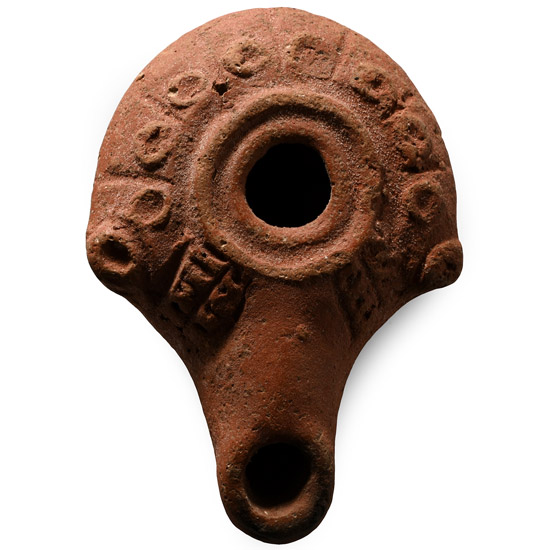
Greek Terracotta Oil Lamp with Annulets
Hellenistic, 3rd century B.C.Sold for (Inc. bp): £104
Low profile and a long nozzle, the body with annulets on the shoulder and two projecting lugs on each side of the nozzle. 49.3 grams, 81 mm
From an important collection of lamps, Germany, 1970s.
