
Loading, please wait...
_900x900.jpg "Greek Bronze Bow Fibula")
_200x200.jpg "Greek Bronze Bow Fibula")
.jpg "Greek Bronze Bow Fibula")
LOT 0509
Greek Bronze Bow Fibula
8TH-7TH CENTURY B.C.
3 1/2 in. (29 grams, 89 mm).
The keeled bow with a central bulb, integral pin and large catch-plate. [No Reserve]
ProvenanceFrom the family collection of a Surrey gentleman since before 1960.
LiteratureCf. Moon-Ja, K., ‘A study on Ancient Fibulae’ in IJCC, vol.8, no.2, 2005, pp.71-84 fig.3, for the type.
FootnotesThe function of the catch-plate fibulae was utilitarian and decorative, they were used for woollen clothing (Herodotus V, 87) and they have been found in houses, tombs and as votive offerings in sanctuaries. Our fibula is an early type, very often found in the graves of the Greek colonies of Southern Italy and widespread in the Magna Graecia. This typology was introduced there by the Greeks. Like all female fibulae, it functioned as a clothing fastener, usually worn as a pair on each shoulder.
CONDITIONTimeLine Auctions follows a vetting process to ensure the authenticity and legality of all items, reinforcing our commitment to integrity and responsible trading. Each antiquity, antique, and coin lot undergoes thorough examination by a vetting committee of at least ten external specialists, professional trade association members, scientists, and archaeologists: Our Vetting Process
AUCTIONS:
TimeLine is a leading auction house specialising in antiquities, ancient art, collectables, natural history, coins, medals, and books. Our auctions offer museums, collectors, historians, and enthusiasts the opportunity to acquire unique and historically significant pieces.
-
.jpg)
Greek Bronze Owl Finial
4th-2nd century B.C.Sold for (Inc. bp): £117
Modelled in the round perched on a discoid base with mounting lug to the underside; the stylised owl with large circular eyes with simple beak and feather detailing, pecked texture to the base; accompanied by a custom-made wooden display stand. 89 grams total, 70 mm high including stand
Acquired 1960s-1990s. From the late Alison Barker collection, a retired London barrister. -
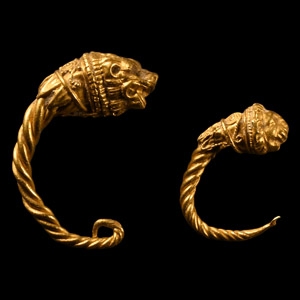
Greek Gold Earring Pair with Lion Heads
4th-3rd century B.C.Estimate: £1,000 - 1,400 (‡+bp*)
Opening Bid: £500
Each with a decoratively twisted ear hook and lion head terminal with ornamental collar adorned with filigree spirals and granule clusters; non-identical. 3.05 grams total, 15-21 mm
Acquired between 1950-1970s. Ex Swiss private collection. -
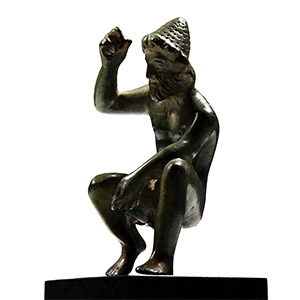
Greek Bronze Hephaistos Statuette
Circa 5th century B.C.Estimate: £20,000 - 30,000 (+bp*)
Opening Bid: £10,000
The elegant figure depicting the Greek god of fire and metalworking seated and nude except for the pilos on his head, lean body with naturalistic detailing, shown bearded and with curly hair emerging beneath the cap; he would have once held a pair of tongs in his left hand and a hammer in his right hand; accompanied by a custom-made display stand. 294 grams total, 13.5 cm high including stand
Fine condition, wonderful state of preservation, very rare.
with Elie Borowski, Basel. Subsequently in the collection of Denys Sutton (1917-1991), London, acquired from the above on 11 October 1963. Thence by descent. with Sotheby's, New York, 6 December 2012, lot 11. Accompanied by an academic report by Dr Raffaele D’Amato. This lot has been checked against the Interpol Database of stolen works of art and is accompanied by search certificate number no. 11827-207739.
According to legend, Hephaistos was thrown into the ocean by his mother Hera and raised by the sea nymph Thetis. Upon his return to Olympus, he took his revenge by imprisoning his mother and obtaining the hand of the most beautiful of the goddesses, Aphrodite. He became the blacksmith of the gods. Sculptural depictions of the god, known as Vulcan to the Romans, are very rare. Hephaistos was the armourer of the heroes, and certainly his greatest artwork was making Achilles' armour.
