
Loading, please wait...
_900x900.jpg "Greek Bronze Bird")
_200x200.jpg "Greek Bronze Bird")
.jpg "Greek Bronze Bird")
LOT 0566
Greek Bronze Bird
GEOMETRIC, 8TH-6TH CENTURY B.C.
1 3/4 in. (19.8 grams, 45 mm).
Modelled in the round with triangular fantail, lateral bulb eyes, pierced transversely at the chest for attachment.
ProvenanceAcquired by a Swiss family in the mid-1980s to late 1990s, thence by descent.
Private collection, Switzerland, since the late 1990s.
TimeLine Auctions follows a vetting process to ensure the authenticity and legality of all items, reinforcing our commitment to integrity and responsible trading. Each antiquity, antique, and coin lot undergoes thorough examination by a vetting committee of at least ten external specialists, professional trade association members, scientists, and archaeologists: Our Vetting Process
AUCTIONS:
TimeLine is a leading auction house specialising in antiquities, ancient art, collectables, natural history, coins, medals, and books. Our auctions offer museums, collectors, historians, and enthusiasts the opportunity to acquire unique and historically significant pieces.
-
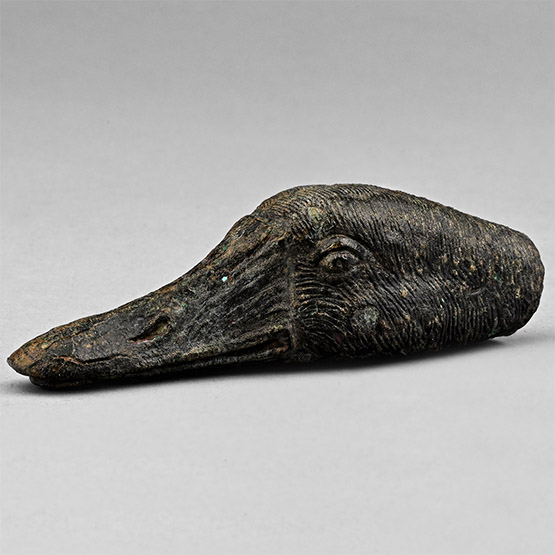
Greek Bronze Duck's Head
3rd-2nd century B.C.Sold for (Inc. bp): £1,690
Modelled in the round with realistic features, textured plumage, rounded beak. 236 grams, 10.1 cm
Acquired in the mid 1980s-1990s. Private collection, Switzerland, thence by descent. Private collection, since the late 1990s. This lot has been checked against the Interpol Database of stolen works of art and is accompanied by a search certificate number no.12378-226677. -
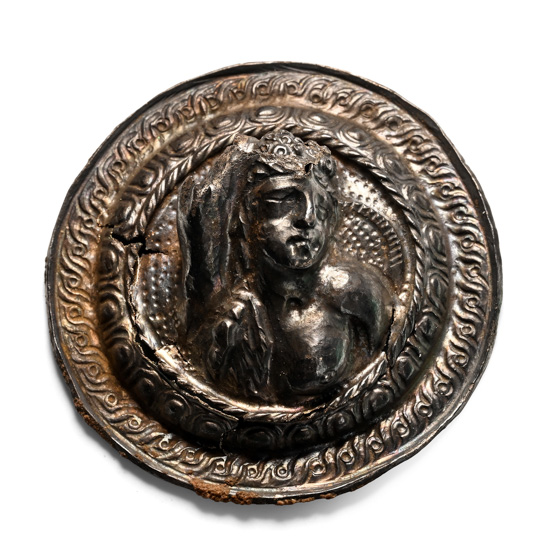
Greek Silver Phalera with Dionysus
3rd-2nd century B.C.Sold for (Inc. bp): £1,560
Discoid in plan with returned rim, guilloche to the outer field and egg-and-dart to the dome; central bust of Dionysus modelled in high-relief with garland in his hair. 5.28 grams, 41 mm
Private collection, assembled in the 1950s-1970s, thence by descent. -
.jpg)
Greek Black-Figure Skyphos with Dancing Satyrs by the Komast Painter Group
Attic, 585-560 B.C.Estimate: £5,000 - 7,000 (+bp*)
Opening Bid: £2,500
Featuring black-figure depictions of the Komos in a lively procession of revellers celebrating Dionysos, with the god portrayed as an ithyphallic satyr; two loop handles on the rim and a palmette beneath each handle, adorned with tendrils; professionally repaired. 219 grams, 20 cm wide
with Sotheby’s, New York, 20 June 1990, no.11. Private collection, New York, USA. Private collection, Georgia, USA. Private collection, UK. Accompanied by copies of the relevant Sotheby's catalogue pages. This lot has been checked against the Interpol Database of stolen works of art and is accompanied by search certificate number no.13103-248960.
The Greek Komos, an integral part of ancient Greek culture, symbolises lively celebrations dedicated to Dionysos, the god of wine and revelry. It involved spirited processions with singing, dancing, music, and wine, fostering communal joy. This tradition was a vital aspect of Greek festivals, underscoring the Greeks’ love for communal bonding, the arts, and the pleasures of life. The Komos vividly illustrates the vibrant cultural and religious practices of ancient Greece. The artwork showcases four nude male dancers in dynamic poses, with their heads turned and arms in animated gestures. Three of them have pointed beards, while one is youthful and beardless.
