
Loading, please wait...


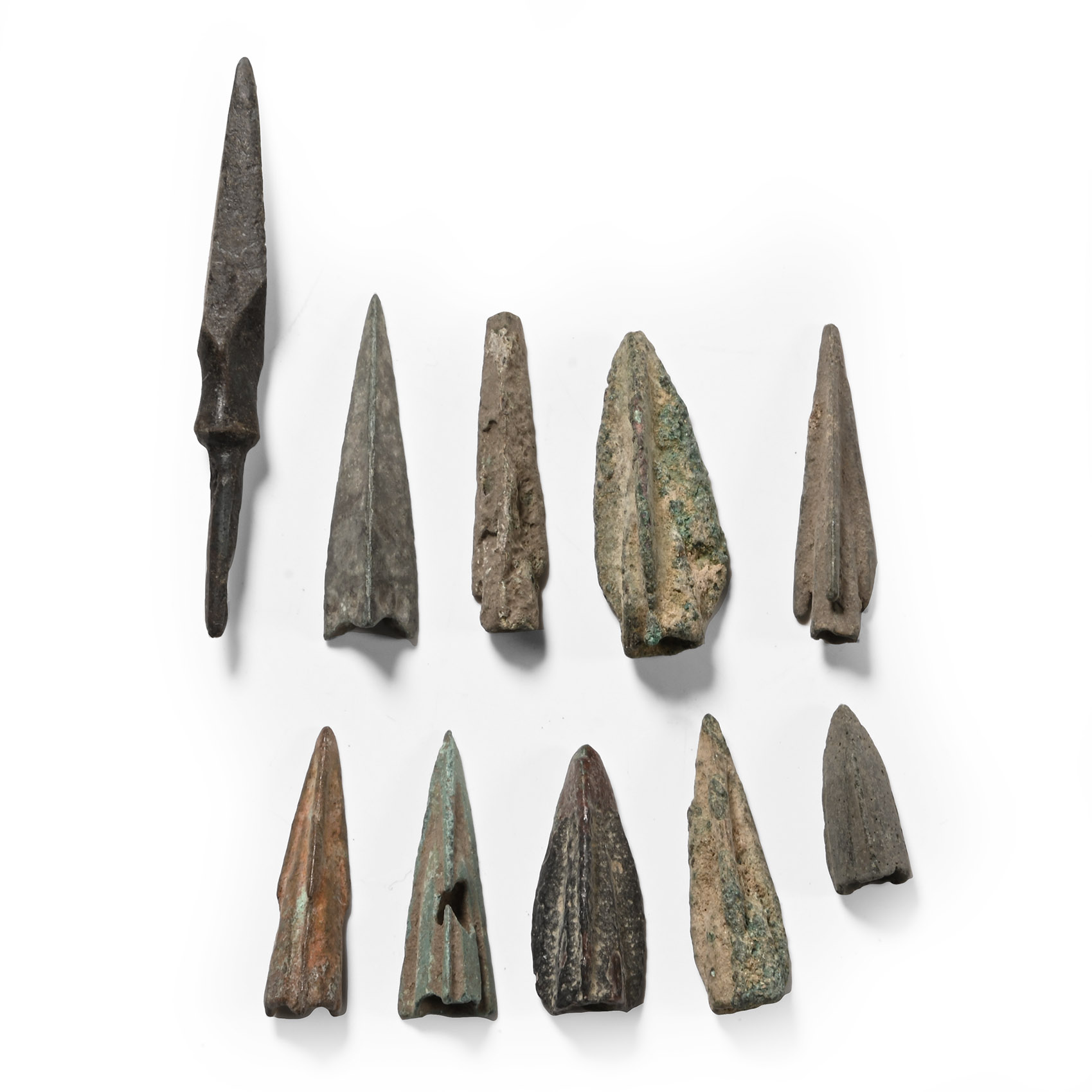
LOT 1388
Greek Bronze Arrowhead Collection
CIRCA 5TH-3RD CENTURY B.C.
5/8 - 2 in. (23 grams total, 15-49 mm).
Mainly socketted and triangular in section. [10, No Reserve]
ProvenanceFrom a private Barnsley, UK, family collection.
CONDITIONTimeLine Auctions follows a vetting process to ensure the authenticity and legality of all items, reinforcing our commitment to integrity and responsible trading. Each antiquity, antique, and coin lot undergoes thorough examination by a vetting committee of at least ten external specialists, professional trade association members, scientists, and archaeologists: Our Vetting Process
AUCTIONS:
TimeLine is a leading auction house specialising in antiquities, ancient art, collectables, natural history, coins, medals, and books. Our auctions offer museums, collectors, historians, and enthusiasts the opportunity to acquire unique and historically significant pieces.
-
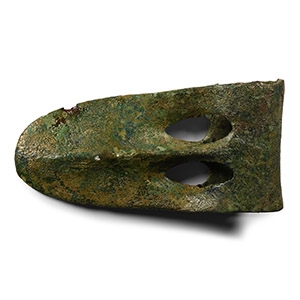
Old Babylonian Bronze Duckbilled Axehead
Early 2nd millennium B.C.Sold for (Inc. bp): £208
With a curved, beak-shaped blade and two pierced eyes flanking a raised median ridge ellipsoid-section socket; repaired. 147 grams, 10.5 cm
From the private collection of Kenneth Machin (1936-2020), Buckinghamshire, UK; with collection no.BA27; his collection of antiquities and natural history was formed since 1948; thence by descent.
This axe corresponds to the type H4B of the Gernez classification. Several of these models, with their moulds, are known from the Levant, like those in Byblos, Ras Shamra, and Tell Arqa. On the other hand, a workshop level II of the Kültepe karum delivered two moulds, showing a local production of arms intended either for export or for the inhabitants originating from Mesopotamia or the Levant. This sub-type of eye-axes is characteristic of the Middle Bronze Age 1 (2050-1750 B.C.). -
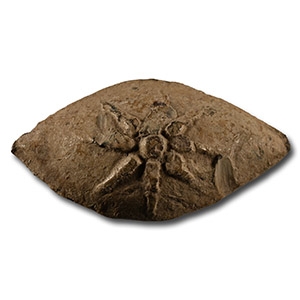
Greek Macedonian Lead Sling Shot
4th-3rd century B.C.Sold for (Inc. bp): £143
Scaphoid in plan and lentoid in section with reserved starburst motif to one face. 18.7 grams, 34 mm
Acquired in the 1980s. From the collection of a London antiquarian. -
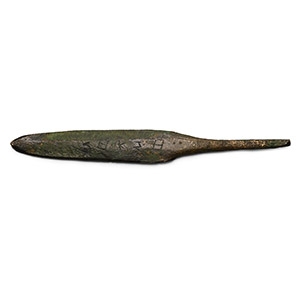
Phoenician Bronze Arrowhead with Inscriptions
Circa 12th-11th century B.C.Sold for (Inc. bp): £650
Slender leaf-shaped two-edged blade with broad neck and sturdy tang; impressed inscriptions to both faces. 14.2 grams, 10.6 cm
Acquired on the UK art market. Property of an Essex, UK, collector.
The arrowhead seems to carry a Proto-Aramaic or Phoenician inscription like many arrows found in the Levant and Israel. They are usually reporting proper names like ‘Suwar, retainer of Abday’. As far as the function of these arrowheads is concerned, we know that the name inscribed on them was the owner's because successive owner's names were incised on two palimpsest examples. The central rib of this arrow bears on both sides a ten letter inscription, which is relatively deep and firmly incised. The inscription should be read 'ḤŞ…BN…NY = ‘arrow of K…son of…ANAY’.
