
Loading, please wait...
LOT 0621
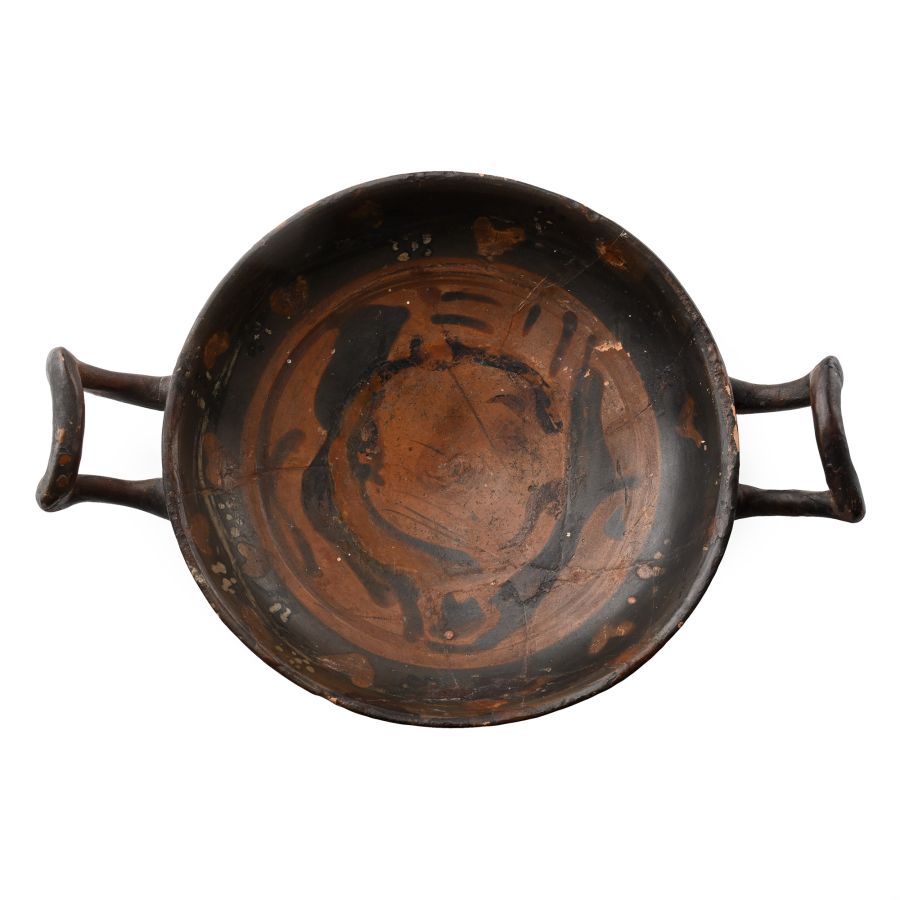
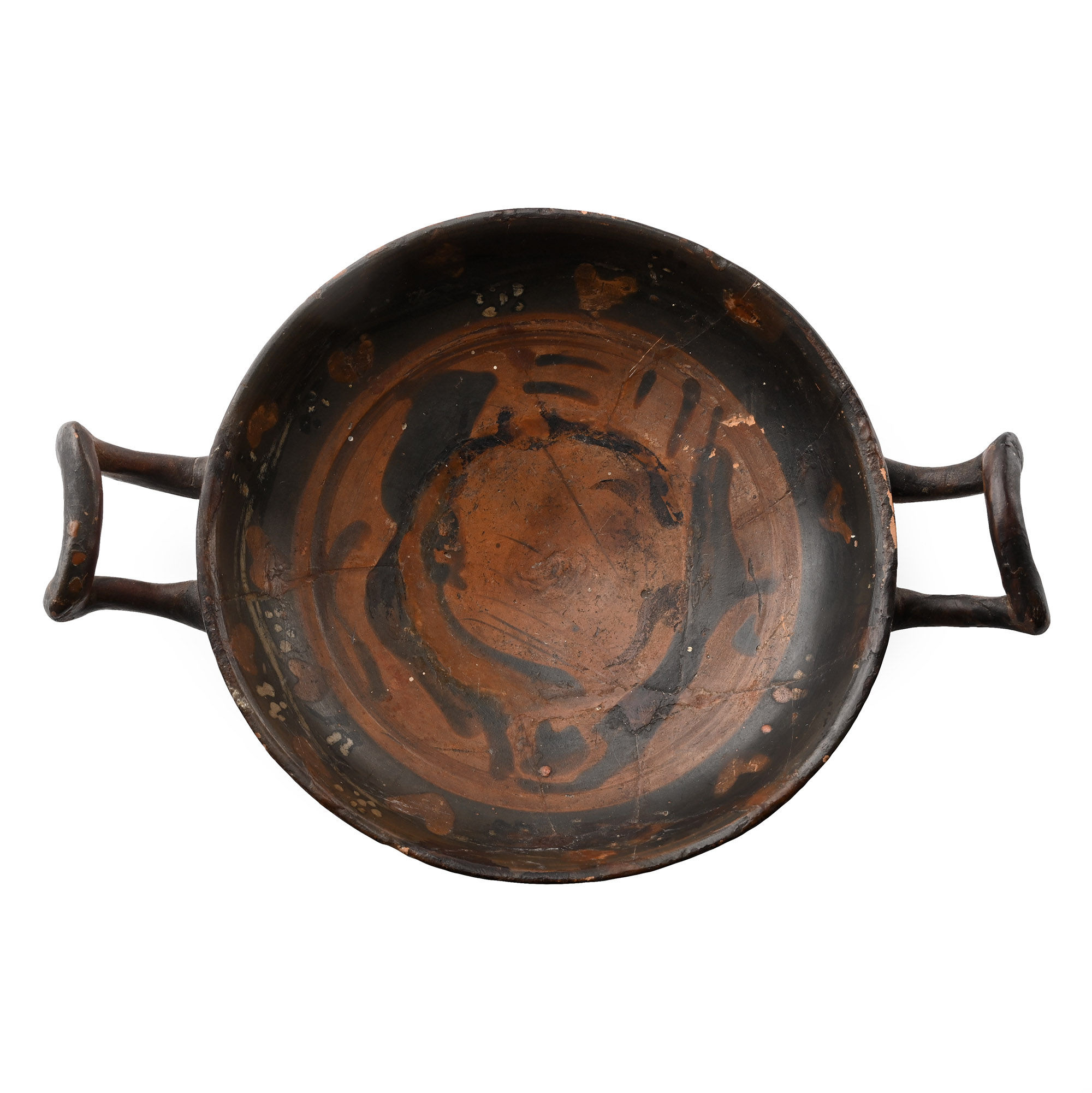
Greek Blackware Kylix
CIRCA 5TH CENTURY B.C.
8 1/2 in. (215 grams, 21.5 cm wide).
Broad and shallow with two strap handles, tondo displaying a wreath of ivy leaves with tendrils and volutes underneath; the underside of the bowl with acanthus motifs; restored.
ProvenanceAcquired on the UK art market, early 2000s.
LiteratureCf. similar kylix in the collections of the Museum of Fine Art, Budapest, inv.no.51.230.
FootnotesDrinking cups (kylikes and skyphoi), along with mixing bowls and wine coolers (kraters and psykters), wine jars (amphorae), water jars (hydrai), pitchers (oinochoai), and ladles (kyathoi), were essential equipment for drinking parties. The kylix appears to have been the most popular form of drinking cup, probably because it was especially well-suited to the Greek custom of eating and drinking while reclining on a couch. These Attic kylikes were usually presented with a stemmed base, a deep bowl and two upturned loop handles, on a concave base.
CONDITIONTimeLine Auctions follows a vetting process to ensure the authenticity and legality of all items, reinforcing our commitment to integrity and responsible trading. Each antiquity, antique, and coin lot undergoes thorough examination by a vetting committee of at least ten external specialists, professional trade association members, scientists, and archaeologists: Our Vetting Process
AUCTIONS:
TimeLine is a leading auction house specialising in antiquities, ancient art, collectables, natural history, coins, medals, and books. Our auctions offer museums, collectors, historians, and enthusiasts the opportunity to acquire unique and historically significant pieces.
-
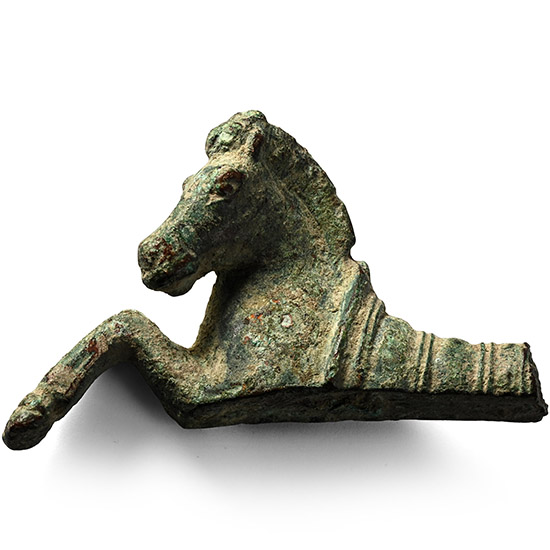
Greek Bronze Laconian Horse
5th-1st century B.C.Sold for (Inc. bp): £338
Protome formed as the upper body of a horse with forelegs bent and head turned; ribbed saddlecloth to the back; remains of attachment peg to underside. 27.8 grams, 49 mm
Acquired by a Swiss family in the mid-1980s to late 1990s, thence by descent. Private collection, Switzerland, since the late 1990s. -
.jpg)
'The Smithsonian' Greek Terracotta Horse
Italy, 3rd-1st century B.C.Sold for (Inc. bp): £6,240
Modelled in the round, horse in advancing pose with one foreleg raised, flange base; old collector's number '170439' to base; old label '170[...]' and '102' to lower body; neck repaired. 1.15 kg, 19.4 cm
Private collection of Baron d’Ussés. Acquired by F.B. Spiridon, New York, believed before 1894. Acquired by Eleanor Magruder (1852-1906), and thence by descent to her heirs in 1906. Accompanied by photographs of the object on display at the Smithsonian Institution and of the corresponding accession catalogue entry. This lot has been checked against the Interpol Database of stolen works of art and is accompanied by search certificate number no.13108-248975. -
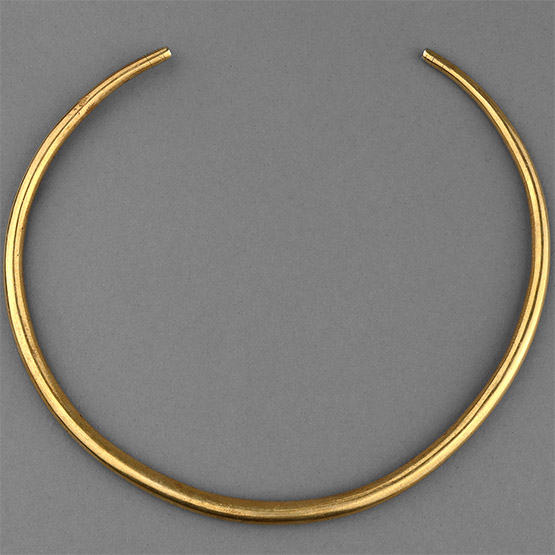
Scythian Electrum Torc
7th-5th century B.C.Sold for (Inc. bp): £14,300
Formed as a simple penannular hoop from a single piece of electrum, tapering towards the terminals. 169 grams, 16.5 cm diameter
Ex Jack Ogden, 1990s. Accompanied by an expertise from Striptwist Ltd, a London-based company run by historical precious metal specialist Dr Jack Ogden, reference number [191101]. This lot has been checked against the Interpol Database of stolen works of art and is accompanied by search certificate number no.13106-248042.
Portable X-ray fluorescence (XRF) analysis confirms the alloy to be electrum, with an average composition of approximately 62% gold, 34% silver, and 3% copper. The purity and metal ratios are consistent with ancient manufacture. The restrained form, lacking figural ornament, is characteristic of early Scythian metalwork and suggests a date prior to the 5th century BC.
