
Loading, please wait...
LOT 0078
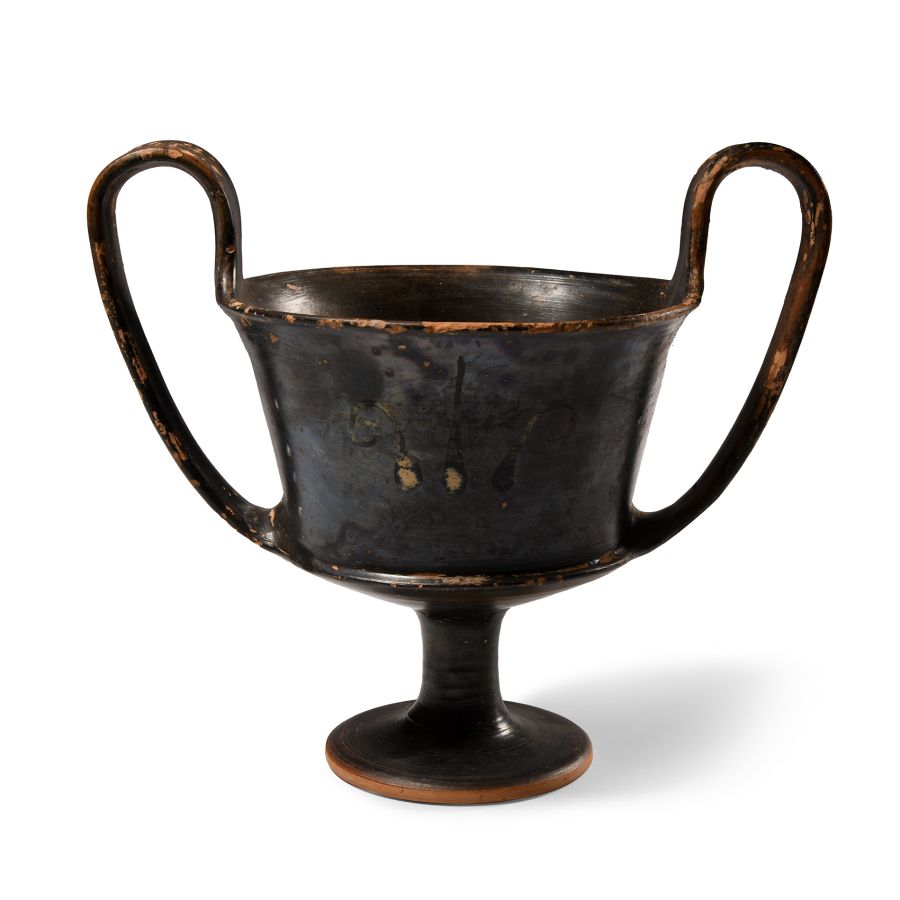
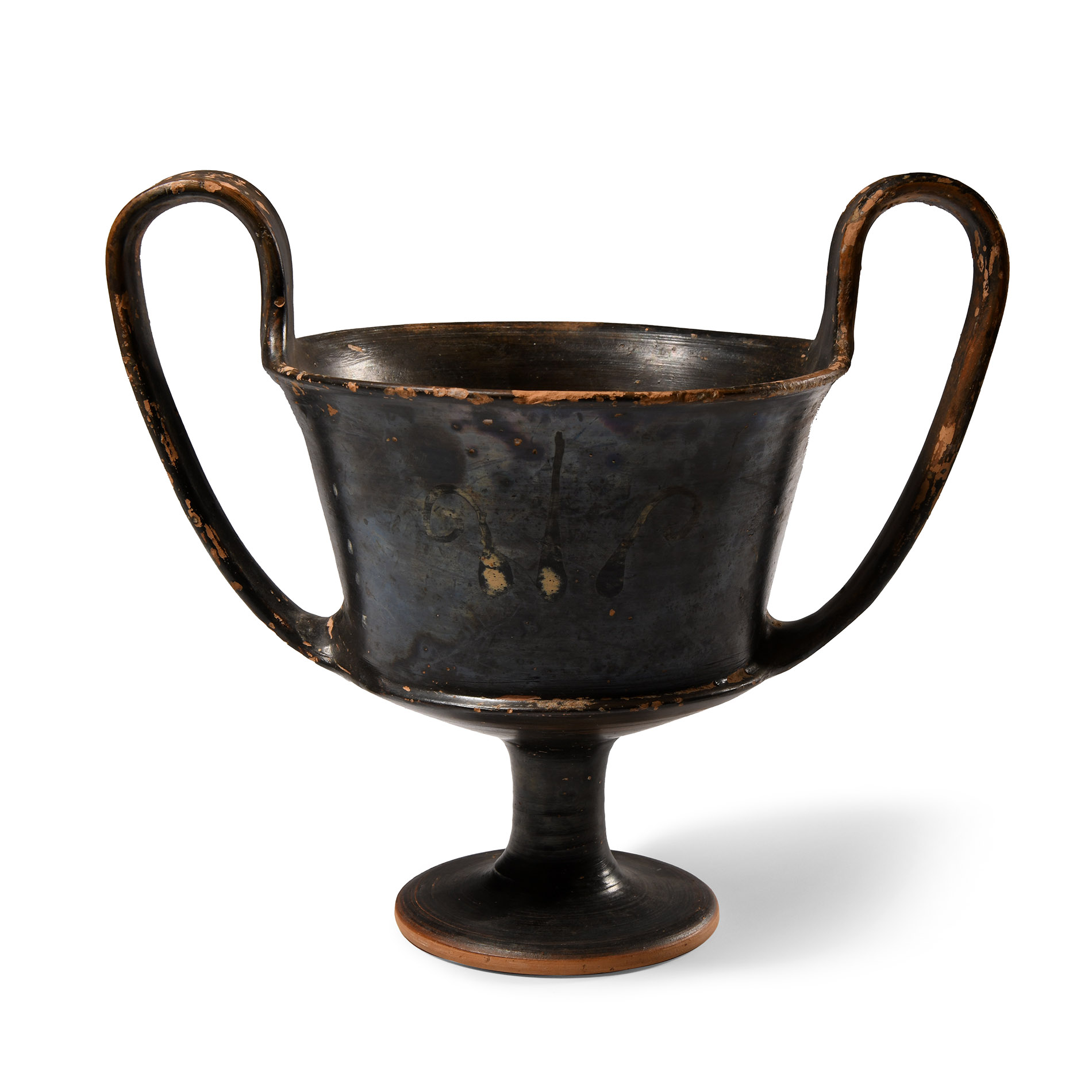
Greek Blackware Kantharos
5TH-4TH CENTURY B.C.
8 1/8 in. (381 grams, 20.5 cm wide).
With broad disc foot, drum-shaped bowl with carinated lower edge, flared rim, two ribbed strap handles rising above the rim; below on each face vine tendrils in a splayed array.
ProvenanceFrom a West Coast collection, Devon, UK, 1980s.
LiteratureCf. The Metropolitan Museum, New York, accession number 1993.197, for a similar 5th century Boeotian example.
CONDITIONTimeLine Auctions follows a vetting process to ensure the authenticity and legality of all items, reinforcing our commitment to integrity and responsible trading. Each antiquity, antique, and coin lot undergoes thorough examination by a vetting committee of at least ten external specialists, professional trade association members, scientists, and archaeologists: Our Vetting Process
AUCTIONS:
TimeLine is a leading auction house specialising in antiquities, ancient art, collectables, natural history, coins, medals, and books. Our auctions offer museums, collectors, historians, and enthusiasts the opportunity to acquire unique and historically significant pieces.
LOT 0078
Greek Blackware Kantharos
Estimate £500 - 700€580 - 810 (for guidance only)$680 - 950 (for guidance only)
-
.jpg)
Hellenistic Cut-Glass Skyphos
1st century B.C.-1st century A.D.Sold for (Inc. bp): £5,850
Drum-shaped frosted glass vessel on a low basal ring, lateral loop handles each with and angled spur below and fish-tail plaque above; 247 grams, 18 cm wide
Acquired in the 1980s. with Christopher Sheppard, London, UK. Acquired from the above in 2007. This lot has been checked against the Interpol Database of stolen works of art and is accompanied by search certificate no.11954-210906. -
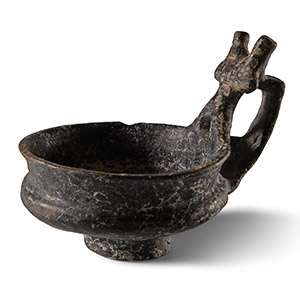
Villanovan Terracotta Kyathos with Zoomorphic Handle
Circa 7th century B.C.Sold for (Inc. bp): £312
Small impasto kyathos with carinated profile, basal ring, zoomorphic handle with spurs above. 113 grams, 10 cm wide
Belgium (Uccle) – Haynault Ventes Publiques, Collectibles Auction, 21 September 2021, lot 15. Property of a South Australian private collector, with collection reference 21.100. Accompanied by a detailed collector's catalogue page including description and photograph.
Villanovan culture is often regarded as the earliest phase of Etruscan civilisation in the Iron Age. -
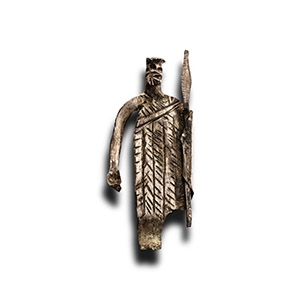
Phoenician Silver Votive Warrior Figure
6th-4th century B.C.Estimate: £400 - 600 (+bp*)
Opening Bid: £200
Sheet-silver figure with vertical banding to the cloak, one curled edge enfolding the shaft of a spear; old collector's label '4' to the reverse. 3.57 grams, 47 mm
Acquired in the late 1980s-early 1990s. Important North West London collection.
