
Loading, please wait...


LOT 0534
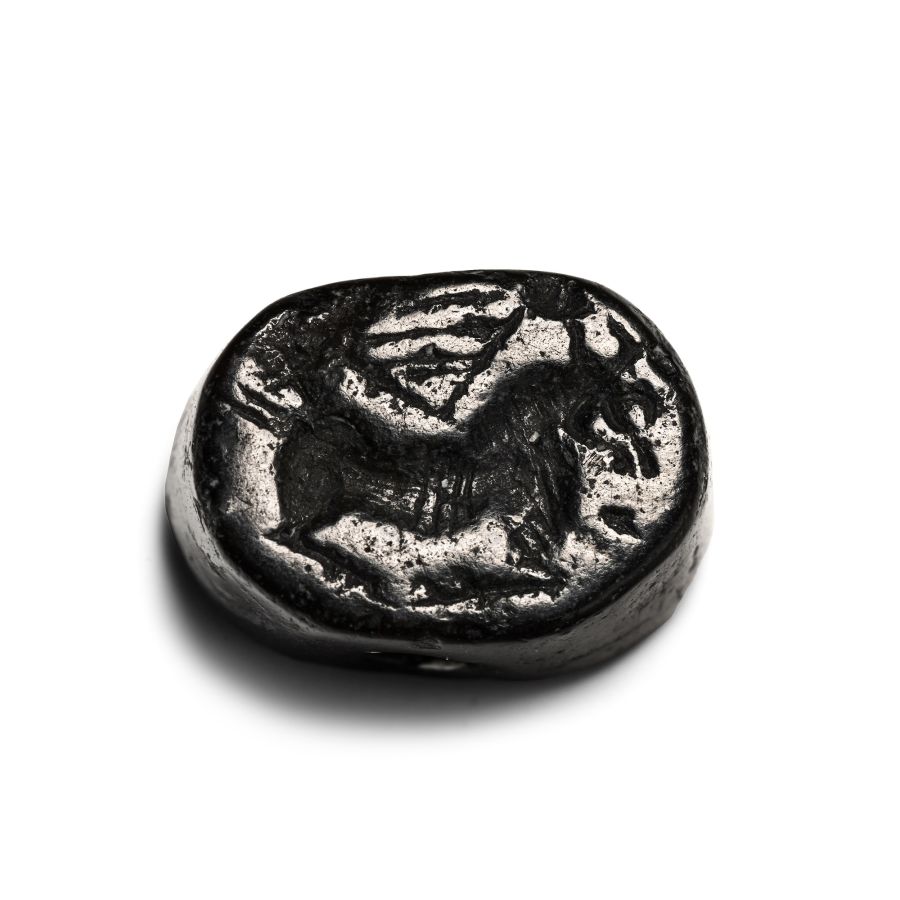
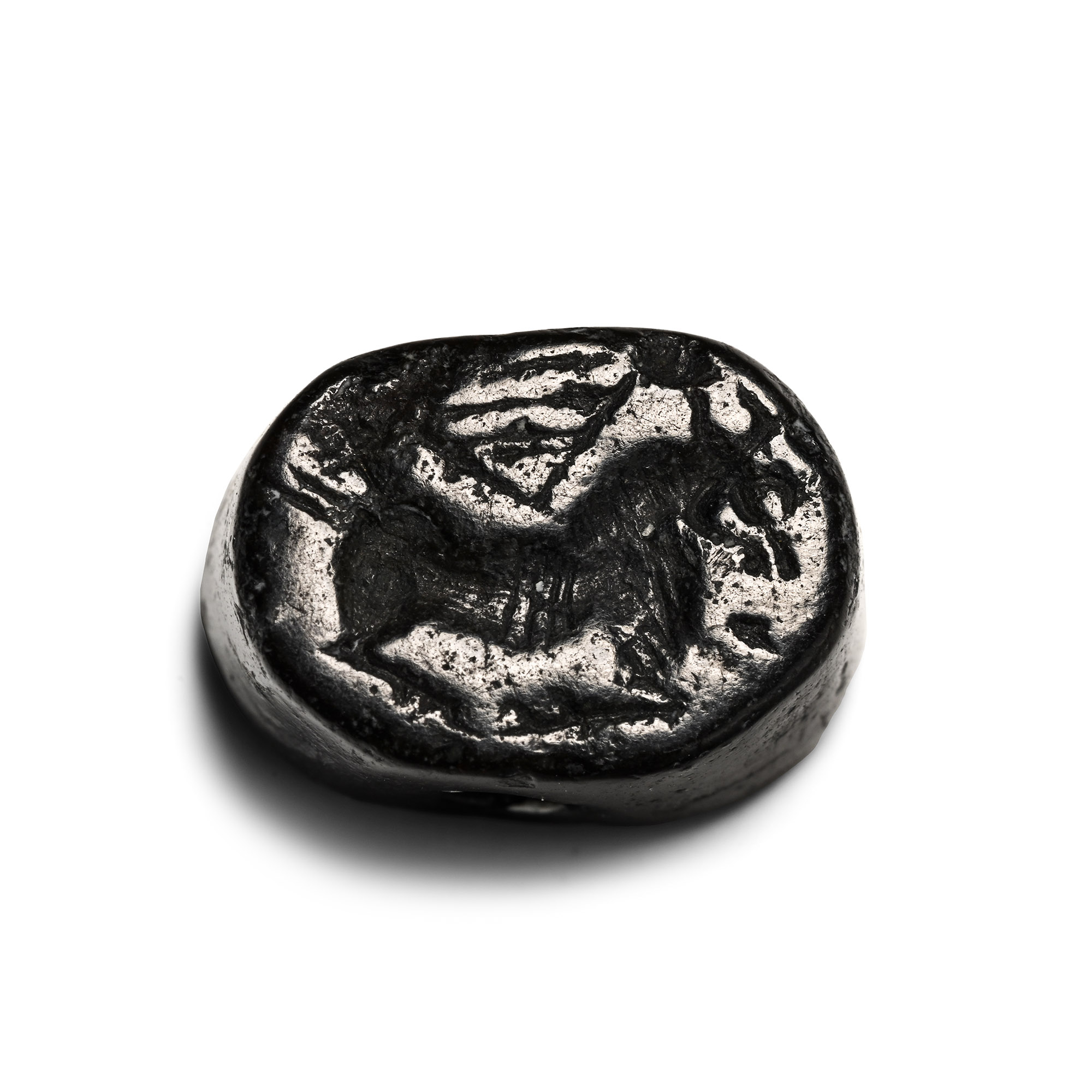
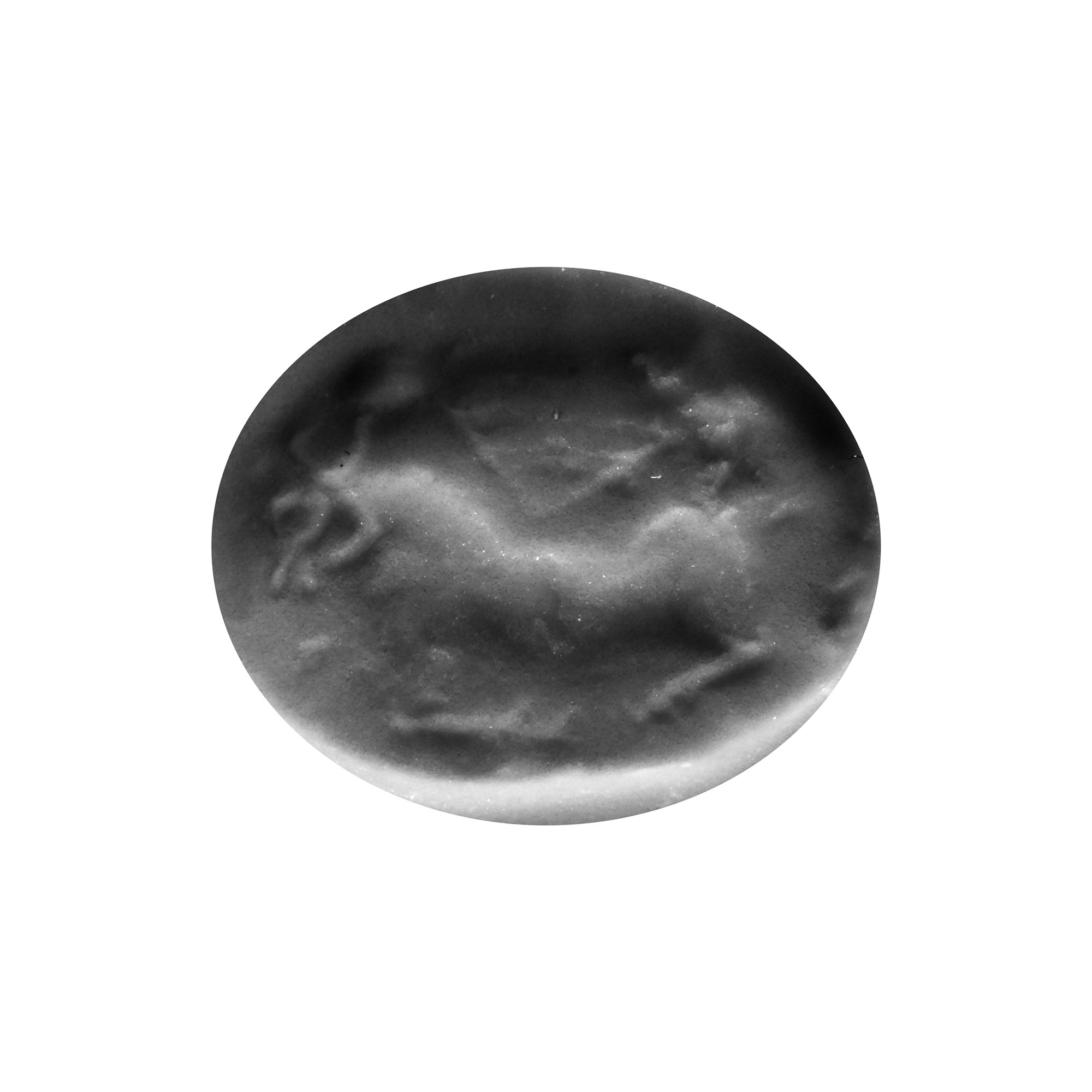
Greek Black Gemstone with Lion
4TH-2ND CENTURY B.C.
1/2 in. (1.68 grams, 13 mm).
Scaraboid type with incuse design to the underside of a bull with its legs folded beneath the body, decorative panel above; supplied with a museum-quality impression. [No Reserve]
ProvenanceFrom the private collection of a European gentleman (1942-2024), formed since the 1970s.
CONDITIONTimeLine Auctions follows a vetting process to ensure the authenticity and legality of all items, reinforcing our commitment to integrity and responsible trading. Each antiquity, antique, and coin lot undergoes thorough examination by a vetting committee of at least ten external specialists, professional trade association members, scientists, and archaeologists: Our Vetting Process
AUCTIONS:
TimeLine is a leading auction house specialising in antiquities, ancient art, collectables, natural history, coins, medals, and books. Our auctions offer museums, collectors, historians, and enthusiasts the opportunity to acquire unique and historically significant pieces.
-
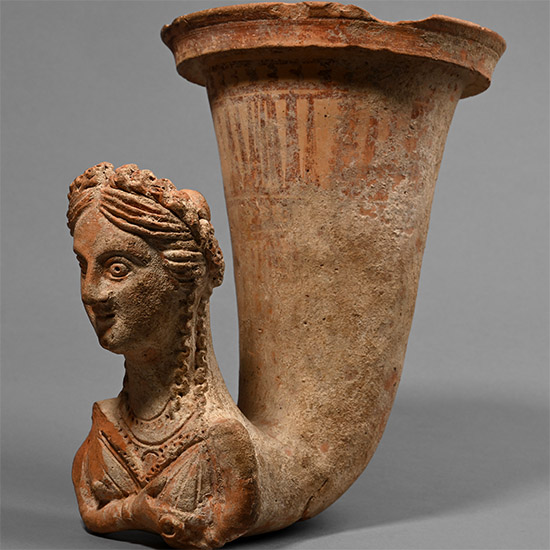
Greek Terracotta Rhyton of a Goddess
3rd-2nd century B.C.Sold for (Inc. bp): £5,720
With flanged and stepped rim, tapering curved body, figural finial of the goddess with diadem; bands of red and cream geometric detail to the rim and upper body, red wave patterns to the inner face; the goddess modelled with carefully dressed hair and floral diadem, ringlets cascading to her collar bone, alert facial expression with almond-shaped eyes and prominent nose, with C-shaped billetted collar and chiton, cupping her left breast in her right hand; mounted on a custom-made stand. 1.25 kg, 24 cm
Private collection, London, UK; formed 1970s-1980s. Accompanied by an academic report by Dr Raffaele D’Amato. This lot has been checked against the Interpol Database of stolen works of art and is accompanied by search certificate number no.13312-258233.
It is challenging to identify the divinity represented on our vessel: it can be associated with Ariadne, wife of the god Dionysus, but also with a Parthian goddess such as Anahita. She was a Zoroastrian goddess associated with water, fertility, and wisdom, widely venerated across the Parthian Empire and often invoked alongside Ahura Mazda in royal and religious inscriptions. Rhyta in her likeness, typically terminating in a zoomorphic or divine protome, were used as ceremonial drinking vessels, reflecting Anahita's close association with libation and purification rites. -
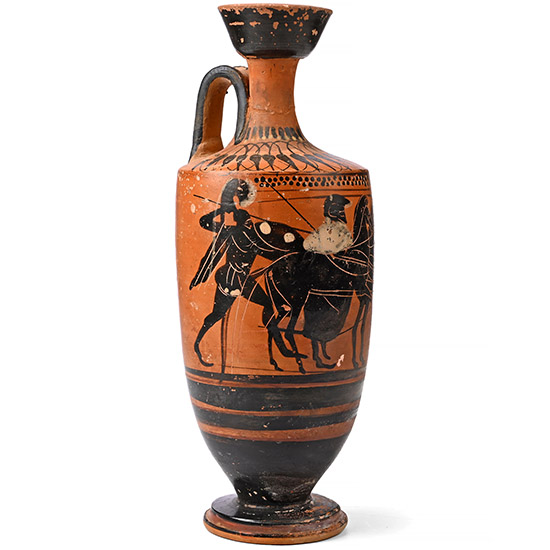
Greek Black-Figure Lekythos with Horses and Fighting Warriors
Athens, 550-500 B.C.Sold for (Inc. bp): £3,900
Cylindrical with echinus mouth and stepped torus foot, on the body a dynamic scene consisting of four rearing horses, side-by-side and wearing harnesses, nestled between the horses a standing warrior wearing a crested helmet, behind the horses an advancing warrior wearing a plumed helmet, holding a long spear in his raised hand a round shield in the other; before the horses a fleeing opponent in a running pose, facing back and holding a spear in one hand while protecting himself with a shield held in the other; long tongue motifs on the shoulder; restored. 472 grams, 23.5 cm
Ex Bonhams, Knightsbridge, London, 1990s. Private collection, Suffolk.
The scene depicts a battle between hoplites, possibly an episode from the Iliad. Originally, one or two of the combatants were positioned on a chariot; four horses from it remain visible. The scene may represent the wounding of Ares, the god of war, as he is pursued by Diomedes and accompanied by the goddess Pallas, whose helmet is emerging from behind the horses. -
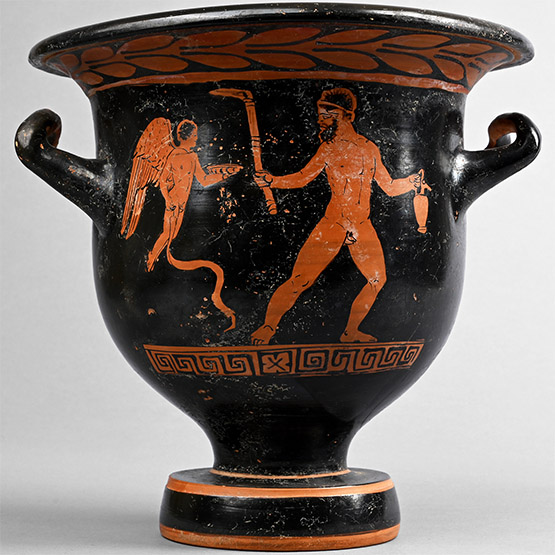
Greek Red-Figure Bell Krater with Satyr and Eros
Apulia, circa 450-400 B.C.Sold for (Inc. bp): £3,120
With laurel-leaf wreath beneath the flared rim, band of meander ornament as a baseline; Side A: striding satyr with torch and oinochoe followed by Eros holding a scroll behind; Side B: woman wearing a himation in active pose with sphere advancing towards a tendril. 814 grams, 20 cm
Acquired on the art market between the late 1990s and mid-2000s. Estate of the late Barry Paul Buxton (1944-2024), Oakham, Rutland. Acquired on the UK art market, 2025. Accompanied by an academic report by Dr Raffaele D'Amato. This lot has been checked against the Interpol Database of stolen works of art and is accompanied by search certificate no.13070-249284.
Often, the iconography of an 'elevated' mythological subject was applied to members of Dionysos' retinue. Here we have three typical examples of them: a satyr, an Eros, and a woman, all three behaving according to Bacchic ecstasies.
