
Loading, please wait...
LOT 0092
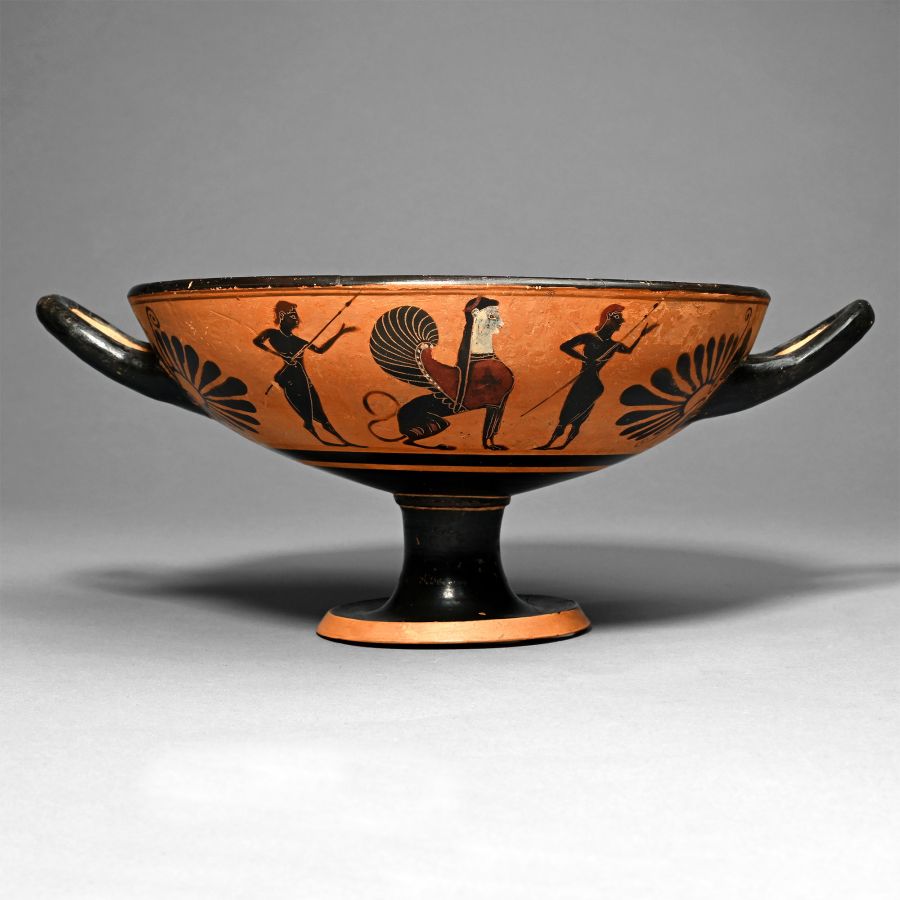
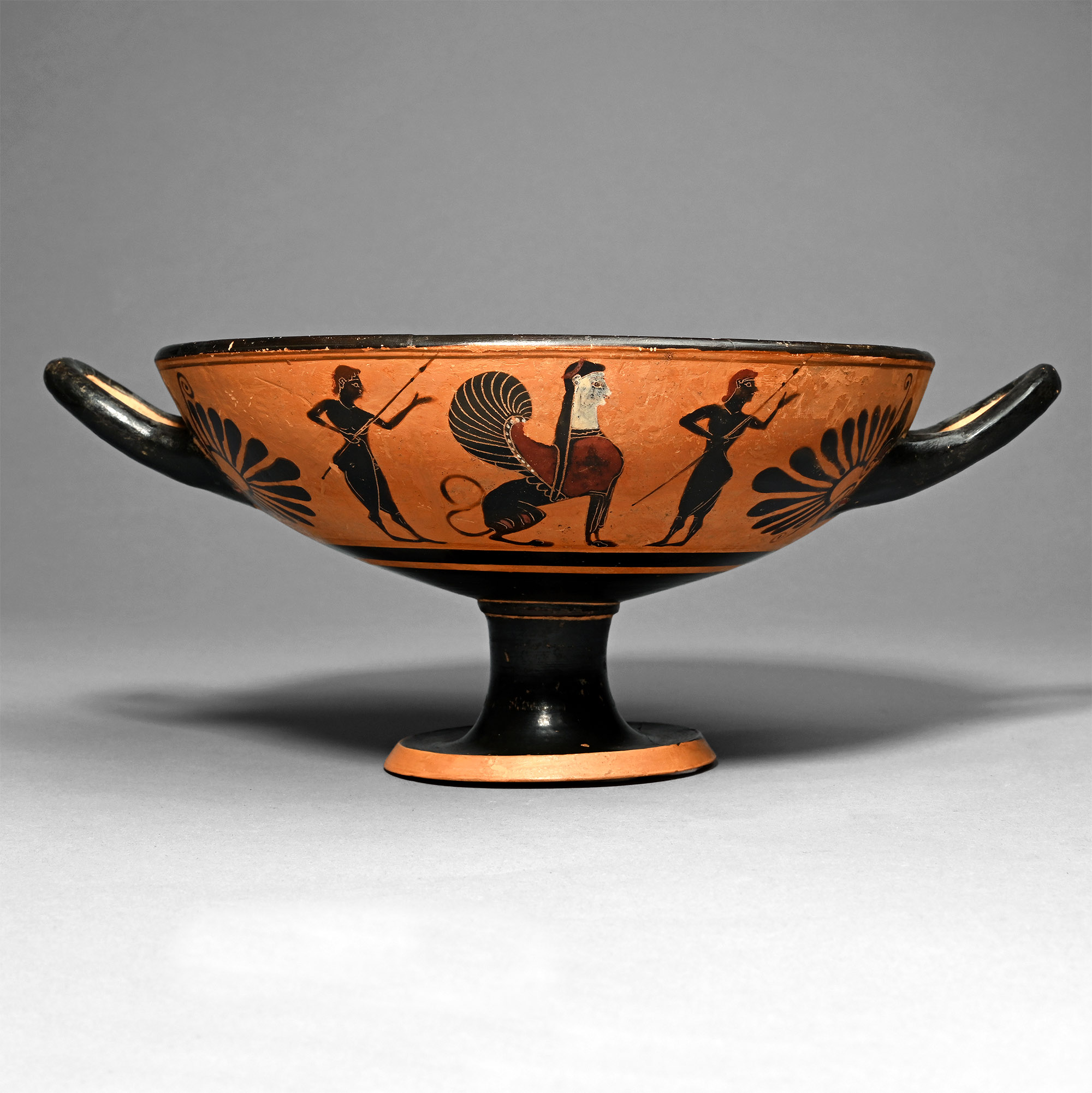
Greek Black-Figure Kylix with Warriors and Sphinxes
ATTIC, CIRCA 530 B.C.
10 3/4 in. (414 grams, 27.3 cm wide).
Comprising: a broad shallow bowl with two loop handles curving up towards the rim, short stem and broad foot with chamfered outer edge; the bowl with reserved central disc to inner face, palmette motifs at the junctions of the handles, frieze depicting two standing nude males flanking a crouching sphinx in profile; restored and with old dealer's labels beneath base.
ProvenanceEx Prof. F.S., Villingen-Schwenningen, Germany, 1991.
with Gallery Drees Archeo S.P.R.L., Brussels.
Acquired from the above, 16 December 2017.
Accompanied by a copy of an Art Loss Register certificate, no.S00041086.
Accompanied by a Gallery Drees Archeo certificate of authenticity.
Accompanied by a thermoluminescence report no.0102 0910 from Laboratory Ralf Kotalla, 6 September 2010.
This lot has been checked against the Interpol Database of stolen works of art and is accompanied by search certificate number no.12945-246388.
For similar examples of kylikes with black-attic figures see the British Museum, London, 1836,0224.65 (Gorgoneion and hippalectryon), 1864,1007.1701 (Hermes and Dionysos); compare with 1864,1007.1688 (Heracles and the Erymanthian boar), 1864,1007.296 (satyrs and dolphin); Athens, Museum of Cycladic Art ΝΓ0702 (‘eyes’ kylix); New York, Metropolitan Museum of Art 44.11.1 (Menelaos and Helen), 56.171.36 (‘eyes’ kylix with ships and warriors), 96.18.64 (‘eyes’ kylix), 98.8.25 ((‘eyes’ kylix with satyrs), 96.18.65 (‘eyes’ kylix); Los Angeles, J. Paul Getty Museum 96.AE.96 (fish market); Brooklyn, Brooklyn Museum 33.399 (procession of men).
FootnotesThe present piece is a wide-bowled drinking cup known as a kylix - one of the most popular forms of pottery from the Achaean times (1600-1100 B.C.) through to the classical period (c.510-323 B.C.). It dates to an important moment in the development of Greek ceramics, just as the black-figure technique was being perfected by Athenian painters. Painted in black slip with details incised on top, kylikes usually had a frieze around the outside of the bowl as well as another scene on the tondo of the inside. The scene here represented can be linked with the well-known episode of Oedipus and the Sphinx.
CONDITIONTimeLine Auctions follows a vetting process to ensure the authenticity and legality of all items, reinforcing our commitment to integrity and responsible trading. Each antiquity, antique, and coin lot undergoes thorough examination by a vetting committee of at least ten external specialists, professional trade association members, scientists, and archaeologists: Our Vetting Process
AUCTIONS:
TimeLine is a leading auction house specialising in antiquities, ancient art, collectables, natural history, coins, medals, and books. Our auctions offer museums, collectors, historians, and enthusiasts the opportunity to acquire unique and historically significant pieces.
-
Greek Bronze Child's Ring
Circa 4th-2nd century B.C.Sold for (Inc. bp): £33
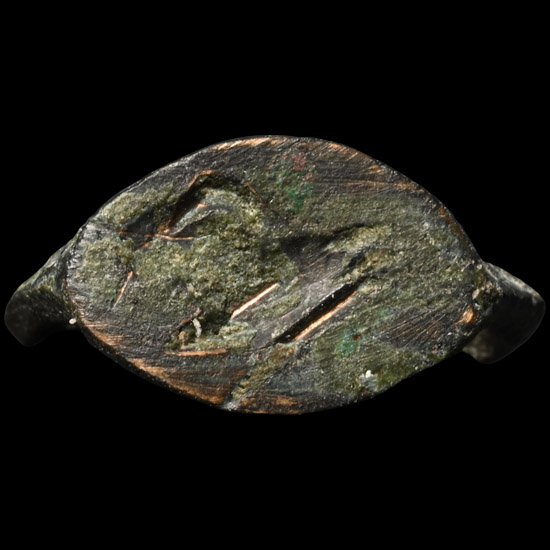
Featuring a slender round-section hoop and a lentoid bezel with a reclining ibex. 0.82 grams, 13.19 mm overall, 10.53 mm internal diameter
From the private collection of a European gentleman (1942-2024), formed since the 1970s. -
.jpg)
Large Phoenician Terracotta Head of a Man
Levant, circa 4th century B.C.Sold for (Inc. bp): £4,680
Hollow-formed moulded head with conical cap, band above the brow with curls beneath, high-relief eyebrows and triangular nose, scaphoid protrusive eyes, tiny pursed mouth; collar to the neck with frontal pendant; ellipsoid vent to rear, flared rim to mouth; some loss to lateral edges at ear-level. 1.73 kg, 27.5 cm
with Phillips, London, 6 July 1993, no.127 (part). Private collection, London, UK. Acquired in London, UK, 2006. Accompanied by copies of the original Phillips and 2006 invoices. This lot has been checked against the Interpol Database of stolen works of art and is accompanied by search certificate number no.13281-254405. -
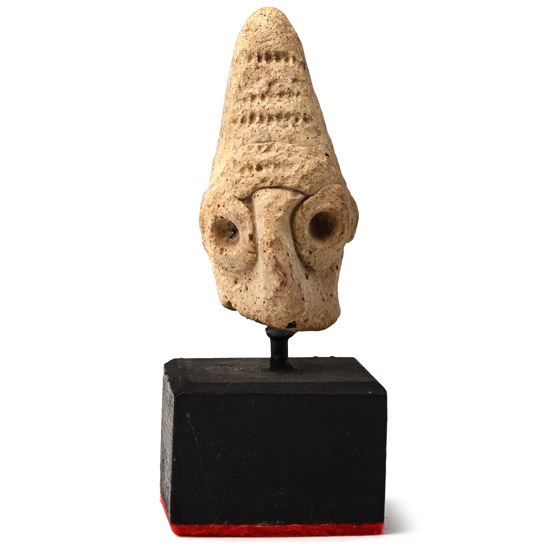
Greek Terracotta Idol Head
Mediterranean, circa 700 B.C.Sold for (Inc. bp): £85
Stylised head with large annular eyes and pinched nose, conical headdress with horizontal striations. 17 grams total, 38 mm (60 mm including stand)
Acquired from Ancient Art, London, UK. From the collection of a Nottingham, UK, collector, established from the early 2000s.
