
Loading, please wait...
LOT 0070
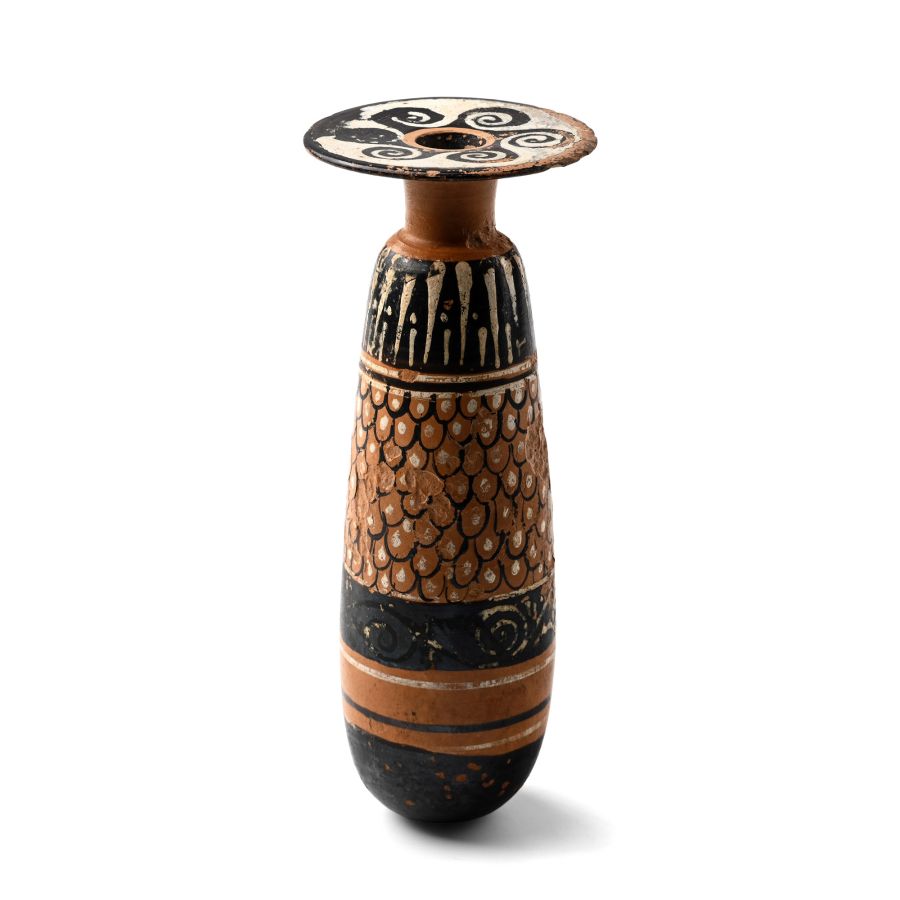
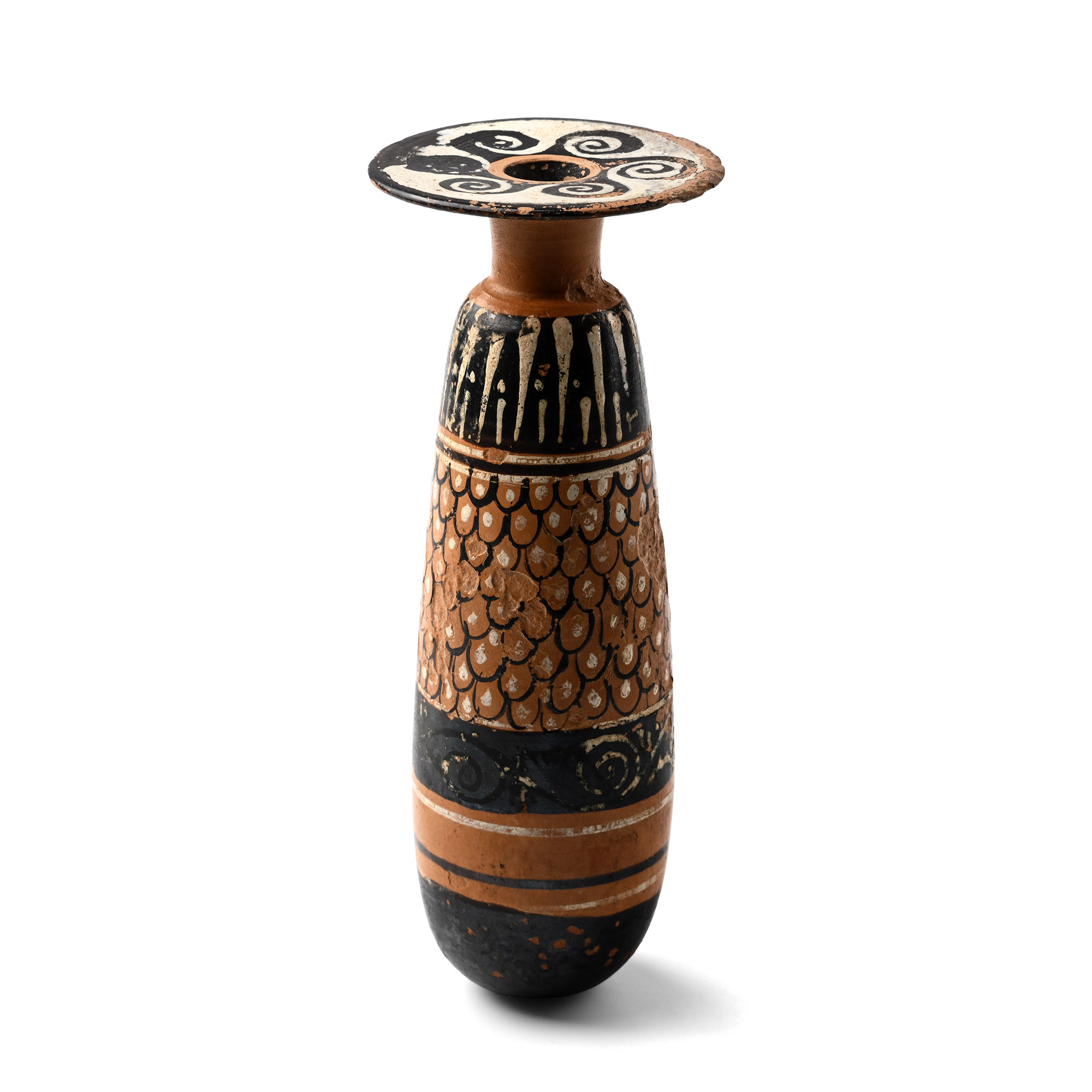
Greek Black-Figure Alabastron with Fish Scale Pattern, Possibly Attributed to the Bulas Group
ATTIC, EARLY 4TH CENTURY B.C.
5 1/8 in. (87 grams, 13 cm).
Ovoid shape with short neck and expanded flat rim; painted with horizontal bands with vertical strokes on the shoulder, fish-scale pattern below and running scrolled tendrils; horizontal stripes below.
ProvenanceCollection of M. Bouvier, Switzerland (1901-1980), Switzerland. Bouvier was a law professor in Alexandria prior to 1930.
with Christie's, London, 7 October 2010, no.117.
Private collection, 2010.
Accompanied by an original thermoluminescence analysis report no.N125q42 by Oxford Authentication.
Accompanied by copies of the Christie's catalogue pages.
Accompanied by an academic report by Dr Raffaele D’Amato.
This lot has been checked against the Interpol Database of stolen works of art and is accompanied by a search certificate number no.13008-246447.
Cf. similar alabastron in the Metropolitan Museum of Art, New York, accession no. 06.1021.89; Algrain, I., Brisart, T., Jubier-Galinier, C., Parfums de l’Antiquité, La rose et l’encens en Méditerranée, Manemont, 2008; Algrain, I., L’alabastre Attique, Origine, Forme et usages, Bruxelles, 2014, pp.145ff.; Algrain, I., ‘Assessing Forming Techniques of Athenian Ceramic Alabastra’ in EXARC Journal, 21/3, 2021, pp.1-10.
FootnotesThe alabastra of the Bulas Group display scale-like patterns. They were painted with slip, a liquid clay which vitrifies when fired. This group is usually dated to the late 5th – early 4th century B.C. It was named after Kazimierz Bulas, who was the first to study them in depth in the 1930s. He characterised various shapes according to their decorative techniques (nets and floral patterns) and their functions.
CONDITIONTimeLine Auctions follows a vetting process to ensure the authenticity and legality of all items, reinforcing our commitment to integrity and responsible trading. Each antiquity, antique, and coin lot undergoes thorough examination by a vetting committee of at least ten external specialists, professional trade association members, scientists, and archaeologists: Our Vetting Process
AUCTIONS:
TimeLine is a leading auction house specialising in antiquities, ancient art, collectables, natural history, coins, medals, and books. Our auctions offer museums, collectors, historians, and enthusiasts the opportunity to acquire unique and historically significant pieces.
LOT 0070
Greek Black-Figure Alabastron with Fish Scale Pattern, Possibly Attributed to the Bulas Group
Sold for (Inc. bp): £2,340
-
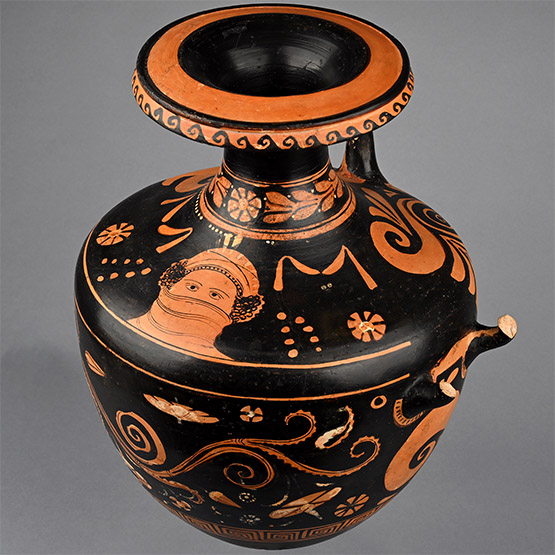
Greek Fragmentary Terracotta Red-Figure Hydria
Paestan or Apulian, 4th century B.C.Estimate: £4,500 - 6,500 (‡+bp*)
Opening Bid: £2,500
Comprising the upper two thirds of the vessel; on the shoulder a facing woman's head with diadem and half-veiled face; rosettes to left and right, with suspended ribbons and dots; vine motif around the body with floral ornaments; to the reverse, palmettes and vines; band of laurel with rosettes around the neck and wavy band at the mouth; reassembled from various fragments with three large areas of restoration, only the beginnings of the handles preserved; mounted on a custom-made stand. 1.95 kg, 31 cm (2.6 kg total, 47.5 cm high including stand)
Ex Herbert A. Cahn, Basel, 1990s. This lot has been checked against the Interpol Database of stolen works of art and is accompanied by search certificate number no.12475-228738.
The face-veiling gesture is a known marriage rite; the diadem may suggest that she is intended to represent Persephone. Alternatively, the veiled woman might be a dancer as many terracotta figurines of dancing women are shown with face-coverings. However, the floral ornaments could indicate a funeral or sepulchral context. -
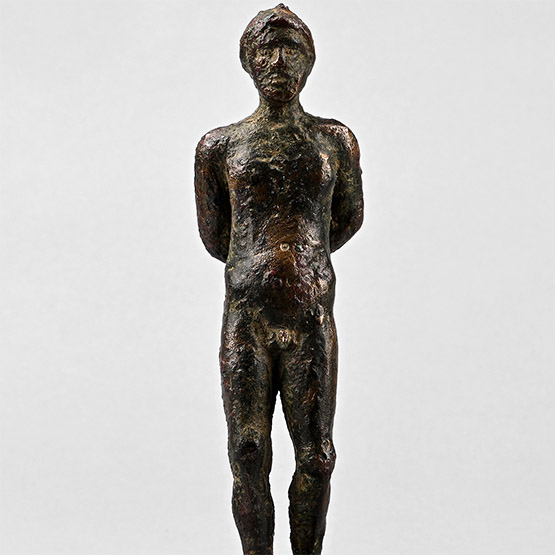
Greek Bronze Figure of a Bound Captive
Hellenistic, 2nd century B.C.Estimate: £3,000 - 4,000 (‡+bp*)
Opening Bid: £1,667
Modelled in the round nude male standing with hands bound behind his back; with short cropped hair and slender figure; left foot absent; mounted on a custom-made stand. 491 grams, 17 cm including stand
Ex S.K. collection. Acquired on the German art market, July 1995. Accompanied by an academic report by Dr Raffaele D'Amato. This lot has been checked against the Interpol Database of stolen works of art and is accompanied by a search certificate number no.12518-232076.
The character's hairstyle of the statuette is simple, and his hair is short, not treated with chalk like that of the famous ‘dying Galatian’ from Pergamon. The gaze is fixed in the distance, while the bony, beardless and long-limbed figure expresses the prisoner's energy. The nose here takes on a strong characteristic together with the broad jaw, which is also recognizable in later statuettes of Roman age. These characteristics, combined with those of nudity, allow us to recognize the figure of the prisoner as a Celtic warrior. warrior. -
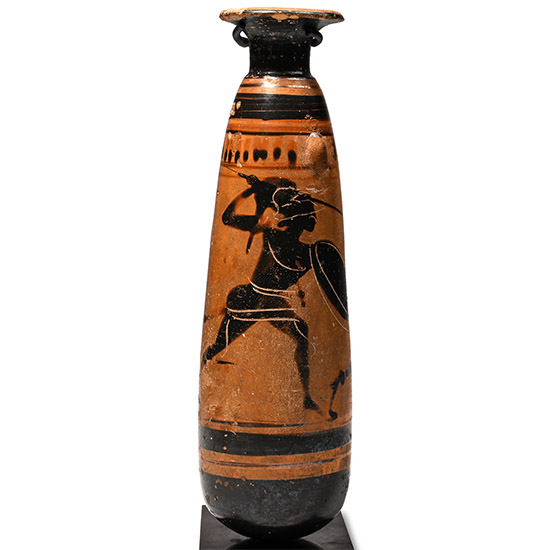
Greek Black-Figure Alabastron with Fighting Warriors
Attic, 500-480 B.C.Estimate: £30,000 - 40,000 (‡+bp*)
Opening Bid: £15,000
Of ovoid shape, short neck and expanded flat rim; painted in horizontal bands with black vertical strokes the shoulder, ovules in the upper part, the central scene representing a Greek Ekdromos fighting a Scythian archer; the Greek warrior, wearing a light sleeveless chiton, and a crested Corinthian helmet, carrying a wide hoplon shield, and a long spear with which he is slashing his opponent; the Scythian archer is wearing a typical tall cap flowing backwards and his long coat-suit, carrying a gorytos, (quiver) and composite bow with arrow; horizontal black stripes below; accompanied by a custom-made display stand. 262 grams total, 16 cm high including stand
Louis-Gabriel Bellon (1819-1899) collection, France. European private collection, 2009. Accompanied by an academic report by Dr Raffaele D’Amato. This lot has been checked against the Interpol Database of stolen works of art and is accompanied by a search certificate number no.13019-246753.
The importance of this alabastron is linked to its iconography, which represents episodes of the Persian Wars, fought 490-480 B.C. Such alabastra are part of a series realised during the period of the conflict and after, and they are an important source of information on the Persian and Greek armies. Here, the two opponents evoke the Greek victories, with a light-armed Greek ekdromos (hoplite fighting in light equipment) killing a Scythian archer, who formed part of the Persian army. The representation of Scythian costume in vase-painting reached its height of popularity between c. 530 and 490 B.C., and went out of fashion after the Graeco-Persian wars, when these clothes began to be associated with the Persian ethnic identity rather than the original Scythian.
