
Loading, please wait...
_900x900.jpg "Greek Black-Figure Alabastron with Fighting Warriors")
_200x200.jpg "Greek Black-Figure Alabastron with Fighting Warriors")
_900x900.jpg "Greek Black-Figure Alabastron with Fighting Warriors")
_200x200.jpg "Greek Black-Figure Alabastron with Fighting Warriors")
_900x900.jpg "Greek Black-Figure Alabastron with Fighting Warriors")
_200x200.jpg "Greek Black-Figure Alabastron with Fighting Warriors")
.jpg "Greek Black-Figure Alabastron with Fighting Warriors")
.jpg "Greek Black-Figure Alabastron with Fighting Warriors")
.jpg "Greek Black-Figure Alabastron with Fighting Warriors")
LOT 0071
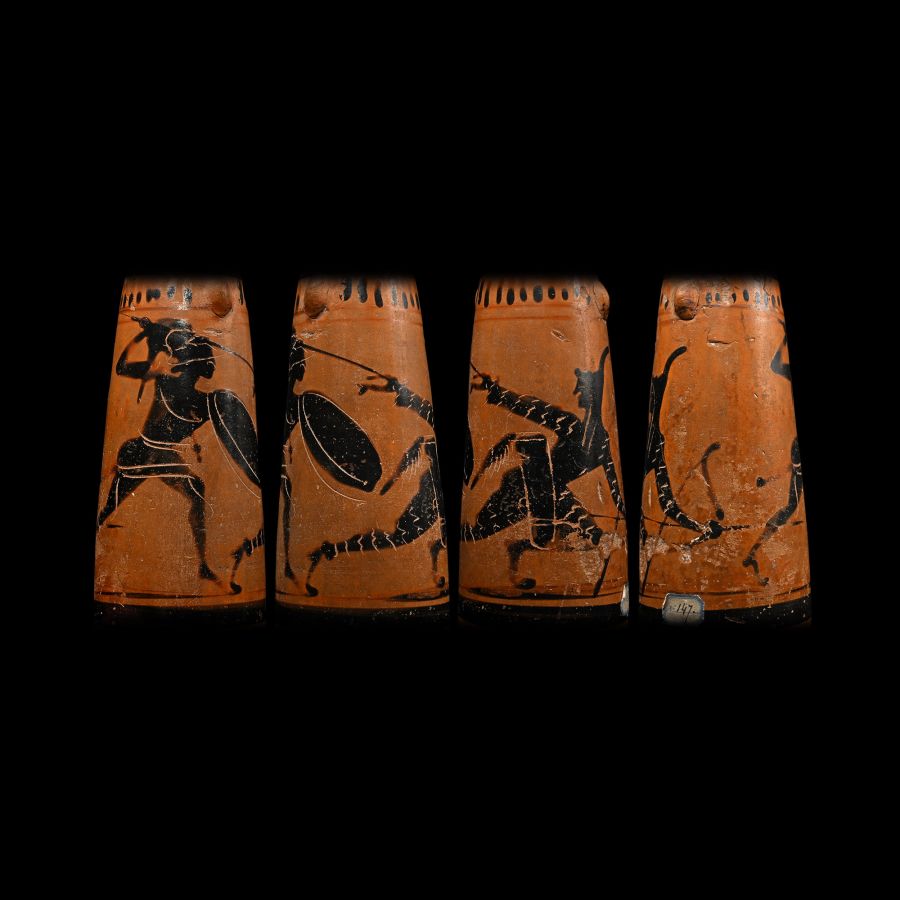
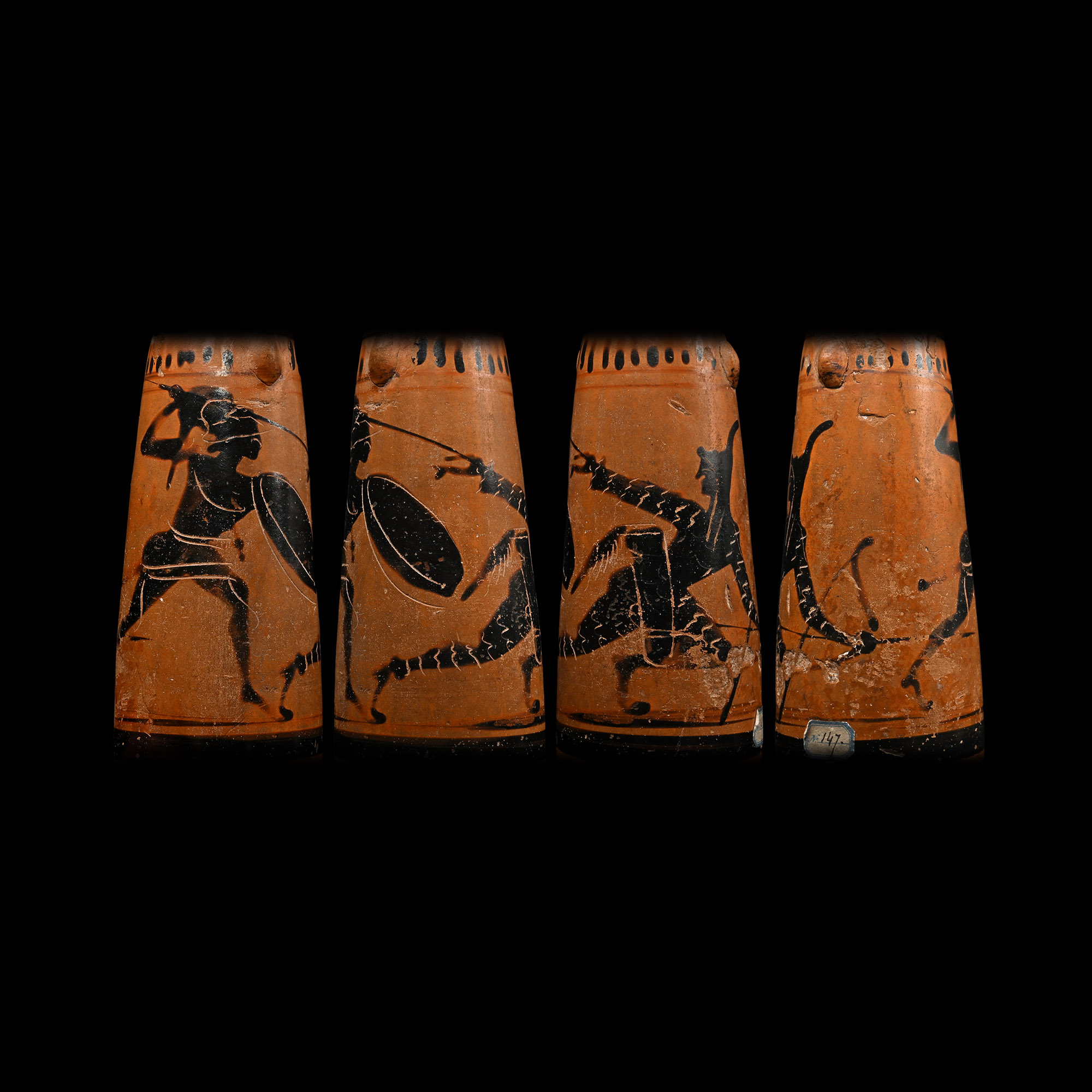
Greek Black-Figure Alabastron with Fighting Warriors
ATTIC, 500-480 B.C.
6 1/4 in. (262 grams total, 16 cm high including stand).
Of ovoid shape, short neck and expanded flat rim; painted in horizontal bands with black vertical strokes the shoulder, ovules in the upper part, the central scene representing a Greek Ekdromos fighting a Scythian archer; the Greek warrior, wearing a light sleeveless chiton, and a crested Corinthian helmet, carrying a wide hoplon shield, and a long spear with which he is slashing his opponent; the Scythian archer is wearing a typical tall cap flowing backwards and his long coat-suit, carrying a gorytos, (quiver) and composite bow with arrow; horizontal black stripes below; accompanied by a custom-made display stand.
ProvenanceLouis-Gabriel Bellon (1819-1899) collection, France.
European private collection, 2009.
Accompanied by an academic report by Dr Raffaele D’Amato.
This lot has been checked against the Interpol Database of stolen works of art and is accompanied by a search certificate number no.13019-246753.
Cf. for similar images Ivantchik, A.I., ‘’Scythian’ Archers on Archaic Attic vases: problems of interpretation’ in Ancient Civilizations from Scythians to Siberia, 12,3-4, Leiden, 2006, figs.nos.5,8; for the Greek and Scythian military costume Sekunda, N., The Ancient Greeks, London, 1986, pp.13-15; Head, D., The Achaemenid Persian Army,Stockport, 1992, figs.12,21, from similar alabastra; Sekunda, N., The Athenian Army 507-322 BC, Oxford, 2025, fig.p.20.
FootnotesThe importance of this alabastron is linked to its iconography, which represents episodes of the Persian Wars, fought 490-480 B.C. Such alabastra are part of a series realised during the period of the conflict and after, and they are an important source of information on the Persian and Greek armies. Here, the two opponents evoke the Greek victories, with a light-armed Greek ekdromos (hoplite fighting in light equipment) killing a Scythian archer, who formed part of the Persian army. The representation of Scythian costume in vase-painting reached its height of popularity between c. 530 and 490 B.C., and went out of fashion after the Graeco-Persian wars, when these clothes began to be associated with the Persian ethnic identity rather than the original Scythian.
CONDITIONTimeLine Auctions follows a vetting process to ensure the authenticity and legality of all items, reinforcing our commitment to integrity and responsible trading. Each antiquity, antique, and coin lot undergoes thorough examination by a vetting committee of at least ten external specialists, professional trade association members, scientists, and archaeologists: Our Vetting Process
AUCTIONS:
TimeLine is a leading auction house specialising in antiquities, ancient art, collectables, natural history, coins, medals, and books. Our auctions offer museums, collectors, historians, and enthusiasts the opportunity to acquire unique and historically significant pieces.
LOT 0071
Greek Black-Figure Alabastron with Fighting Warriors
Estimate £30,000 - 40,000€34,800 - 46,400 (for guidance only)$40,500 - 54,000 (for guidance only)
-
.jpg)
Parthian Terracotta Horse-Head Finial
2nd-3rd century A.D.Sold for (Inc. bp): £247
A hollow-formed horse-head finial with ribbed mane to the arched neck, elaborate bridle strap detail. 62 grams, 79.5 mm
Fine condition.
From an important central London collection formed since the mid 1960s; thence by descent. From the private collection of John Meredith, acquired since the 1990s; thence by descent. -
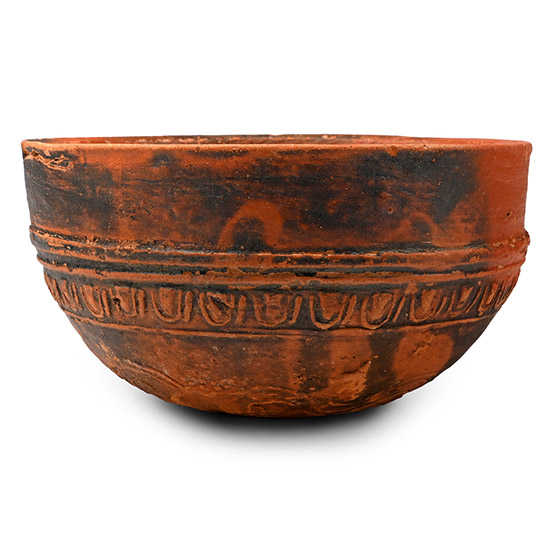
Greek Megarian Bowl
2nd century B.C.Sold for (Inc. bp): £386
Hemispherical in profile with slightly everted rim and a matt glaze, raised architectural motifs to the shoulder, dense stylised vines below; shallow rosette foot. 208 grams, 13.5 cm
From the collection of a gentleman, acquired on the London art market in the 1990s. -
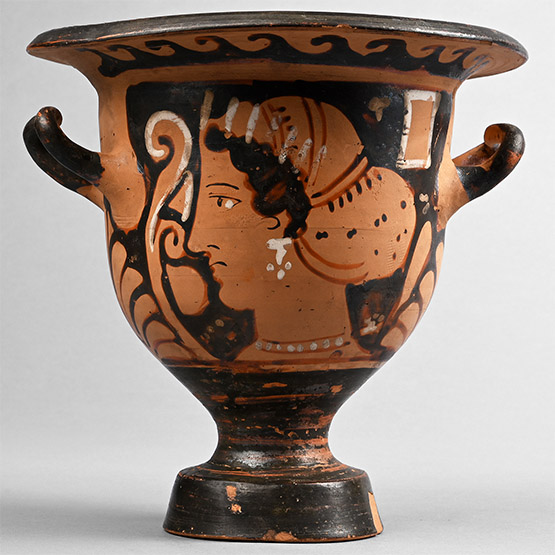
Greek Red-Figure Bell Krater
Campanian, 340-325 B.C.Estimate: £3,000 - 4,000 (+bp*)
Opening Bid: £1,500
With notable added white details; Side A: woman moving to her right while holding a cista, dressed in a chiton clinched at the waist, with a himation draped over her left arm, her hair adorned with a sakkos; Side B: profile head of a woman wearing a patterned sakkos and radiated stephane, intricate earrings and necklace of beads, objects in the field; beneath the handles, palmettes with floral elements. 585 grams, 18 cm high
Ex Rev. & Mrs T.S. Hichens, Cornwall with Charles Ede, 1981 (Stock No.8370). Ex Mrs B. Shankes, November 1986. This lot has been checked against the Interpol Database of stolen works of art and is accompanied by search certificate no.13068-248976.
Bell kraters were commonly used in regions of ancient Italy for mixing and serving wine during communal gatherings, thanks to their wide shape and flared mouth. These vessels also served as artistic expressions, reflecting the cultural tastes of the time. The Chevron Group is the conventional name for a group of ancient Apulian red-figure vase painters who were active in Southern Italy between approximately 335-310 BC. They are named for their distinctive use of a band of chevron patterns to encircle the rims of the small kraters (mixing vessels) they decorated.
