
Loading, please wait...
_900x900.jpg "Greek Attic Red-Figure Kylix Fragment of a Hand")
_200x200.jpg "Greek Attic Red-Figure Kylix Fragment of a Hand")
_900x900.jpg "Greek Attic Red-Figure Kylix Fragment of a Hand")
_200x200.jpg "Greek Attic Red-Figure Kylix Fragment of a Hand")
.jpg "Greek Attic Red-Figure Kylix Fragment of a Hand")
.jpg "Greek Attic Red-Figure Kylix Fragment of a Hand")
LOT 0575
Greek Attic Red-Figure Kylix Fragment of a Hand
EARLY 5TH CENTURY B.C.
2 in. (10.63 grams, 52 mm).
Irregular fragment framed by a meander on one side and finely painted hand; reverse depicting foot and part of the chiton of a standing figure.
ProvenancePrivate collection, Europe.
CONDITIONTimeLine Auctions follows a vetting process to ensure the authenticity and legality of all items, reinforcing our commitment to integrity and responsible trading. Each antiquity, antique, and coin lot undergoes thorough examination by a vetting committee of at least ten external specialists, professional trade association members, scientists, and archaeologists: Our Vetting Process
AUCTIONS:
TimeLine is a leading auction house specialising in antiquities, ancient art, collectables, natural history, coins, medals, and books. Our auctions offer museums, collectors, historians, and enthusiasts the opportunity to acquire unique and historically significant pieces.
-
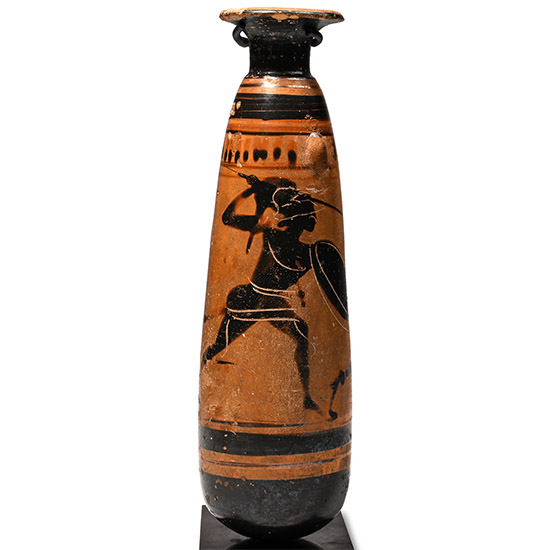
Greek Black-Figure Alabastron with Fighting Warriors
Attic, 500-480 B.C.Estimate: £30,000 - 40,000 (‡+bp*)
Opening Bid: £15,000
Of ovoid shape, short neck and expanded flat rim; painted in horizontal bands with black vertical strokes the shoulder, ovules in the upper part, the central scene representing a Greek Ekdromos fighting a Scythian archer; the Greek warrior, wearing a light sleeveless chiton, and a crested Corinthian helmet, carrying a wide hoplon shield, and a long spear with which he is slashing his opponent; the Scythian archer is wearing a typical tall cap flowing backwards and his long coat-suit, carrying a gorytos, (quiver) and composite bow with arrow; horizontal black stripes below; accompanied by a custom-made display stand. 262 grams total, 16 cm high including stand
Louis-Gabriel Bellon (1819-1899) collection, France. European private collection, 2009. Accompanied by an academic report by Dr Raffaele D’Amato. This lot has been checked against the Interpol Database of stolen works of art and is accompanied by a search certificate number no.13019-246753.
The importance of this alabastron is linked to its iconography, which represents episodes of the Persian Wars, fought 490-480 B.C. Such alabastra are part of a series realised during the period of the conflict and after, and they are an important source of information on the Persian and Greek armies. Here, the two opponents evoke the Greek victories, with a light-armed Greek ekdromos (hoplite fighting in light equipment) killing a Scythian archer, who formed part of the Persian army. The representation of Scythian costume in vase-painting reached its height of popularity between c. 530 and 490 B.C., and went out of fashion after the Graeco-Persian wars, when these clothes began to be associated with the Persian ethnic identity rather than the original Scythian. -
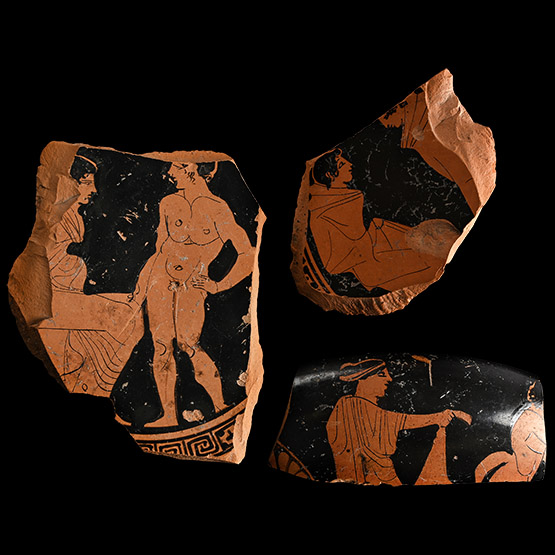
Greek Attic Red-Figure Fragment Collection
5th-4th century B.C.Sold for (Inc. bp): £1,950
Comprising irregular fragments depicting draped females, a standing nude male, a satyr body and a draped young man. 143 grams total, 87-116 mm
From the stock of a former UK antiquarian, acquired at trade fairs and from private collection formed in the 1980s-1990s. Private collection, Europe. -
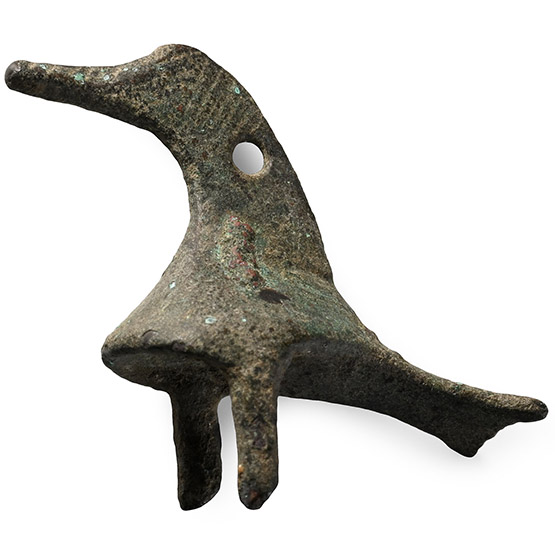
Greek Bronze Animal
Geometric, 8th-6th century B.C.Sold for (Inc. bp): £234
Modelled with a conical body and two stub legs, carinated back and neck, pierced for suspension. 11.5 grams, 43 mm
Ex collection Mr K.H., Germany. Private collection, acquired in 2012.
