
Loading, please wait...
LOT 0572
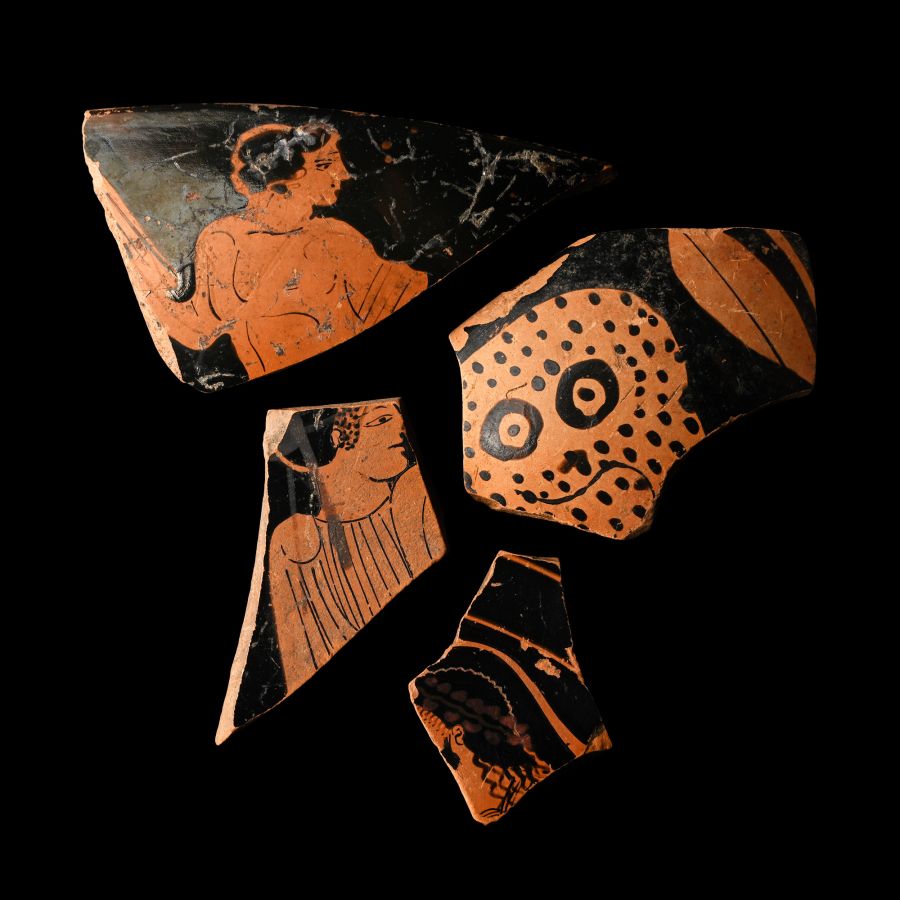
Greek Attic Red-Figure Fragment Collection
EARLY 5TH CENTURY B.C.
1 3/8 - 2 3/4 in. (26 grams total, 36-70 mm).
Comprising four irregular fragments depicting an owl with a dotted body and large circular eyes, a youthful nude wearing a laurel wreath, a draped young female, male head with long hair wearing a wreath of vine leaves. [4]
ProvenanceFrom the stock of a former UK antiquarian, acquired at trade fairs and from private collection formed in the 1980s-1990s.
Private collection, Europe.
TimeLine Auctions follows a vetting process to ensure the authenticity and legality of all items, reinforcing our commitment to integrity and responsible trading. Each antiquity, antique, and coin lot undergoes thorough examination by a vetting committee of at least ten external specialists, professional trade association members, scientists, and archaeologists: Our Vetting Process
AUCTIONS:
TimeLine is a leading auction house specialising in antiquities, ancient art, collectables, natural history, coins, medals, and books. Our auctions offer museums, collectors, historians, and enthusiasts the opportunity to acquire unique and historically significant pieces.
-
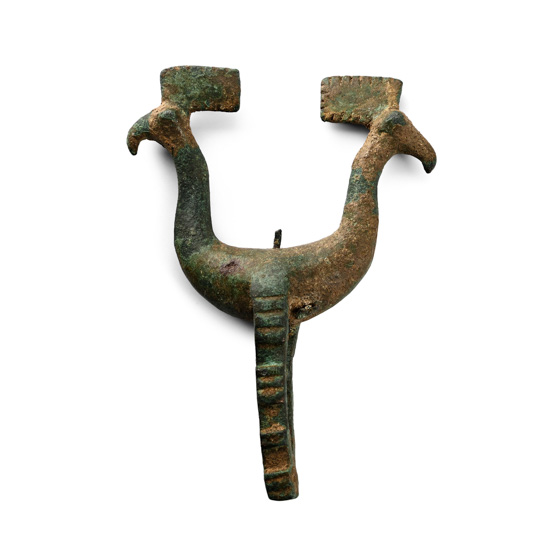
Large Greek Bronze Double-Headed Animal Terminal
Geometric, 8th-6th century B.C.Estimate: £1,500 - 2,000 (‡+bp*)
Opening Bid: £750
Comprising a crescent body with a slender neck at each end, topped by a bird-head with a rectangular crest, vertical legs with raised block detailing conjoined at the lower end into a mounting peg. 55.6 grams, 86 mm
Ex collection Mr K.H., Germany. Private collection, acquired in 2012. This lot has been checked against the Interpol Database of stolen works of art and is accompanied by search certificate no.13077-246757.
Bird figures, standing on plates or discs, are found as votives mainly in Northern Greek sanctuaries of the Geometric Age. They should be regarded as symbolic and sometimes modest gifts to the gods. Some birds were also designed as pendants. The present fitting evokes the rooster, but a possible representation of a peacock and its connection with Hera is not to be excluded. -
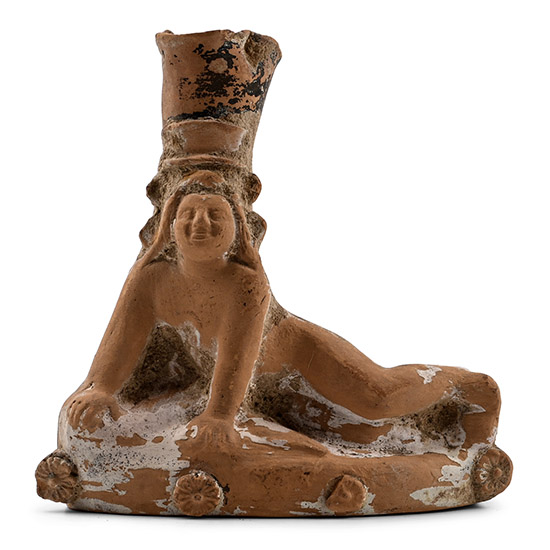
Greek Terracotta Kohl Vessel
Hellenistic, 2nd century B.C.Sold for (Inc. bp): £416
Hollow-formed as a nude figure rising from a prone position on an ellipsoid base; rosettes to foot; flared tubular mouth pinched into a trefoil. 86 grams, 10.2 cm
Acquired on the European art market in the early 2000s. with Galerie Rhéa, Zurich, Switzerland. -
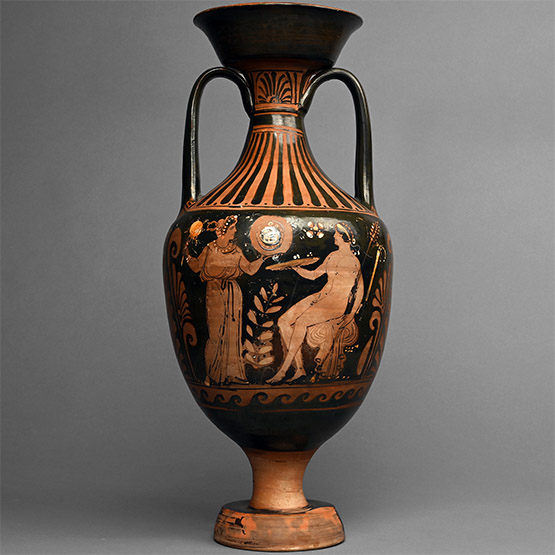
Large Greek Red-Figure Amphora with Dionysian Scenery
Apulian, 3rd-2nd century B.C.Sold for (Inc. bp): £3,640
The piriform body with broad, stepped rim and two lentoid-section handles; painted palemete beneath each handle and on the neck below the mouth; Side A: red-figure frieze depicting a standing woman wearing a himation and stephane, her hands raised supporting objects, a laurel frond before her and a seated nude male with thyrsus and other items; Side B: two opposed figures standing supported by staves, each wearing a loosely draped floor-length garment; objects in the field. 1.88 kg, 43 cm
Acquired on the art market between the late 1990s and mid-2000s. Estate of the late Barry Paul Buxton (1944-2024), Oakham, Rutland. Acquired on the UK art market, 2025. Accompanied by a thermoluminescence analysis report no.N126a18 from Oxford Authentication. This lot has been checked against the Interpol Database of stolen works of art and is accompanied by search certificate no.13075-248951.
The subject is standard, often representing the draped youths completely enveloped in their himatia.
