
Loading, please wait...
_900x900.jpg "Greek Attic Red-Figure Fragment Collection")
_200x200.jpg "Greek Attic Red-Figure Fragment Collection")
.jpg "Greek Attic Red-Figure Fragment Collection")
LOT 0614
Greek Attic Red-Figure Fragment Collection
EARLY 5TH CENTURY B.C.
3/4 - 1 in. (6.31 grams total, 18-26 mm).
Comprising four irregular, finely painted fragments depicting: an outstretched hand below a letter, a young male face in profile, and a pair of horseheads. [4]
ProvenanceFrom the stock of a former UK antiquarian, acquired at trade fairs and from private collection formed in the 1980s-1990s.
Private collection, Europe.
TimeLine Auctions follows a vetting process to ensure the authenticity and legality of all items, reinforcing our commitment to integrity and responsible trading. Each antiquity, antique, and coin lot undergoes thorough examination by a vetting committee of at least ten external specialists, professional trade association members, scientists, and archaeologists: Our Vetting Process
AUCTIONS:
TimeLine is a leading auction house specialising in antiquities, ancient art, collectables, natural history, coins, medals, and books. Our auctions offer museums, collectors, historians, and enthusiasts the opportunity to acquire unique and historically significant pieces.
-
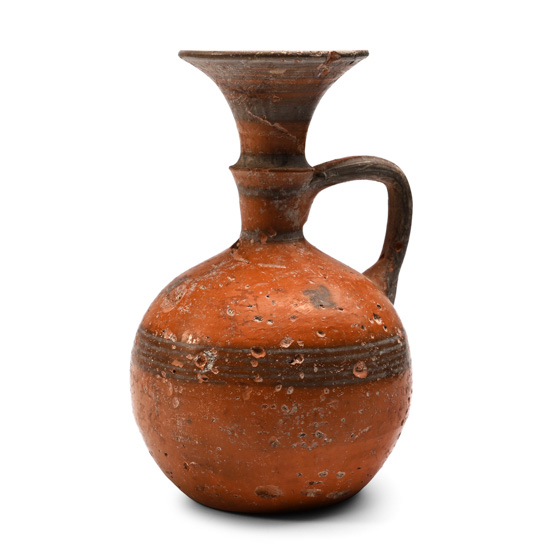
Cypriot Terracotta Jug with Decorations
7th-6th century B.C.Sold for (Inc. bp): £364
Comprising a spherical body and flat base, trumpet-shaped mouth with biconvex collar and strap handle; painted circumferential bands. 67 grams, 91 mm
Acquired by a Swiss family in the mid-1980s to late 1990s, thence by descent. Private collection, Switzerland, since the late 1990s. -
.jpg)
Greek Red-Figure Kantharos with Lady of Fashion
Apulian, 3rd-2nd century B.C.Sold for (Inc. bp): £1,040
High-handled cup with flared body and a tall offset foot with a collar, coiled lateral handles; profile 'ladies of fashion' busts with white and cream detailing to the hair, diadem and earrings. 415 grams, 18.6 cm
Acquired on the art market between the late 1990s and mid-2000s. Estate of the late Barry Paul Buxton (1944–2024), Oakham, Rutland. Acquired on the UK art market, 2025. -
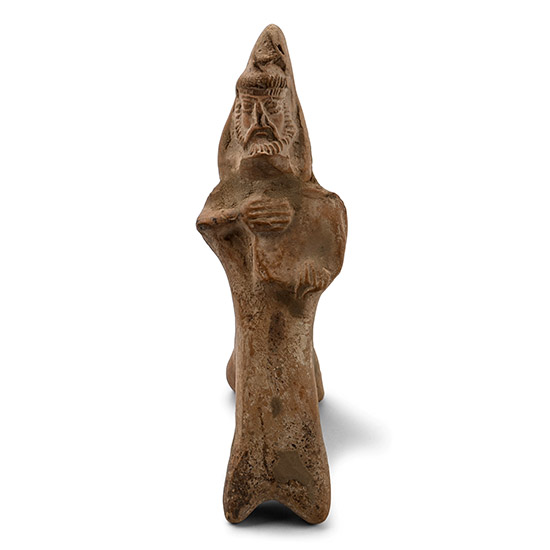
Parthian Horse and Rider Figurine
1st century B.C.-3rd century A.D.Estimate: £150 - 200 (+bp*)
Opening Bid: £75
Formed as a stylised horseman on four splayed legs, with finely modelled facial features and beard; the head of the horse integrated into the rider's body. 97 grams, 12.9 cm
Acquied on the UK art market. Private collection, London, UK.
