
Loading, please wait...




LOT 0075
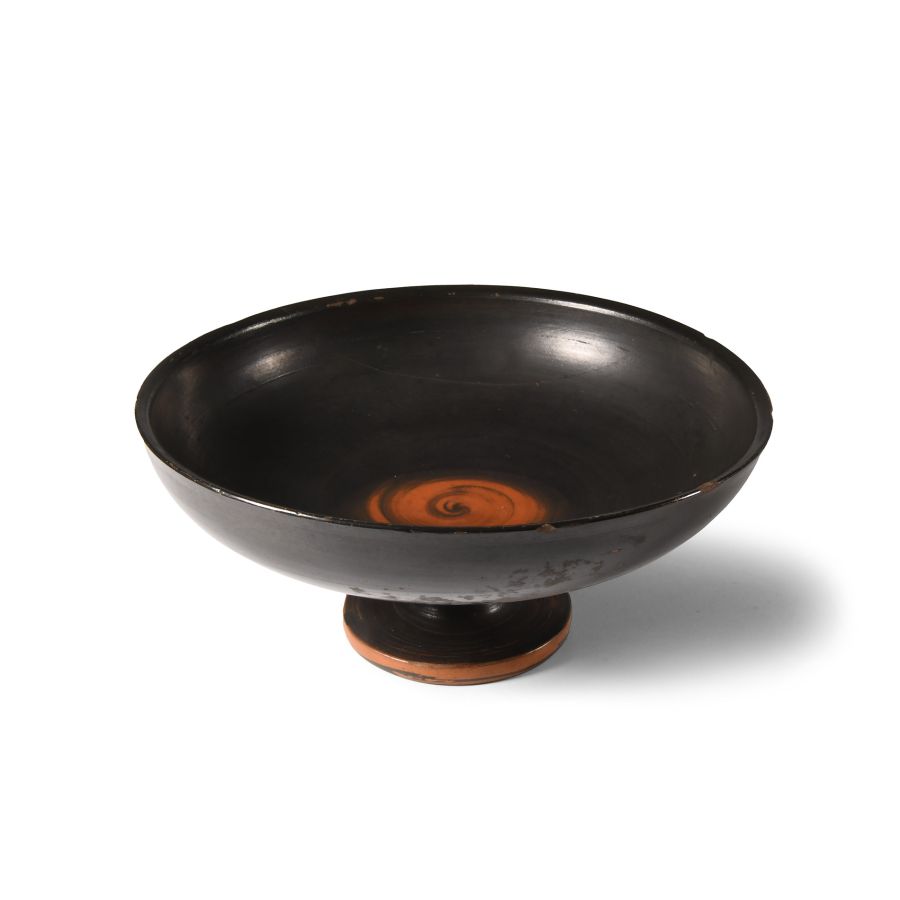
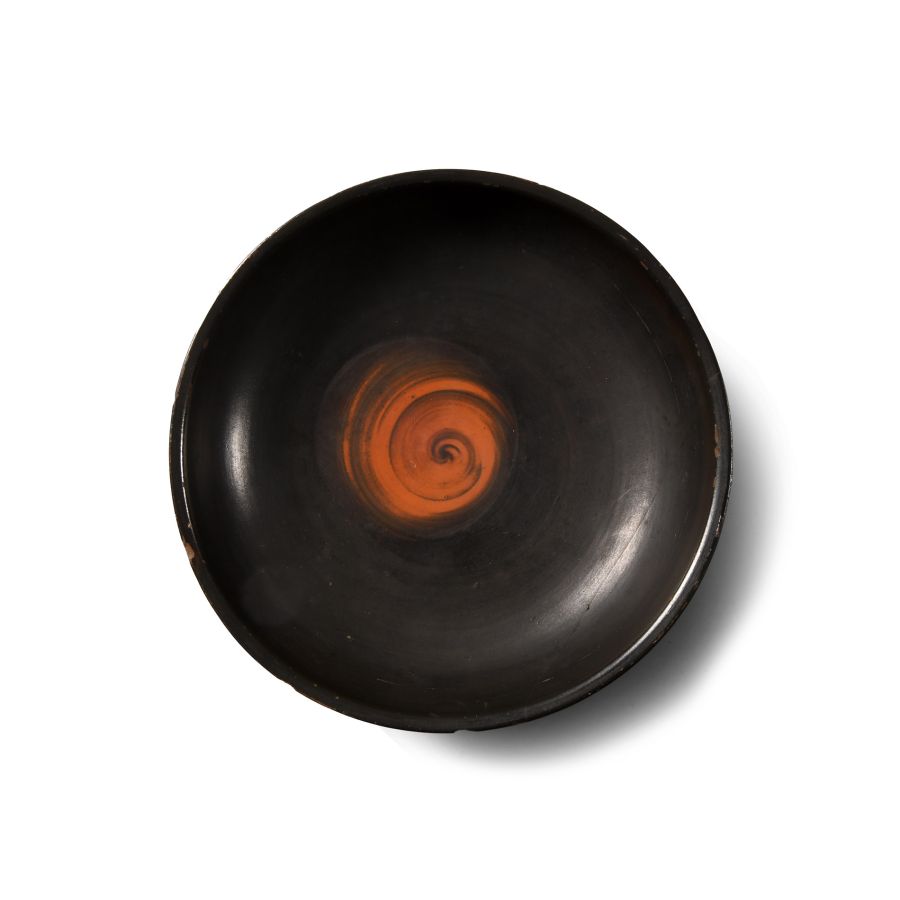
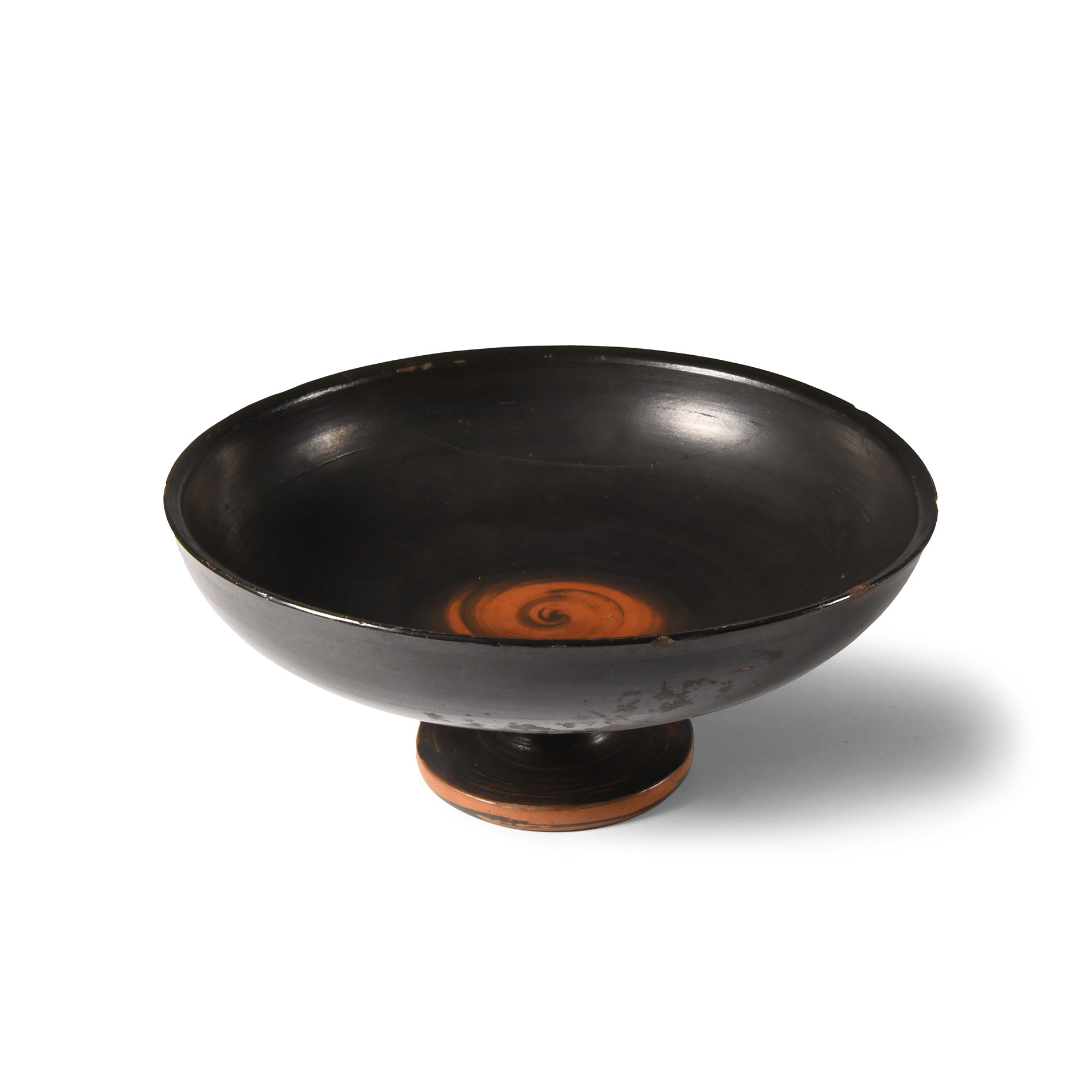
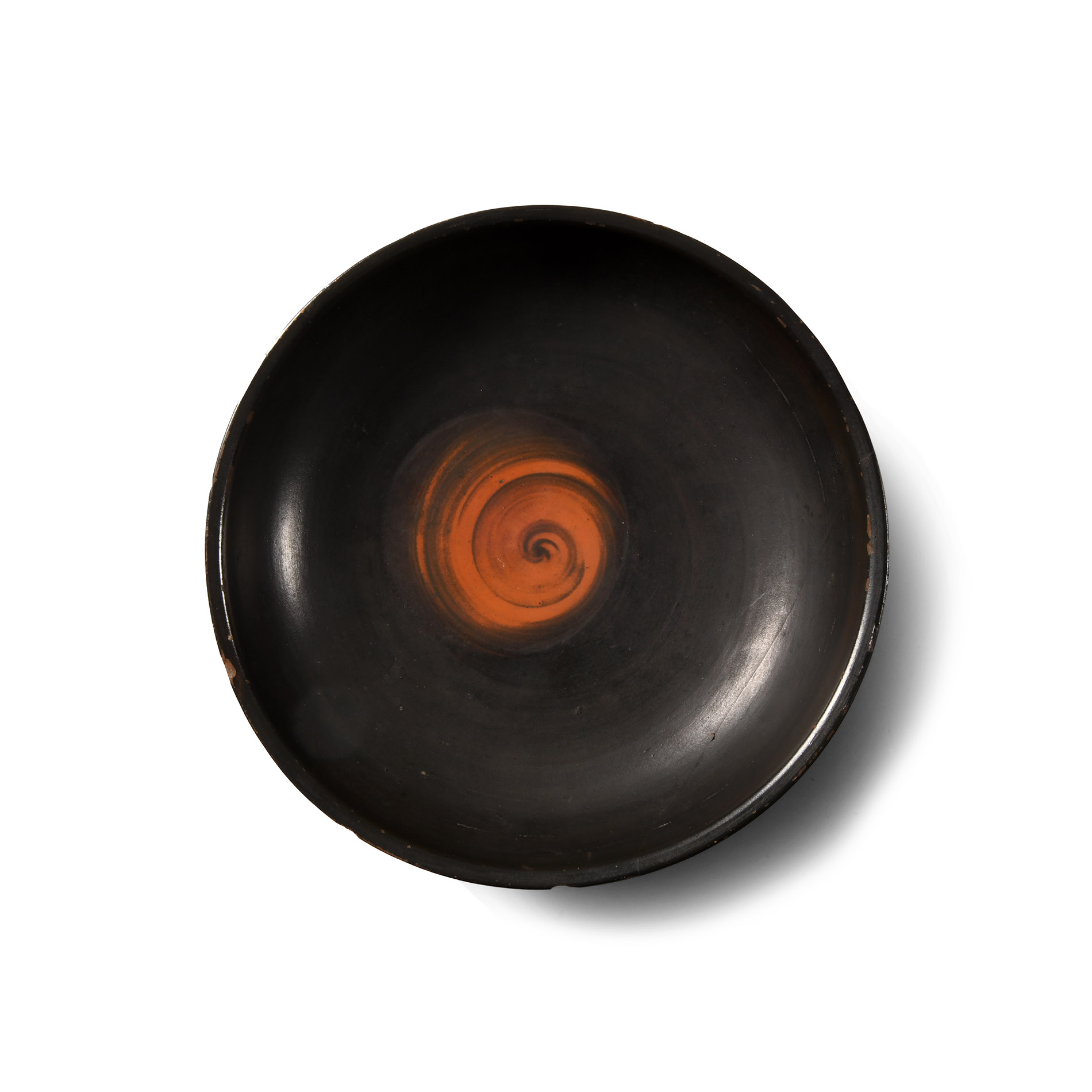
Greek Attic Black-Glazed Kylix
CIRCA 5TH CENTURY B.C.
6 1/8 in. (230 grams, 15.6 cm wide).
Without handles, composed of a D-section bowl with attractive whorl pattern to the centre, everted rim, spool-shaped stem and discoid foot; old label with '37' to the outside of the bowl; restored.
ProvenanceEx Louis-Gabriel Bellon (1819?-1899), France.
Private collection, acquired on the French art market in 2009.
Cf. Sparkes B.A., Talcott, L., The Athenian Agora XII, Black and Plain Pottery of the 6th, 5th, and 4th Centuries B.C., 2 vol., Princeton, New York, 1970, p.138.
FootnotesThis Attic pottery type, developed towards the late 6th century B.C., made from a fine light tan clay with a semi-lustrous black gloss, except for the edge and underside of discoid foot. Usually this kind of handleless kylix evidences a shallow, segmental form body with the lip curving inward and being slightly offset on the exterior. A wide circle in black is usually visible on the underside of the foot.
CONDITIONTimeLine Auctions follows a vetting process to ensure the authenticity and legality of all items, reinforcing our commitment to integrity and responsible trading. Each antiquity, antique, and coin lot undergoes thorough examination by a vetting committee of at least ten external specialists, professional trade association members, scientists, and archaeologists: Our Vetting Process
AUCTIONS:
TimeLine is a leading auction house specialising in antiquities, ancient art, collectables, natural history, coins, medals, and books. Our auctions offer museums, collectors, historians, and enthusiasts the opportunity to acquire unique and historically significant pieces.
LOT 0075
Greek Attic Black-Glazed Kylix
Estimate £400 - 600€460 - 700 (for guidance only)$540 - 810 (for guidance only)
-
Graeco-Parthian Marble Head of a Divinity
2nd century B.C.-1st century A.D.Estimate: £1,200 - 1,700 (‡+bp*)
Opening Bid: £600
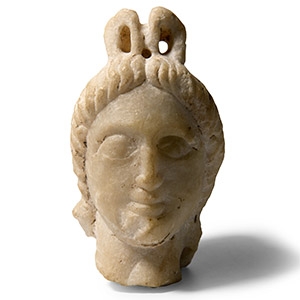
With elongated face and large almond-shaped eyes; braided hair with openwork topknot and socket to accept an inset stud, gathered at the rear in a chignon. 639 grams, 11.6 cm
Acquired early 1990s. Ex private American collection; thence by descent. Private Swiss collection since 1998. This lot has been checked against the Interpol Database of stolen works of art and is accompanied by search certificate no.11611-199026.
Several female figures, found in the Parthian graves of Babylonia, are represented in loose attire exhibiting unusual headdresses, which give us some notion of the costume of the period. Some of them show a headgear rising into two tall conical peaks, from which a veil is suspended. Nude female figures, probably representing Assyrian Mylitta or Venus, were extremely common during the Parthian period, having been handed down from antiquity. Similar figures are universal throughout the east before the Christian era. -
Greek Terracotta Protome Mask
Late 6th-early 5th century B.C.Sold for (Inc. bp): £156
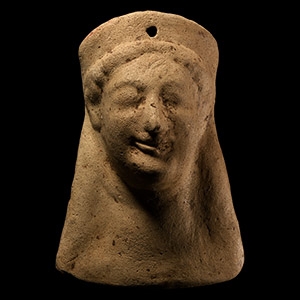
Modelled as a female head with rounded oval face, slightly bulging eyes and pronounced chin, indistinct smiling mouth with thin lips, outline of ears; low straight polos with fastening hole. 142 grams, 13 cm
Acquired 1970s-1996. Property of a North American collector. London collection, 2016.
The figure belongs to a common type known from mainland Greece and the islands. The head clearly shows the so-called 'Archaic smile' visible on the dedicatory protomes of the same typology. They were terracotta votive offerings attached with a nail to the shrine of a goddess for ex-voto or to receive the grace of the represented goddess (Demeter?). -
Hellenistic Gold Earrings with Gemstones
Circa 2nd-1st century B.C.Estimate: £1,200 - 1,700 (+bp*)
Opening Bid: £625
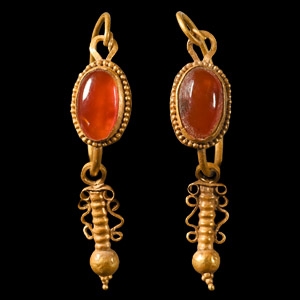
Matched pair of gold earrings, each wire hoop with hook-and-eye closure, ellipsoid shield with beaded rim and cell with carnelian cabochon, free-running dangle with filigree crocketting and granule cluster. 3.85 grams total, 40 mm each
From a collection of a London lady, acquired annually during 1990s-2000s.
