
Loading, please wait...
_900x900.jpg "Greek Attic Black-Glazed Kylix")
_200x200.jpg "Greek Attic Black-Glazed Kylix")
_900x900.jpg "Greek Attic Black-Glazed Kylix")
_200x200.jpg "Greek Attic Black-Glazed Kylix")
.jpg "Greek Attic Black-Glazed Kylix")
.jpg "Greek Attic Black-Glazed Kylix")
LOT 0562
Greek Attic Black-Glazed Kylix
CIRCA 5TH CENTURY B.C.
6 1/8 in. (230 grams, 15.6 cm wide).
A black-glazed kylix or stemmed cup created without handles, composed of a D-section bowl with attractive whorl pattern to the centre, everted rim, spool-shaped stem and discoid foot; old label with '37' to the outside of the bowl.
ProvenanceEx Louis-Gabriel Bellon (1819?-1899), France.
Private collection, acquired on the French art market in 2009.
Cf. Sparkes B.A., Talcott L., The Athenian Agora XII, Black and Plain Pottery of the 6th, 5th, and 4th Centuries B.C., 2 vol., Princeton, New York, 1970, p.138.
FootnotesThis Attic pottery type, developed towards the late 6th century B.C., made from a fine light tan clay with a semi-lustrous black gloss, except for the edge and underside of discoid foot. Usually this kind of handleless kylix evidences a shallow, segmental form body with the lip curving inward and being slightly offset on the exterior. A wide circle in black is usually visible on the underside of the foot.
CONDITIONTimeLine Auctions follows a vetting process to ensure the authenticity and legality of all items, reinforcing our commitment to integrity and responsible trading. Each antiquity, antique, and coin lot undergoes thorough examination by a vetting committee of at least ten external specialists, professional trade association members, scientists, and archaeologists: Our Vetting Process
AUCTIONS:
TimeLine is a leading auction house specialising in antiquities, ancient art, collectables, natural history, coins, medals, and books. Our auctions offer museums, collectors, historians, and enthusiasts the opportunity to acquire unique and historically significant pieces.
LOT 0562
Greek Attic Black-Glazed Kylix
Estimate £500 - 700€580 - 810 (for guidance only)$680 - 950 (for guidance only)
-
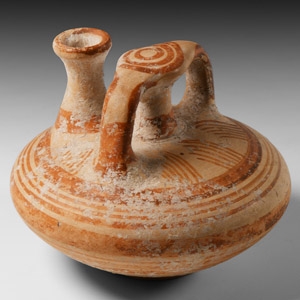
Mycenaean Pottery Stirrup Jar
1400-1200 B.C.Sold for (Inc. bp): £1,430
A pottery vessel formed with a squat carinated body, slender waisted neck and similar central stem with two flanking handles; painted geometric ornament composed of concentric bands and clusters of lines. 154 grams, 91 mm wide
with Christie's, London, South Kensington, 12 December 1989, lot 220. -
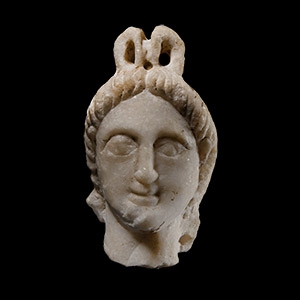
Graeco-Parthian Marble Head of a Divinity
2nd century B.C.-1st century A.D.Estimate: £2,000 - 3,000 (‡+bp*)
Opening Bid: £1,000
An alabaster bust of a goddess with elongated face and large almond-shaped eyes; braided hair with openwork topknot and socket to accept an inset stud, gathered at the rear in a chignon. 639 grams, 11.6 cm
Acquired early 1990s. Ex private American collection; thence by descent. Private Swiss collection since 1998. This lot has been checked against the Interpol Database of stolen works of art and is accompanied by search certificate no.11611-199026.
Several female figures, found in the Parthian graves of Babylonia, are represented in loose attire exhibiting strange headdresses, which give us some notion of the costume of the period. Some of them show a headgear rising into two tall conical peaks, from which a veil is suspended. Nude female figures, probably representing Assyrian Mylitta or Venus, were extremely common during the Parthian period, having been handed down from antiquity. Similar figures are universal throughout the east before the Christian era. -
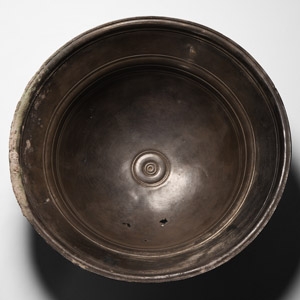
Hellenistic Silver Decorated Bowl
3rd century B.C.-1st century A.D.Estimate: £4,000 - 6,000 (‡+bp*)
Opening Bid: £2,000
A squat sheet-silver bowl with carinated profile, rolled rim, raised circumferential bands to the inner face and centre. 437 grams, 20 cm wide
cracked
Private Swiss collection, acquired 1999. Ex Surena collection, London, UK. Private European collection. This lot has been checked against the Interpol Database of stolen works of art and is accompanied by search certificate no.11617-199030.
