
Loading, please wait...
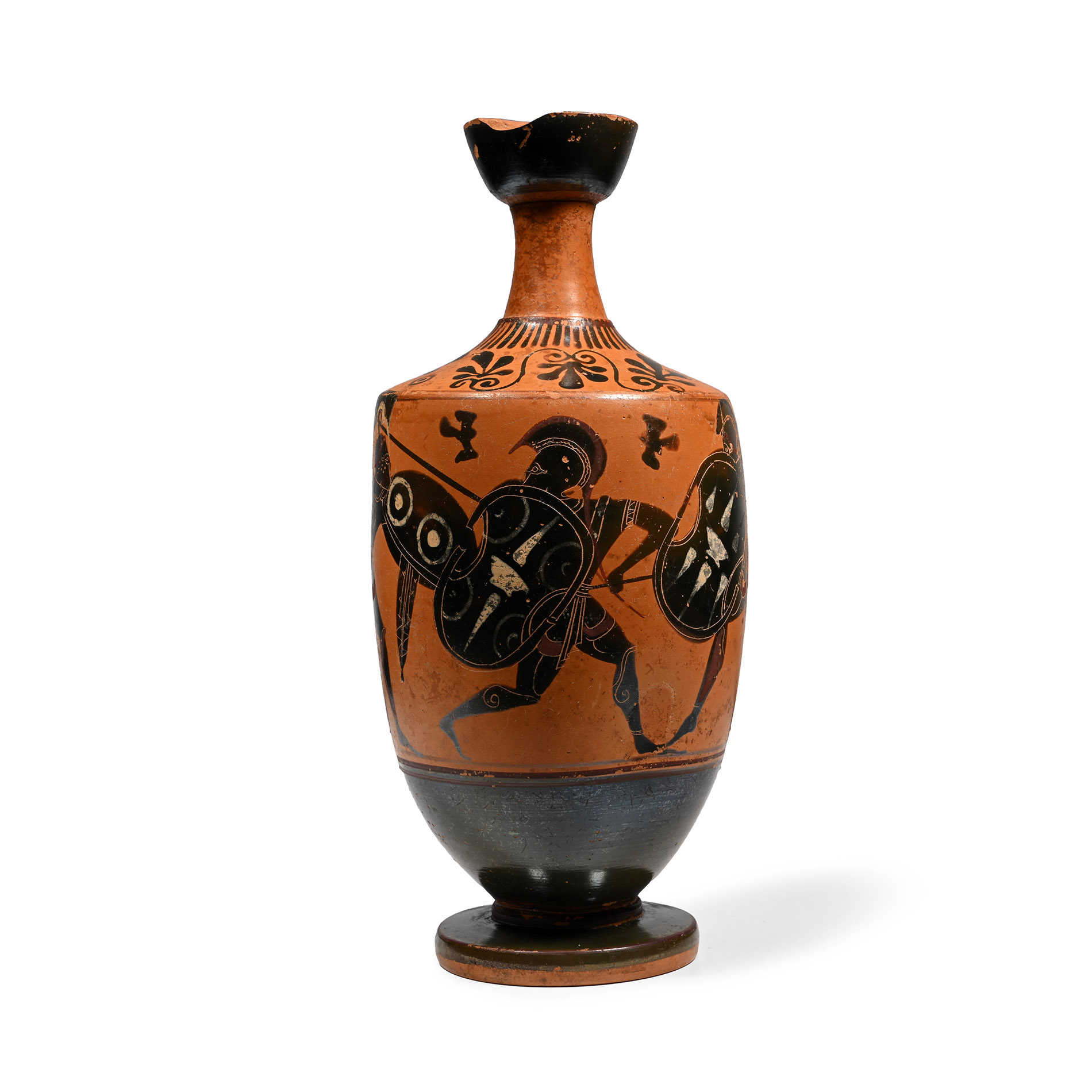
LOT 0041
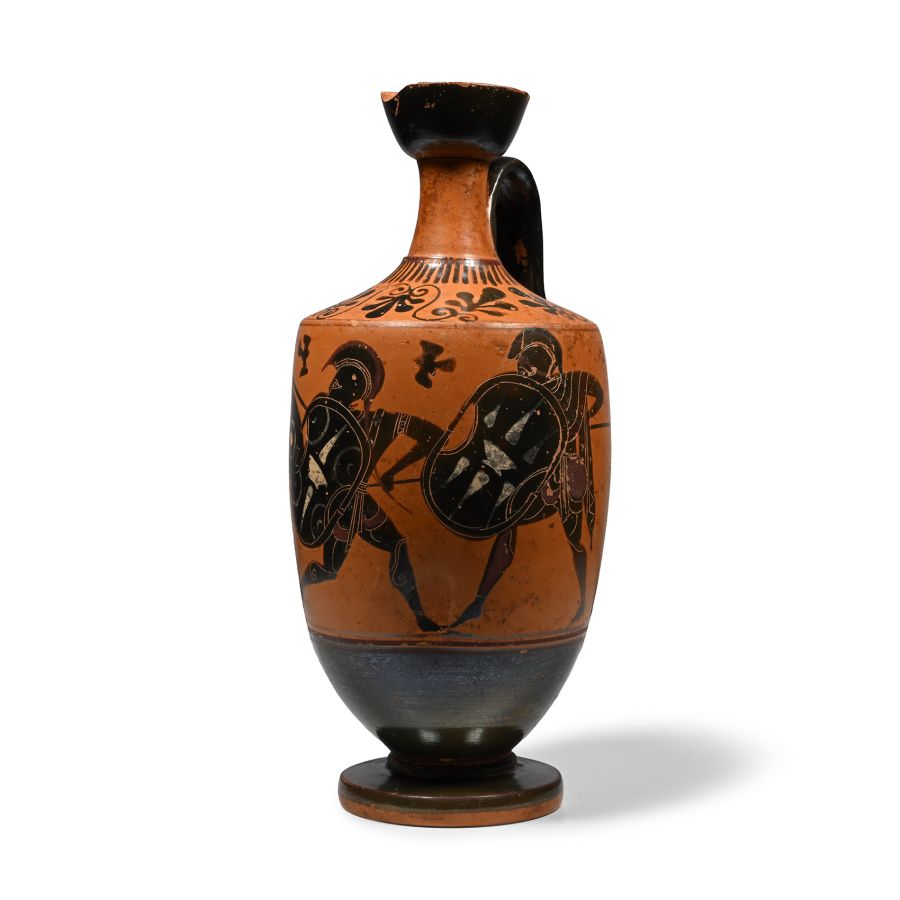
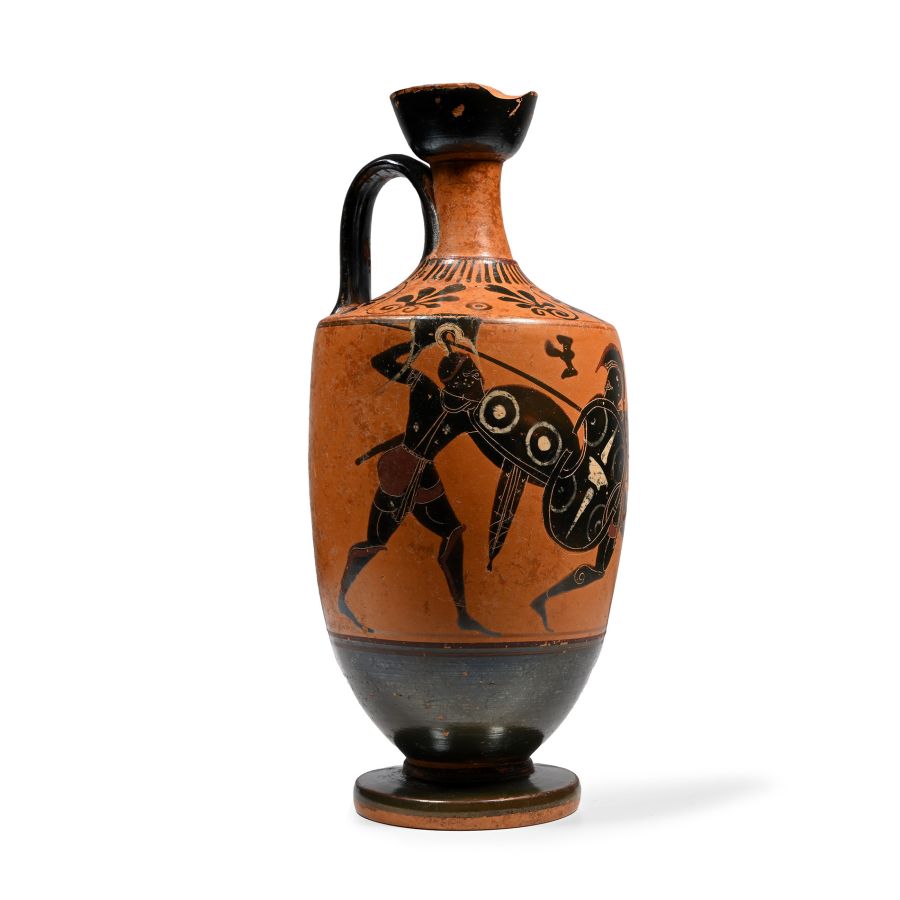
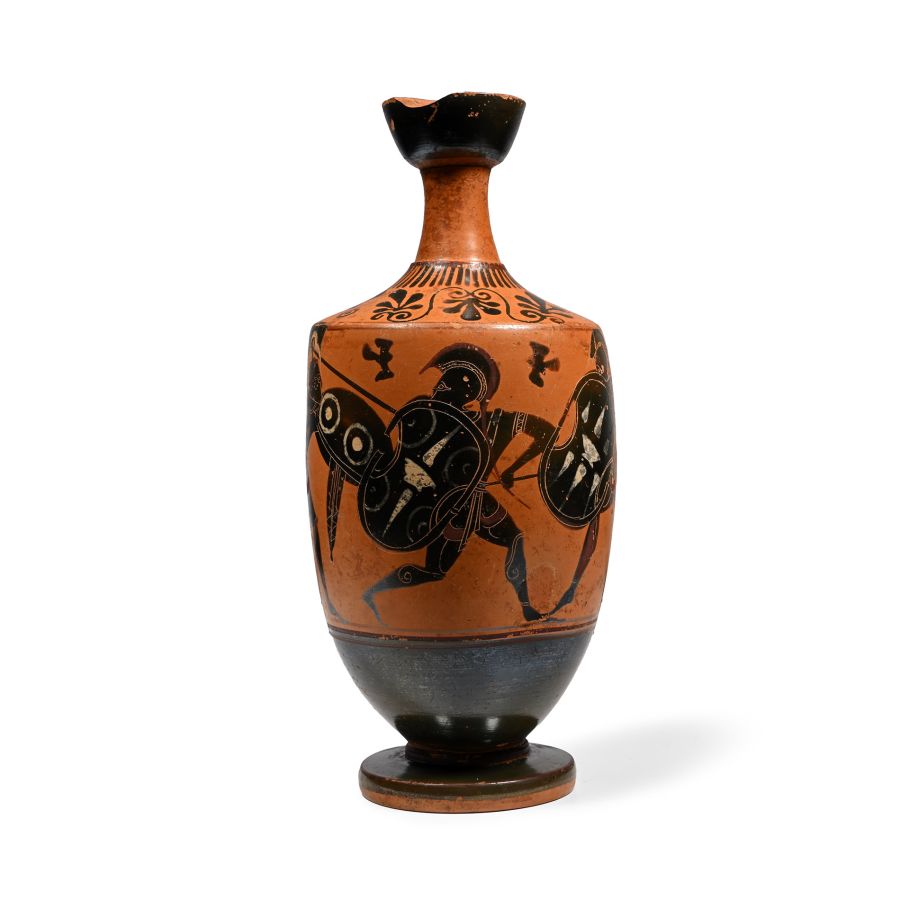
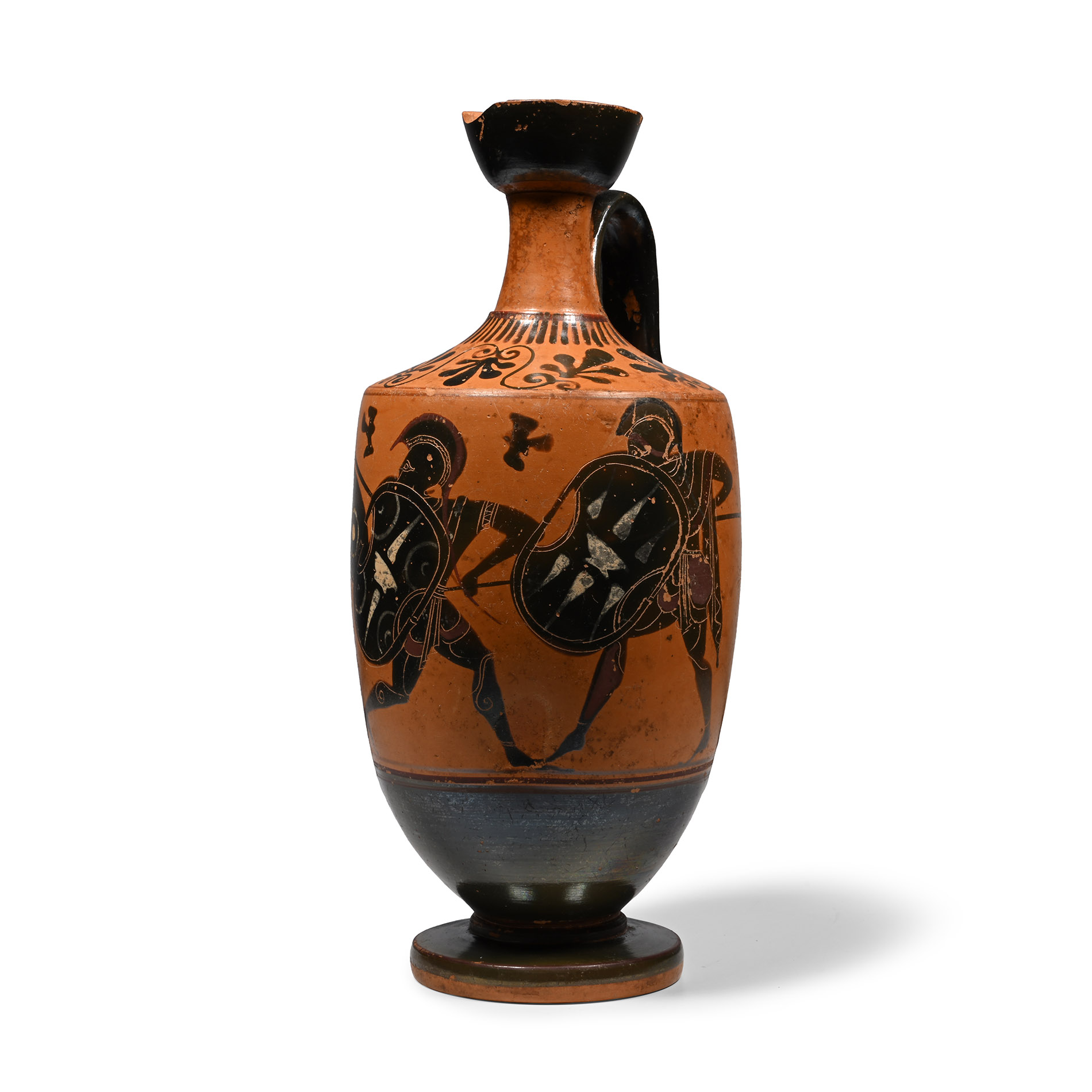
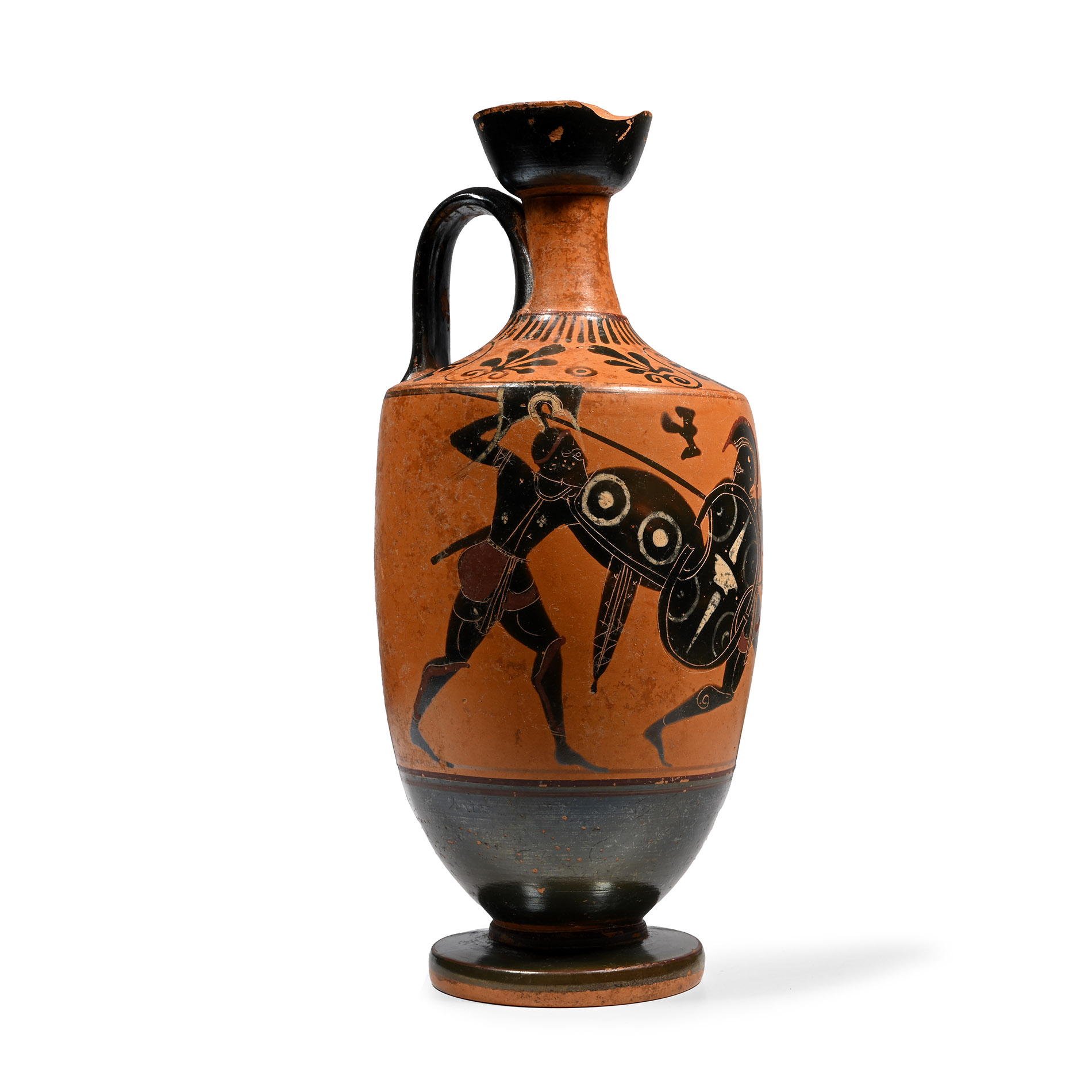
Greek Attic Black-Figure Lekythos with Combat Scene
CIRCA 520 B.C.
10 3/8 in. (481 grams, 26.5 cm).
The ovoid body decorated with a combat scene, band of tendrils and leaves to the shoulder and vertical bands to the slender neck, trumpet-shaped mouth, strap handle and discoid foot; the scene comprising three Hoplites, the first in tall-crested Corinthian helmet, cuirass and greaves, xiphos hanging on his right side, thrusting with his long spear over his ellipsoid shield towards the middle figure, running forwards but with his helmetted head turned towards his attacker, using his Boeotian shield to ward off the blow while manoeuvring his own spear blocked by the third figure advancing against him, with spear held underarm, with birds in flight above.
ProvenancePrivate collection, Southern Germany, acquired in 1960s.
with Paul-Francis Jacquier, Numismatique Antique, Münzen und Kunst der Antique, 13 September 2013.
Acquired by the present owner at the above sale.
This lot has been checked against the Interpol Database of stolen works of art and is accompanied by search certificate number no.12189-222313.
This lot has been cleared against the Art Loss Register database, and is accompanied by an illustrated lot declaration signed by the Head of the Antiquities Department, Dr Raffaele D'Amato.
Cf. The Metropolitan Museum, New York, accession number 76.12.4, for similar; for other similar examples Papuci-Władyka, E., Corpus Vasorum Antiquorum, Poland, Fascicule 11, Cracow Fascicule I, Cracow, 2012, pl.43; see also a similar lekythos decorated with warriors in combat at the New Art Gallery Walsall, inventory no.1973.284.GR; for a general bibliography on the Attic Greek black-figure lekythoi see Haspels, C.H.E., Attic Black Figured Lekythoi, Paris, 1936; Beazley, J. D., Attic Black-Figure Vase-Painters, New York, 1978, pp.463-464, 699; Boardman, J., Athenian Black Figure Vases, New York, 1993, pp.114-115, fig.237; also Boardman, J., Les vases athéniens à figures noires, Paris, 1996.
FootnotesThe clothing and weapons of the hoplites are detailed copies of hoplites of late decades of 6th century B.C. The left warrior wears a Corinthian helmet with a high crest, a richly decorated robe and greaves. His round Attic shield, from which a richly pleated chlamys hangs down, is decorated with large circles. The middle and the right hoplite wear Corinthian helmets with a lower crest, and also beautifully decorated robes and greaves. They hold very large, Boeotian-shaped shields with striking bundles of lightning and 'flames'. As a beautiful counterpart to the left fighter, the right warrior carries a chlamys with long folds over his shoulder.
CONDITIONTimeLine Auctions follows a vetting process to ensure the authenticity and legality of all items, reinforcing our commitment to integrity and responsible trading. Each antiquity, antique, and coin lot undergoes thorough examination by a vetting committee of at least ten external specialists, professional trade association members, scientists, and archaeologists: Our Vetting Process
AUCTIONS:
TimeLine is a leading auction house specialising in antiquities, ancient art, collectables, natural history, coins, medals, and books. Our auctions offer museums, collectors, historians, and enthusiasts the opportunity to acquire unique and historically significant pieces.
-
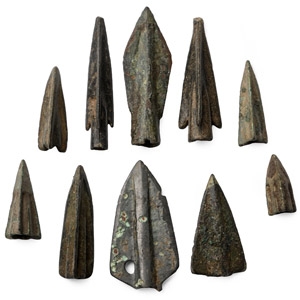
Greek Period High Quality Bronze Arrowhead Collection
5th-3rd century B.C.Sold for (Inc. bp): £143
Mainly triangular-section socketted and deltoid types. 28 grams total, 16-35 mm
From an English collection formed before 2000. This lot is accompanied by an illustrated lot declaration signed by the Head of the Antiquities Department, Dr Raffaele D'Amato. -
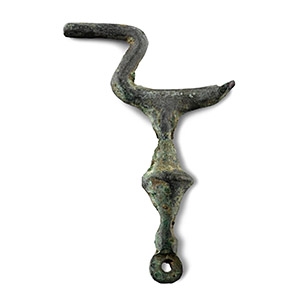
Greek Geometric Bronze Bird
8th century B.C.Estimate: £100 - 140 (‡+bp*)
Opening Bid: £50
Stylised bird figure perching on a convex panel, shank beneath pierced and lug finial pierced perpendicularly. 16.9 grams, 60 mm
Acquired in the 1994. Private collection, Switzerland, thence by descent. Private collection, since the late 1990s. This lot is accompanied by an illustrated lot declaration signed by the Head of the Antiquities Department, Dr Raffaele D'Amato. -
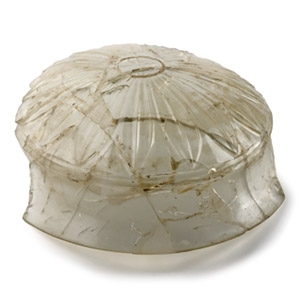
Hellenistic Shallow Glass Dish
3rd century B.C.Estimate: £3,000 - 4,000 (+bp*)
Opening Bid: £1,500
Broad dish with carinated profile and curved flange rim; lotiform decoration to underside with central starburst tondo. 114 grams, 12.7 cm
Private collection of Mr S.A., Düsseldorf, formed prior to 1967. Private collection, UK. This lot has been checked against the Interpol Database of stolen works of art and is accompanied by search certificate number no.12813-241336. This lot has been cleared against the Art Loss Register database, and is accompanied by an illustrated lot declaration signed by the Head of the Antiquities Department, Dr Raffaele D'Amato.
