
Loading, please wait...
LOT 1077
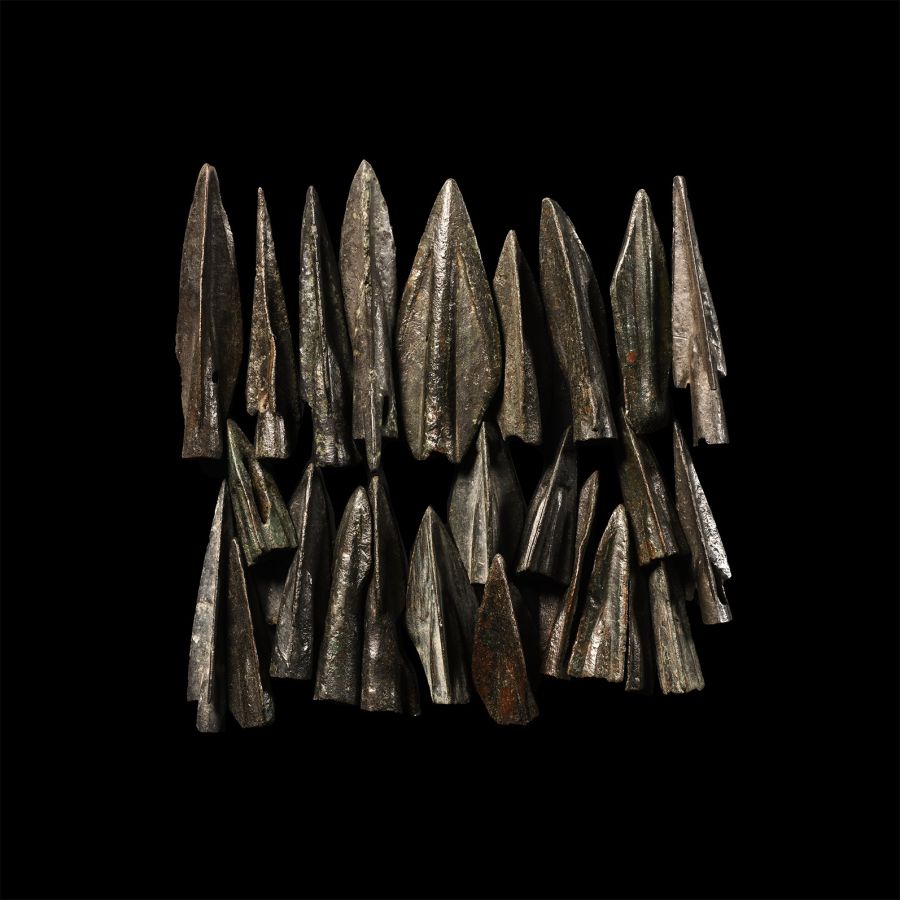
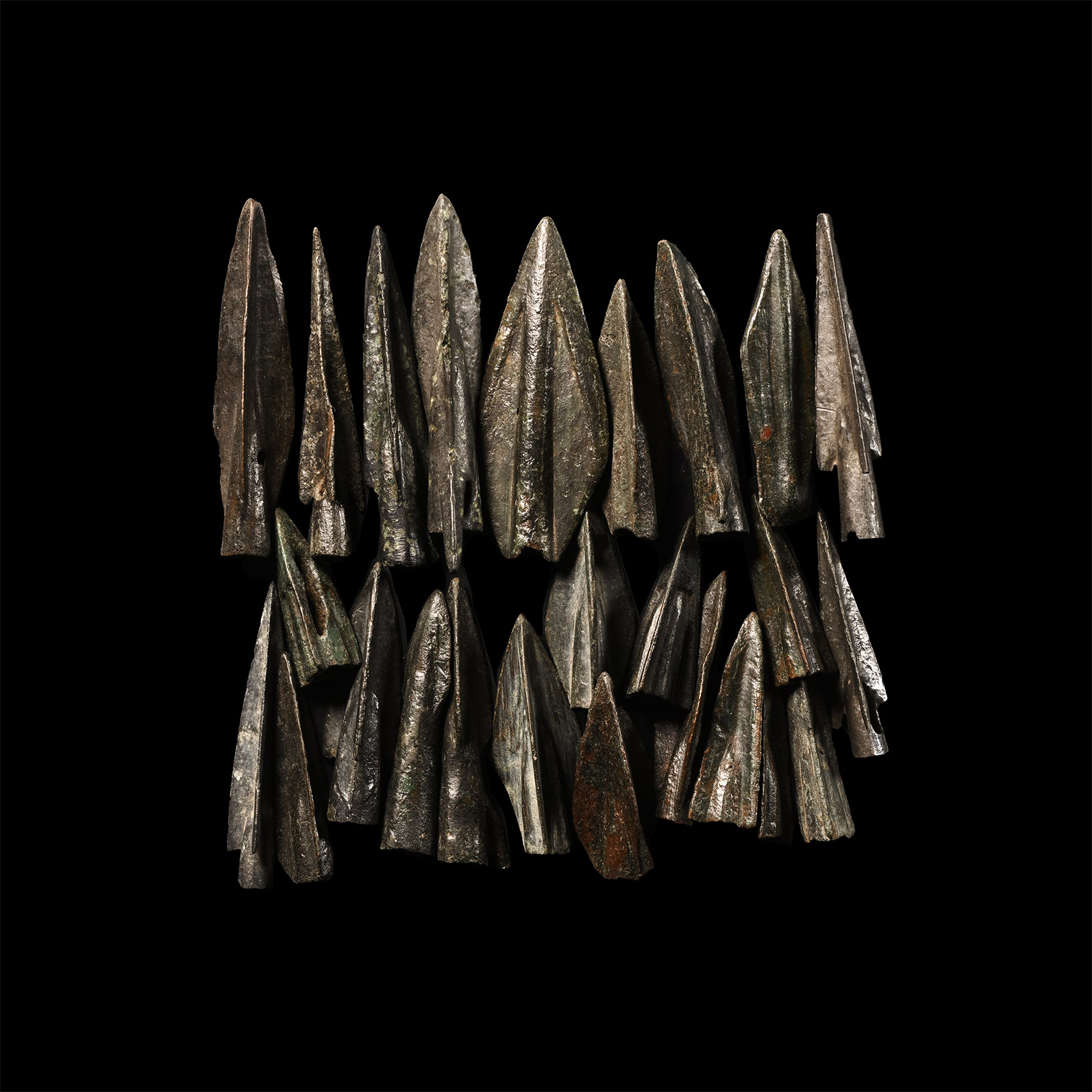
Greek Arrowhead Group
5TH-3RD CENTURY B.C.
1 - 1 3/4 in. (68.3 grams total, 24-45 mm).
A group of bronze socketted arrowheads of various types, including lozenge-shaped examples, spurred types and examples with triangular cross-sections. [25]
ProvenanceAcquired before 2000.
From the collection of a European gentleman living in the UK.
TimeLine Auctions follows a vetting process to ensure the authenticity and legality of all items, reinforcing our commitment to integrity and responsible trading. Each antiquity, antique, and coin lot undergoes thorough examination by a vetting committee of at least ten external specialists, professional trade association members, scientists, and archaeologists: Our Vetting Process
AUCTIONS:
TimeLine is a leading auction house specialising in antiquities, ancient art, collectables, natural history, coins, medals, and books. Our auctions offer museums, collectors, historians, and enthusiasts the opportunity to acquire unique and historically significant pieces.
-
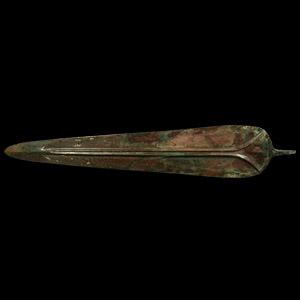
Luristan Sword Blade with Blood Channels
2nd millennium B.C.Sold for (Inc. bp): £229
A substantial bronze leaf-shaped blade with raised midrib extending to a short tang, ribbed fullers with curved ends extending to the shoulders. 422 grams, 41.5 cm
Fine condition.
Acquired in the 1990s. With a London, UK, gallery. Property of a London collector; from her family's private collection.
The metalworking techniques used in making bronze weapons in Luristan were very complex. Surfaces were often finished in repoussé work, and some of the weapons were chased, others engraved. -
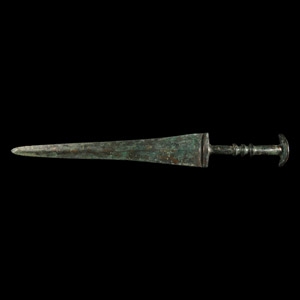
Luristan Dagger with Decorated Hilt
9th-8th century B.C.Sold for (Inc. bp): £780
A bronze dagger with a tapering triangular blade, the handle with three raised concentric bands, crescent-shaped pommel. 322 grams, 37 cm
Ex S. Motamed collection. with Bellman's Auctions, 20th-26th June 2015, lot 2482. Property of a London gentleman.
Several similar iron daggers were discovered during excavations at War Kabud. Differently from the bronze specimens, where the handle is ribbed, the iron specimens have bronze nails for fastening of the wooden grip on either side. -
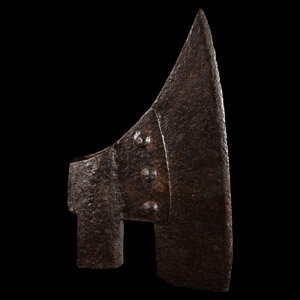
Large Medieval Iron Axehead
15th century A.D.Sold for (Inc. bp): £650
A substantial hand-forged iron axe with D-section socket and broad offset blade, fixed with three nails to the iron handle. 2.3 kg, 33.5 cm
Acquired 1971-1972. From the collection of the vendor's father. Property of a London, UK, collector.
The axe corresponds to the type XII of the Glosek classification. The type is known from Poland and Sweden. However, very often these axes were found without context, and generally classified as 15th century A.D. While the axes from Sweden are regarded as weapons, and dated 14th century A.D., the long and thickened back of the axe is rather characteristic of a butcher's axe, or of an executioner's axe.
