
Loading, please wait...
LOT 1039
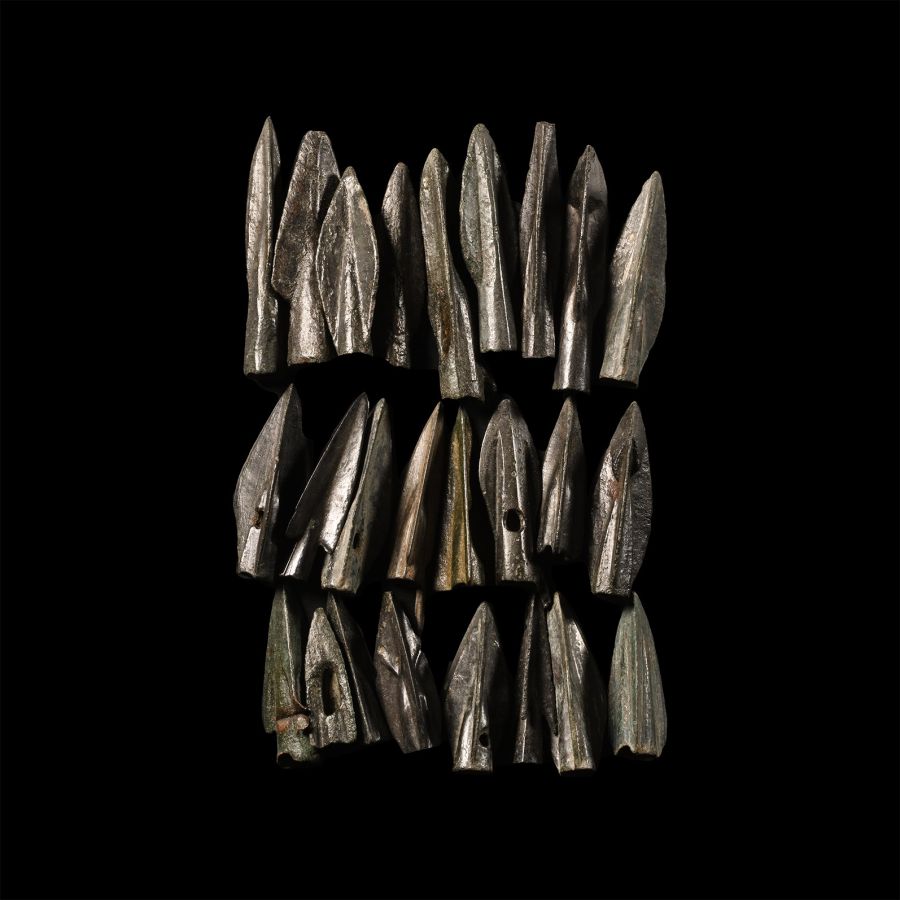
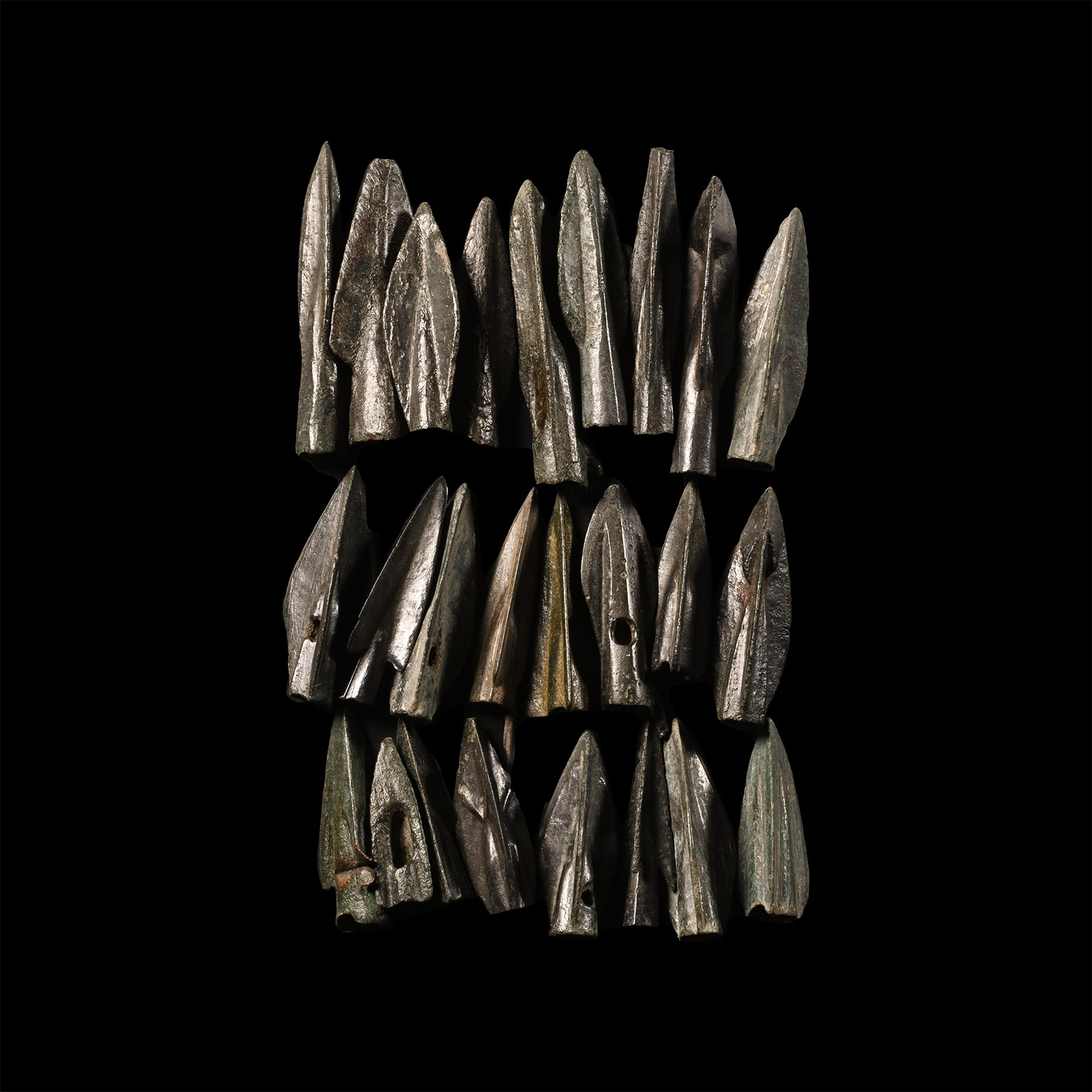
Greek Arrowhead Group
5TH-3RD CENTURY B.C.
7/8 - 1 5/8 in. (76.9 grams total, 21-40 mm).
A group of 25 bronze socketted arrowheads, including leaf-shaped types and examples with triangular cross-sections. [25]
ProvenanceAcquired before 2000.
From the collection of a European gentleman living in the UK.
TimeLine Auctions follows a vetting process to ensure the authenticity and legality of all items, reinforcing our commitment to integrity and responsible trading. Each antiquity, antique, and coin lot undergoes thorough examination by a vetting committee of at least ten external specialists, professional trade association members, scientists, and archaeologists: Our Vetting Process
AUCTIONS:
TimeLine is a leading auction house specialising in antiquities, ancient art, collectables, natural history, coins, medals, and books. Our auctions offer museums, collectors, historians, and enthusiasts the opportunity to acquire unique and historically significant pieces.
-
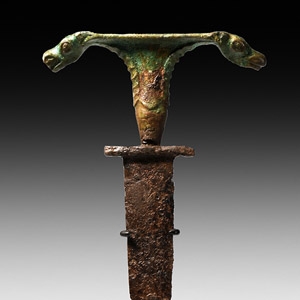
Heniochi Dagger with Beast Heads
4th-2nd century B.C.Sold for (Inc. bp): £520
A short iron dagger with triangular blade, short straight guard surmounted by a bronze pommel characterised by twinned beast heads projecting from each side; accompanied by a custom-made display stand. 170 grams, 28 cm (753 grams total, 39 cm high including stand)
Acquired 1971-1972. From the collection of the vendor's father. Property of a London, UK, collector.
The tribe of the Heniochs, according to Artemidorus of Ephesus, existed during the 5th-1st century B.C., on the Black Sea littoral that is part of present-day Abkhazia. Aristotle describes the Heniochi as a group of people "ready enough to kill and eat men." The dagger shows similarities with the pommel of a sword from Akhul Abaa grave 4 with twinned beast heads. These weapons of subtype I, according to the classification of Gamkrelidze-Shatberashvili-Pirtskhalava-Charkviani, were popular not only in Abkhazia, but throughout the territory of west Georgia during the 4th-1st century B.C. -
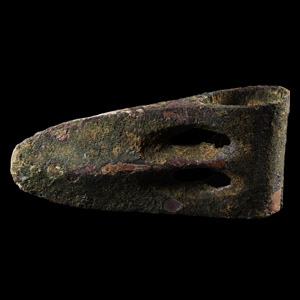
Babylonian Bronze Axehead
2nd millennium B.C.Sold for (Inc. bp): £416
A bronze duck-billed shaft-hole axe head featuring a curved, beak-shaped blade with two pierced eyes and a raised median ridge. 204 grams, 10.5 cm
Acquired early 1990s. Ex private American collection; thence by descent. Private Swiss collection since 1998. -
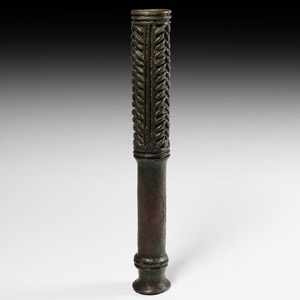
Akkadian Bronze Mace Head
2400-2000 B.C.Sold for (Inc. bp): £390
A bronze cylindrical mace head or cudgel with collared stem and flanged rim, the upper body with alternating vertical ribs and chevrons. 510 grams, 23 cm
Acquired 1980-2015. Ex Abelita family collection.
