
Loading, please wait...
LOT 0073
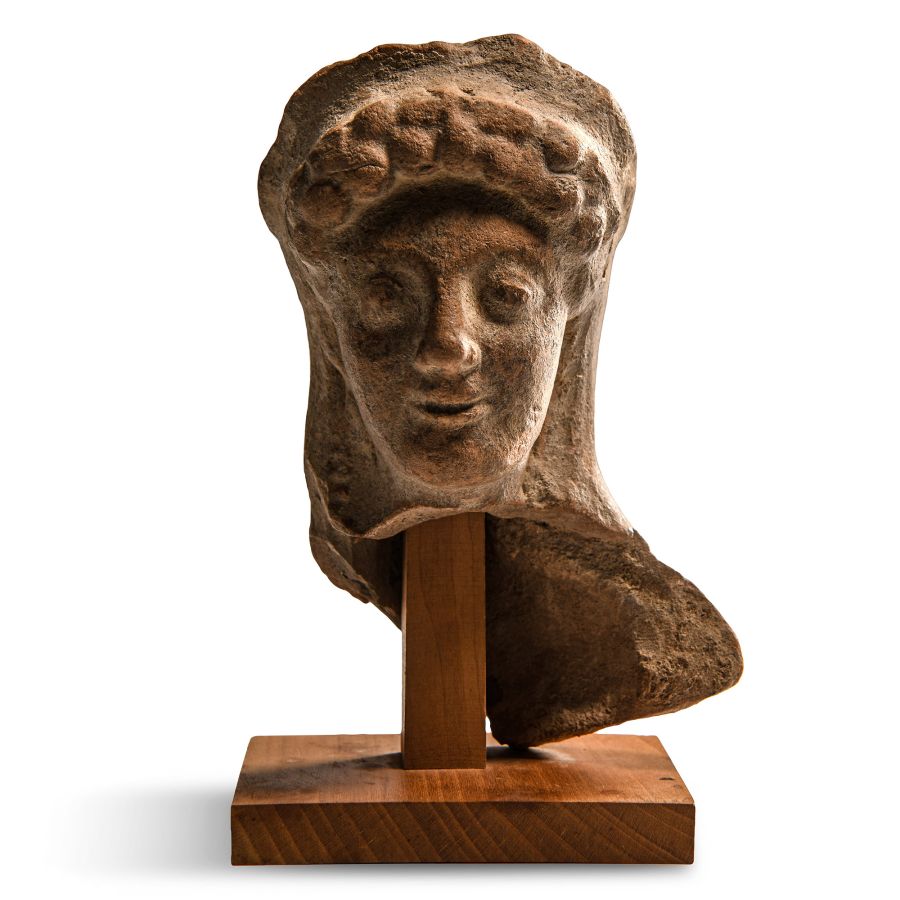
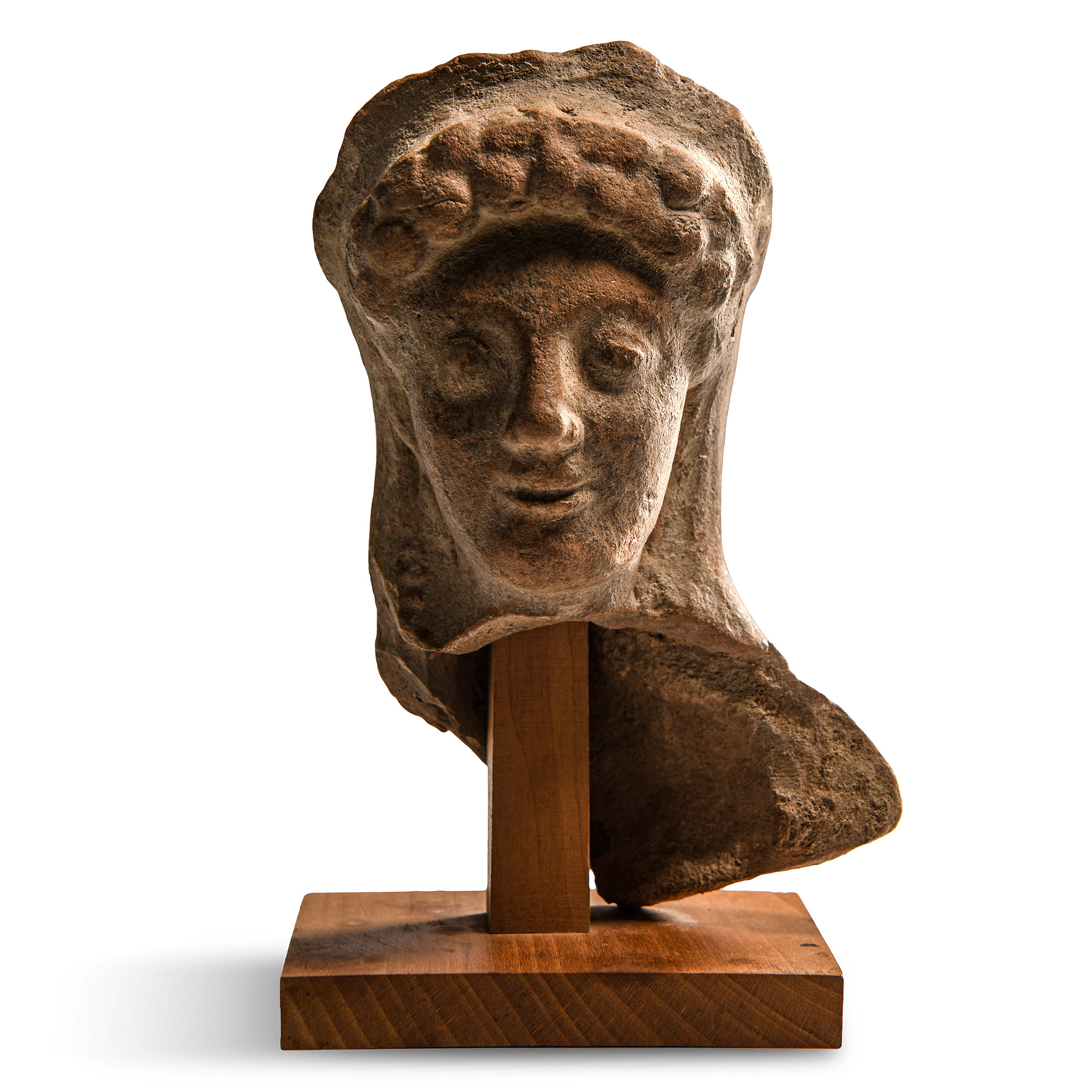
Greek Archaic Terracotta Head of Kore
6TH-5TH CENTURY B.C.
4 3/4 in. (5 3/8 in.) (229 grams, 12 cm (263 grams total, 13.5 cm high including stand)).
Modelled in the round wearing a diadem or headdress, either a Kore or Aphrodite, hollow-formed; accompanied by a custom-made display stand.
ProvenanceAcquired in the 1970s.
Ex European private collection.
Cf. similar statuette in the archaeological museum of Komotini, inv. no.ΑΓK13512/1323 da Rhodope; Cleveland Museum of Art, no.1926.518.
FootnotesThe type belongs to the evolution of the ‘Aphrodite Group’ that was distributed and copied by local workshops in Ionia and the rest of Greece. The figurines of this type are found in sanctuaries of female deities, as well as graves (eg. in Molyvoti). Similar figurines have also been found in Thassos.
CONDITIONTimeLine Auctions follows a vetting process to ensure the authenticity and legality of all items, reinforcing our commitment to integrity and responsible trading. Each antiquity, antique, and coin lot undergoes thorough examination by a vetting committee of at least ten external specialists, professional trade association members, scientists, and archaeologists: Our Vetting Process
AUCTIONS:
TimeLine is a leading auction house specialising in antiquities, ancient art, collectables, natural history, coins, medals, and books. Our auctions offer museums, collectors, historians, and enthusiasts the opportunity to acquire unique and historically significant pieces.
-
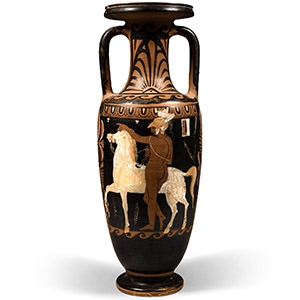
Campanian Red-Figure Neck-Amphora with Cavalryman
340-330 B.C.Sold for (Inc. bp): £10,400
The piriform body with broad, stepped rim and two round-section handles; red-figure frieze depicting two standing women facing, wearing a himation and stephane; the other side with a nude standing warrior wearing an Apulo-Corinthian helmet, holding the reins of his horse, acanthus leaves, ovolo and wave motifs to the neck and lower body; probably from a Cuma workshop. 1.55 kg, 40.2 cm high
Ex private collection Mr S., Geneva, by inheritance. Accompanied by an academic report by Dr Raffaele D’Amato. Accompanied by an original thermoluminescence analysis report no.N123k3 from Oxford Authentication. This lot has been checked against the Interpol Database of stolen works of art and is accompanied by search certificate number no.11784-206515.
The illustration of the horse is noteworthy: contemporary descriptions speak about the Sicilian horses as 'generous, swift and with firm foot' (Aeneid III, 704). The Oscan poet Lucilius of the 2nd century B.C. quotes the Campanian chargers as ‘fiery and brave although not very fine in their look’. The artistic evidence, like here, depicts well-built horses with fine legs suitable for middle-light cavalry. -
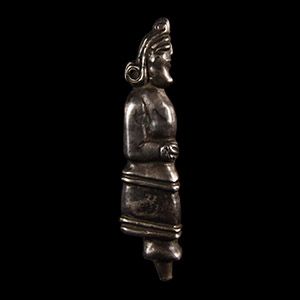
Parthian Figural Silver Dagger Hilt
3rd-1st century B.C.Estimate: £500 - 700 (+bp*)
Opening Bid: £212
Formed as a standing male figure with swept back, shoulder-length hair, hands held at the waist; mounting lug below. 66 grams, 86 mm
with a London, UK gallery 1971-early 2000s.
This hilt was probably for an acinaces blade, usually 14-18 inches long and used throughout a vast swath of territory encompassing the eastern Mediterranean, the Near East and central Asia, by such diverse cultures as the Parthians, the Medes, the Greeks, and the Scythians. -
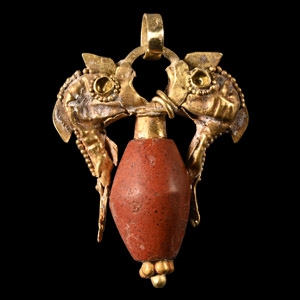
Greek Large Gold Dolphin Pendant
Circa 4th-3rd century B.C.Estimate: £600 - 800 (+bp*)
Opening Bid: £300
Formed as an amphora with dolphin handles, the body composed of a biconical jasper bead, repoussé and filigree detailing to the animals, suspension loops between; restored. 4.68 grams, 33 mm
From a late Japanese specialist collector, 1970-2000s.
