
Loading, please wait...
_900x900.jpg "Greek Archaic Laconian Black-Figure Kylix Fragment Group Attributed to the Rider Painter")
_200x200.jpg "Greek Archaic Laconian Black-Figure Kylix Fragment Group Attributed to the Rider Painter")

.jpg "Greek Archaic Laconian Black-Figure Kylix Fragment Group Attributed to the Rider Painter")
LOT 0089
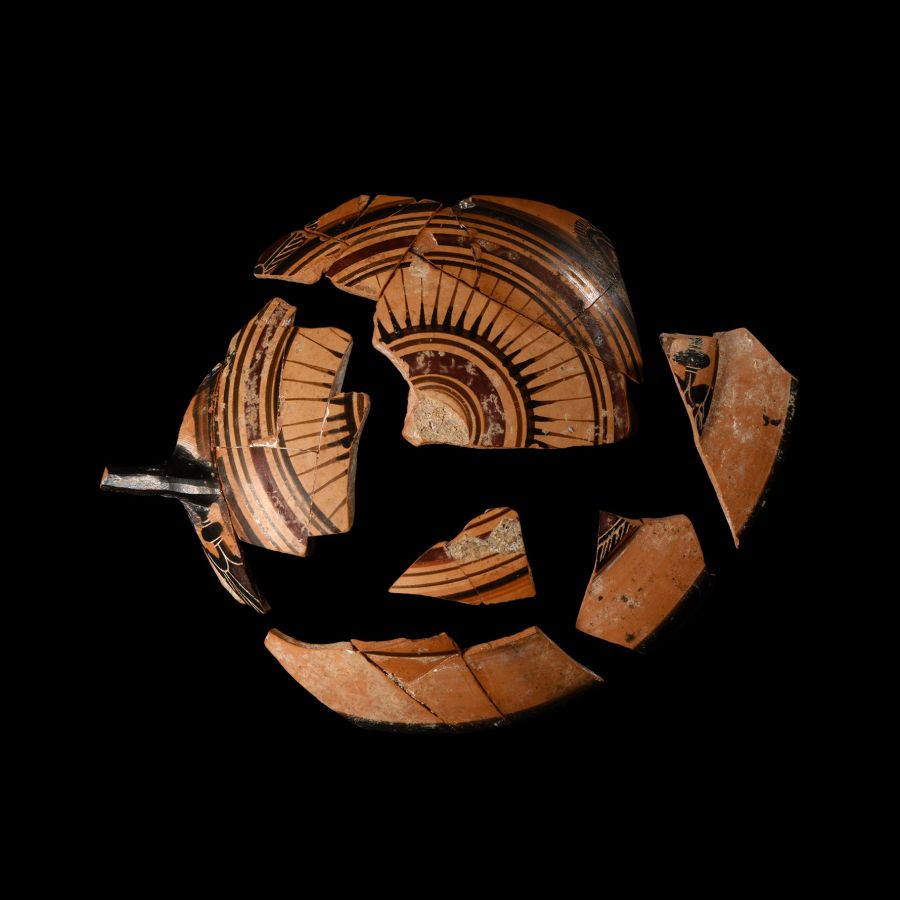
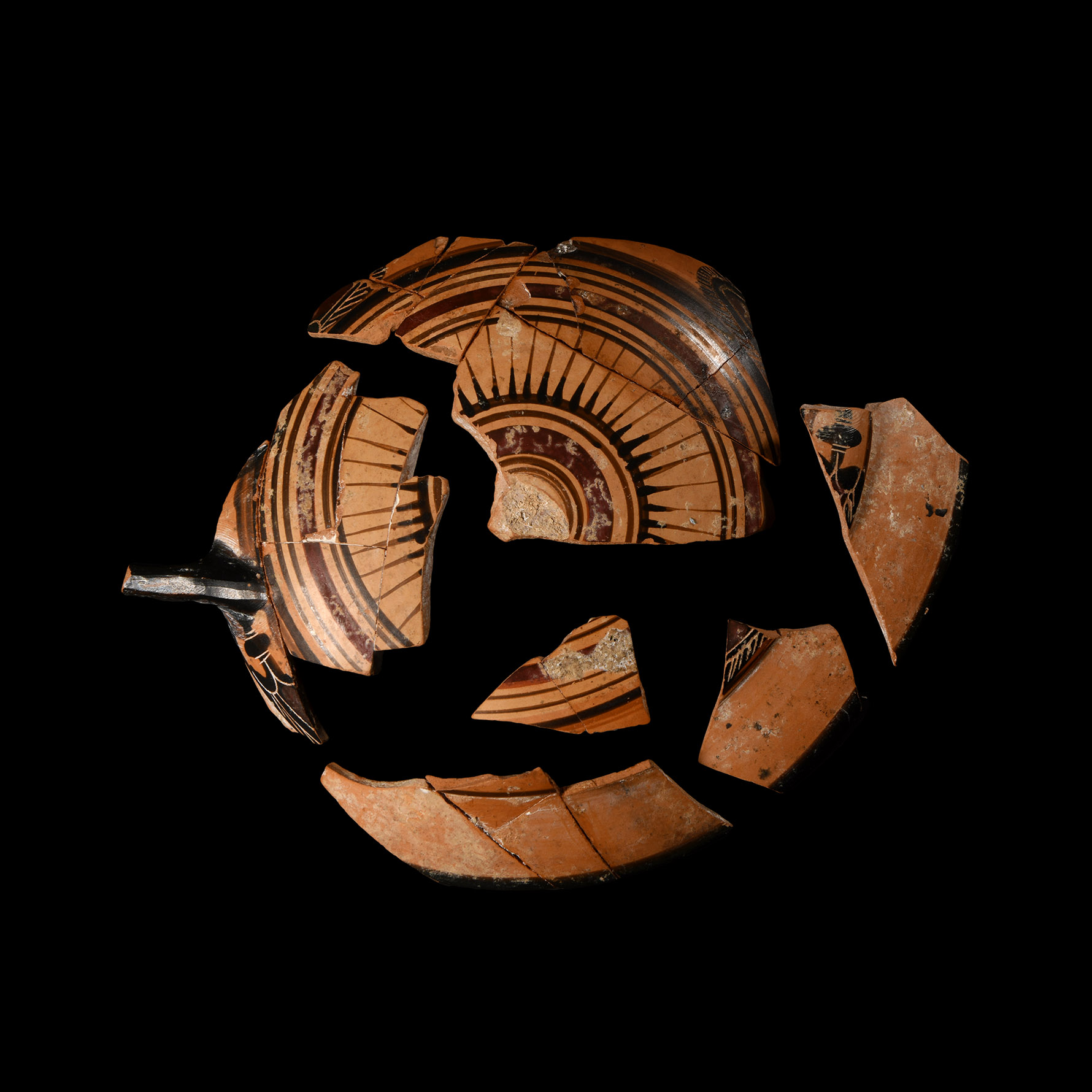
Greek Archaic Laconian Black-Figure Kylix Fragment Group Attributed to the Rider Painter
550-540 B.C.
1 3/8 - 3 1/2 in. (67 grams total, 34-89 mm).
Comprising six fragments from a bowl once decorated with concentric circles around a central disc with expanding black rays, remains of palmette to the sides of the handle; the internal base with two facing warriors holding spears and a wreath, the older one depicted with a beard. [6]
ProvenanceAcquired in Europe before 1990.
Private collection, Europe.
Accompanied by an academic report by Dr Raffaele D’Amato.
This lot has been checked against the Interpol Database of stolen works of art and is accompanied by search certificate number no.11820-206481.
Cf. a similar kylix with identical external decorations in the British Museum, accession no.1854,0810.4, from Sicyonia, and BM 1842,0407.7 in Walters, H.B., Forsdyke, E.J., Smith, C.H., Vase / Catalogue of Vases in the British Museum, London, 1893-1925, B1 and B3; Nicol, W., A Catalogue of the Greek and Etruscan Vases in the British Museum, London, 1851-1879, no.686.
FootnotesThe Rider Painter was a Laconian vase painter active between 560 and 530 B.C. and is considered to be one of the five great vase painters of Sparta. He painted various forms predominantly kylikes but also lebetes, a form rare in this area. He mainly painted scenes from mythology, such as figures like Cadmos or Heracles, and tales such as the blinding of Polyphemus. In addition, he realised pictures from everyday life. The attribution of these fragments to his workmanship can be supported by the motifs painted on the exterior decoration of the vessel, and by the shape of the birds and figures. The illustrated scene is fitting within the warrior society of Spartan Laconia.
CONDITIONTimeLine Auctions follows a vetting process to ensure the authenticity and legality of all items, reinforcing our commitment to integrity and responsible trading. Each antiquity, antique, and coin lot undergoes thorough examination by a vetting committee of at least ten external specialists, professional trade association members, scientists, and archaeologists: Our Vetting Process
AUCTIONS:
TimeLine is a leading auction house specialising in antiquities, ancient art, collectables, natural history, coins, medals, and books. Our auctions offer museums, collectors, historians, and enthusiasts the opportunity to acquire unique and historically significant pieces.
LOT 0089
Greek Archaic Laconian Black-Figure Kylix Fragment Group Attributed to the Rider Painter
Estimate £4,000 - 6,000€4,640 - 6,960 (for guidance only)$5,400 - 8,100 (for guidance only)
-
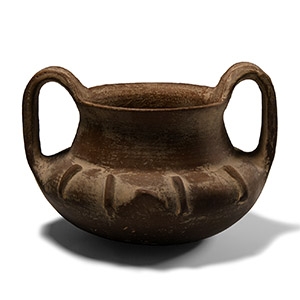
Etruscan Brownware Impasto Vase
8th-7th century B.C.Estimate: £1,000 - 1,400 (‡+bp*)
Opening Bid: £500
Biconical with a broad neck, everted rim and two high handles, shoulder decorated with high vertical ridges with conical knop at centre to two faces. 328 grams, 14.4 cm
Ex private Mister X. (1931-2017) collection. Sold in the benefit of the 'Croix-Rouge of Monaco'. -
.jpg)
Large Greek Apulian Red-Figured Knob-Handled Patera with Eros
Circa 350-320 B.C.Estimate: £5,000 - 7,000 (+bp*)
Opening Bid: £2,425
With raised rim and stepped foot, two strap handles to the rim each flanked by two domed studs; rim with reserved wave pattern band, studs with starburst motif; painted central scene with outer foliate bands and reserved wave pattern framing the tondo displaying Eros in flight with wings spread, holding a red cloth over an inverted shield; some repainting. 2.76 kg, 41 cm wide
Fine condition.
French collection, 1990s-early 2000s. Formerly in Patrick Declerck Auction, Douai, France, 2014, lot 72. From an important Paris gallery, France. Ex private Parisian collection. Accompanied by an original thermoluminescence analysis report no.N122j42 from Oxford Authentication. This lot has been checked against the Interpol Database of stolen works of art and is accompanied by search certificate no.11616-196567. -
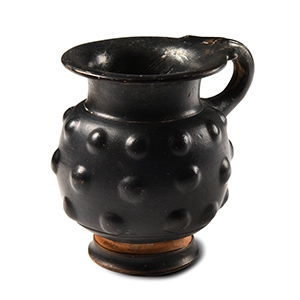
Greek Black-Glazed Pinecone Jug
5th-3rd century B.C.Sold for (Inc. bp): £1,040
With raised domes to the body, broad neck, everted rim, bifurcated handle, foot. 105 grams, 86 mm
Very fine condition.
Acquired European art market, 1980s-1990s. Private English collection.
