Loading, please wait...

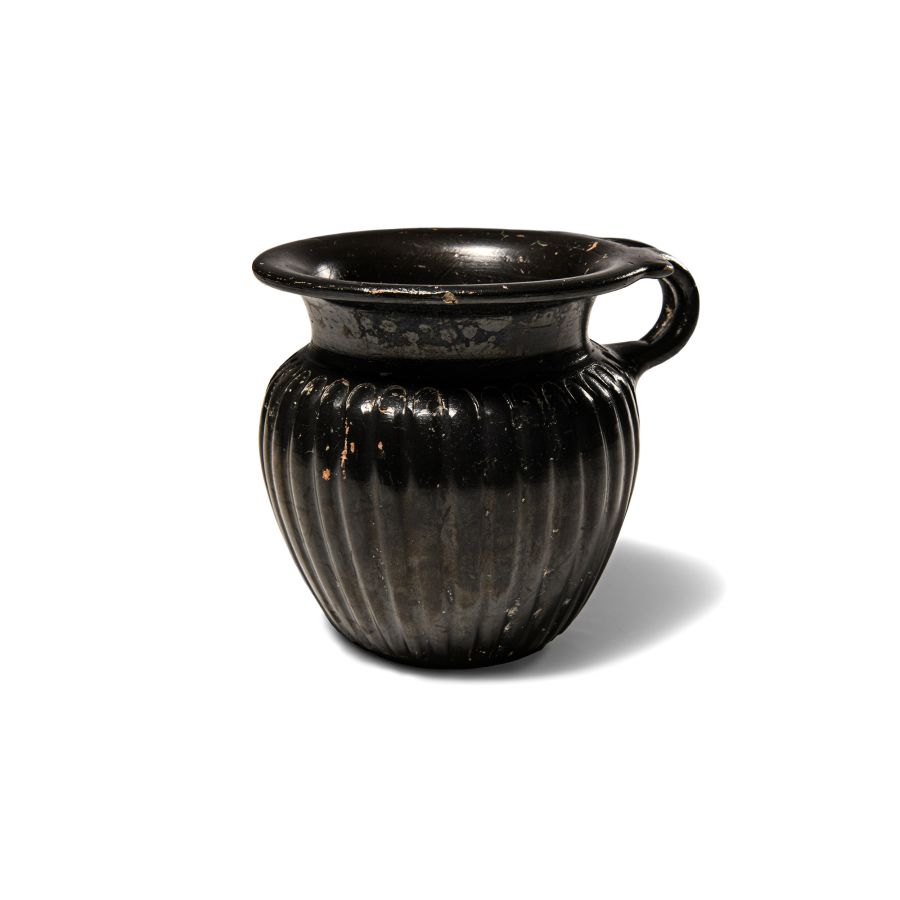
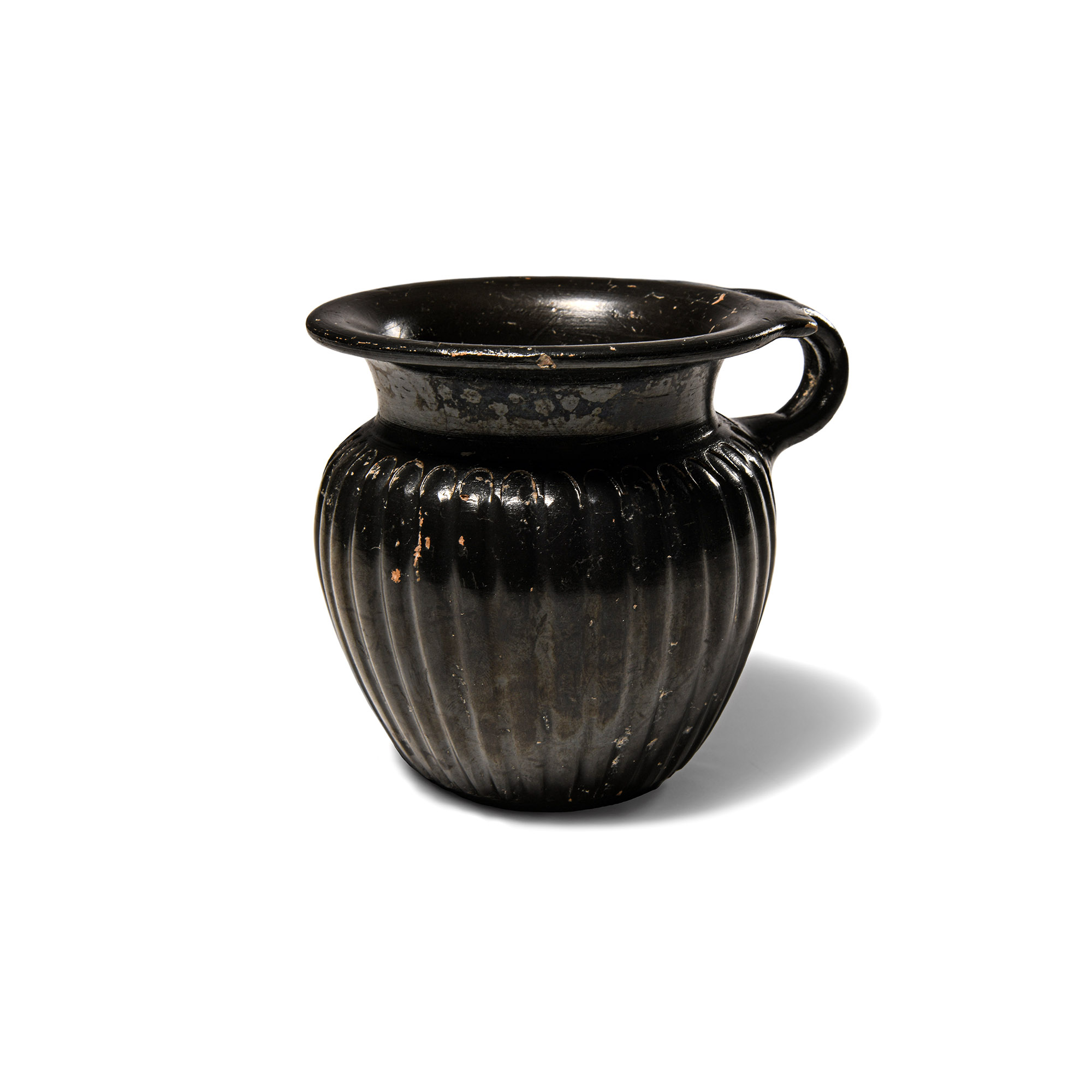
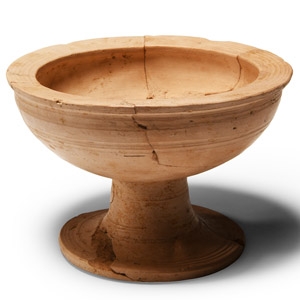
Greek Apulian High-Glazed Fluted Cup Greek Apulian High-Glazed Fluted Cup Greek Apulian High-Glazed Fluted Cup
Use mousewheel to zoom in and out, click to enlarge
Details

LOT 0103

Greek Apulian High-Glazed Fluted Cup

4TH CENTURY B.C.

3 1/2 in. (174 grams, 90 mm high).

Raised fluting decorating the body, broad c-section neck and everted rim, segmented openwork handle.

Provenance

Acquired in the 1960s-1970s.
Ex European private collection.

This lot has been checked against the Interpol Database of stolen works of art and is accompanied by search certificate number no.11856-206542.

Literature

Cf. The Metropolitan Museum, accession number 1983.571.4, for a very similar example.

CONDITION
VETTING:

TimeLine Auctions follows a vetting process to ensure the authenticity and legality of all items, reinforcing our commitment to integrity and responsible trading. Each antiquity, antique, and coin lot undergoes thorough examination by a vetting committee of at least ten external specialists, professional trade association members, scientists, and archaeologists: Our Vetting Process


AUCTIONS:

TimeLine is a leading auction house specialising in antiquities, ancient art, collectables, natural history, coins, medals, and books. Our auctions offer museums, collectors, historians, and enthusiasts the opportunity to acquire unique and historically significant pieces.

LOT 0103

Greek Apulian High-Glazed Fluted Cup

Estimate £2,000 - 3,000€2,320 - 3,480 (for guidance only)$2,700 - 4,050 (for guidance only)

Print page

RELATED LOTS
  • Hellenistic Gold Earrings with Lapis and Mother of Pearl
    Hellenistic Gold Earrings with Lapis and Mother of Pearl
    4th-2nd century B.C.

    Sold for (Inc. bp): £19,500

    Comprising a shallow disc with central flower motif inlaid with carnelian and lapis lazuli, surrounded by a beaded border, the outer pearled border inlaid with mostly replicant lapis lazuli, and mother of pearl inserts; three pendants to the lower edge, two with chain and carnelian bead, the central pendant formed as a miniature amphora with filigree, repaired; housed in a custom-made display box. 10.23 grams total, 57-61 mm


    Acquired by Tuyet Nguyet in the 1970s-1980s. From the jewellery collection of Tuyet Nguyet and Stephen Markbreiter. Important North West London collection. Accompanied by an academic report by Dr Raffaele D’Amato. This lot has been checked against the Interpol Database of stolen works of art and is accompanied by search certificate number no.11777-204568.

    Lot Details

  • Etruscan Bronze Statuette of Herakles
    Etruscan Bronze Statuette of Herakles
    4th-3rd century B.C.

    Estimate: £30,000 - 40,000 (‡+bp*)

    Opening Bid: £11,111

    Modelled in the round with a muscular nude body, his club lifted in his right hand behind his head, his hair dressed in rows of tight, close-set curls underneath a Nemean lionskin hood with cloak billowing over his left arm, the paws tied across his chest; mounted on a custom-made display stand. 290 grams total, 14.5 cm high (19.5 cm high including stand)

    Fine condition, excellent uniform patina.

    with Sotheby's, New York, 21 November 1985, lot 60. Ex private New York collection. Accompanied by an academic report by Dr Raffaele D'Amato. This lot has been checked against the Interpol Database of stolen works of art and is accompanied by search certificate number no.11794-206497.

    The statuette assumes the position of the 'attacking Hercules', which characterises numerous Etruscan statues of the hero of the classical era, however, with a less aggressive stance. The type was probably an Etruscan creation of the 5th century B.C., based on Greek models, which lasted until the end of the Hellenistic period, when Etruria was by then incorporated into the Roman world. This statuette, despite certain anatomical stylisation and an impersonal characterisation of the face, is the result of a good artistic and technical quality. The comparison of the artwork with the group identified as ‘Trieste’ from Colonna shows that this specimen is more recent and should be dated to the end of the Hellenistic Age. These small statuettes were probably offered ex-voto by the Romano-Etruscan aristocracy of the period.

    Lot Details

  • Greek Attic Black-Figure Lekythos with Fighting Hoplites
    Greek Attic Black-Figure Lekythos with Fighting Hoplites
    6th century B.C.

    Sold for (Inc. bp): £3,380

    The piriform body tapering towards the splayed foot, D-section strap handle and calyx-shaped mouth with flat rim; the body painted with a scene of two duelling hoplites, dressed in full armour comprising shields, greaves and helmets, dressed in short chitons and assisted by their arbiters holding staffs and dressed in long himation; the shoulder with palmette decoration and facing figures of a man and a woman with long garments around the shoulder; restored. 381 grams, 23 cm high


    Old Swiss collection. Acquired in Europe before 2011. Private collection, Europe. Accompanied by an academic report by Dr Raffaele D’Amato. This lot has been checked against the Interpol Database of stolen works of art and is accompanied by search certificate number no.11815-206482.

    To the Greeks, lekythoi were containers for dispensing oil. The characteristics shape of this vessel was that of a long body, narrow neck, one handle and a cup-shaped mouth. The shape was fit for the function of the lekythos: the narrow neck prevented the unnecessary loss of oil by enabling small amounts to be distributed evenly and the mouth to collect the excess. The represented scene is probably taken from the Iliad and could represent the combat between Ajax and Hector, assisted by arbiters.

    Lot Details

Stay up-to-date with the latest from TimeLine Auctions by joining our mailing list