
Loading, please wait...
LOT 0057
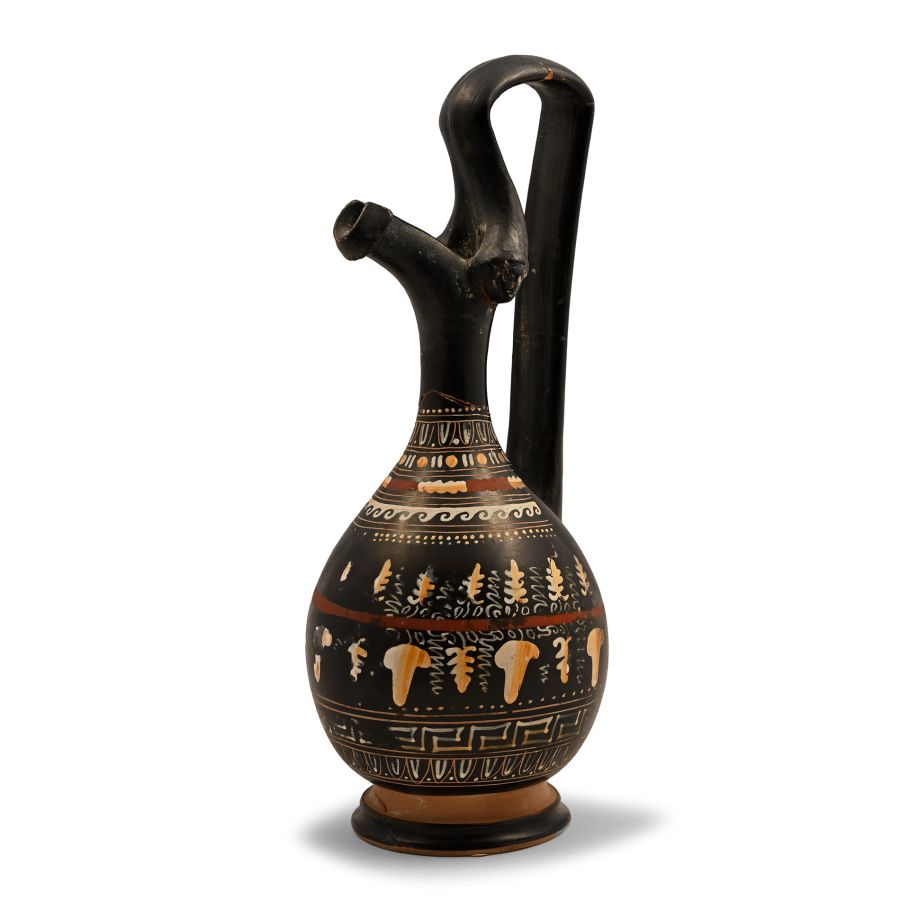
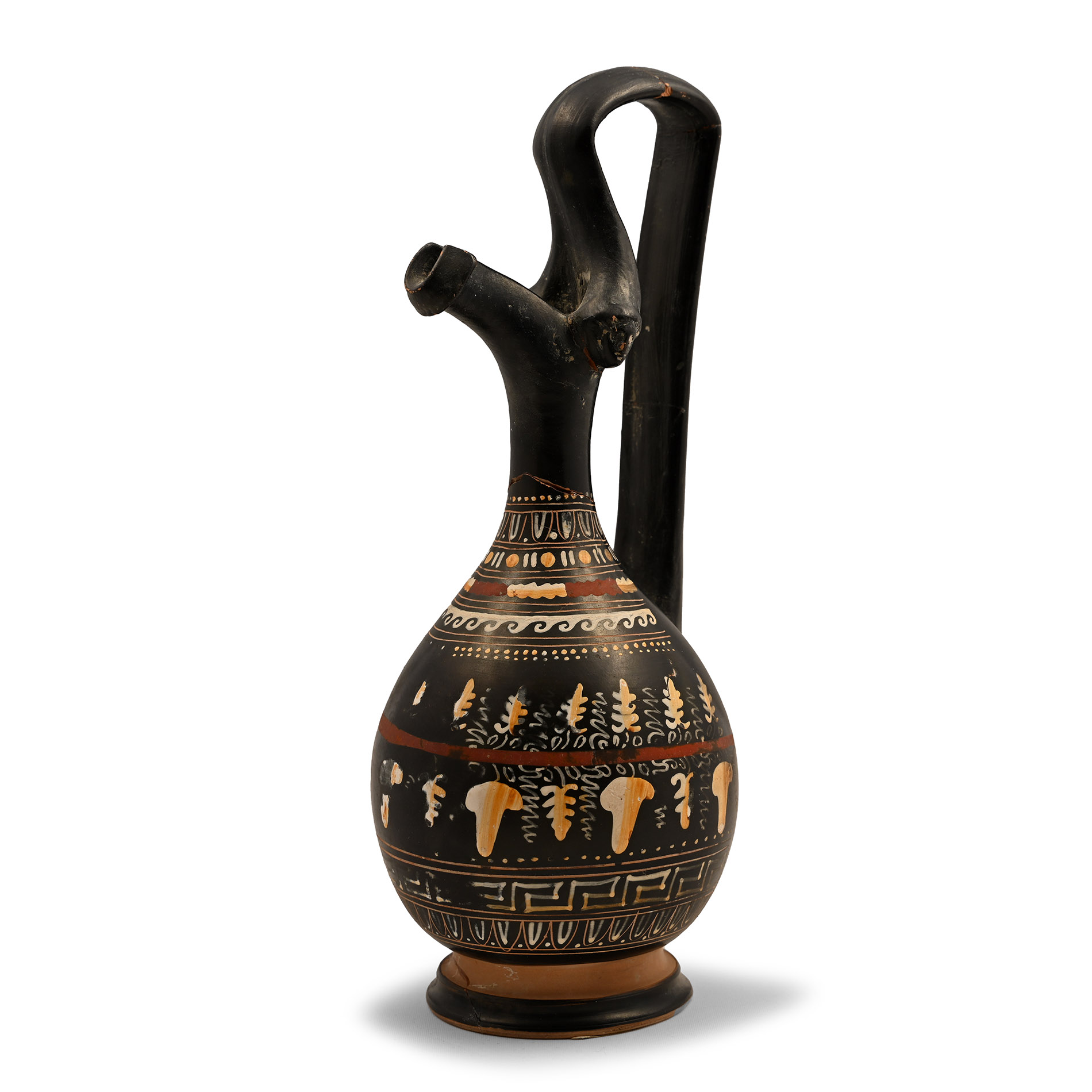
Greek Apulian Black-Glazed Prochous
CIRCA 320 B.C.
7 1/4 in. (176 grams, 18.3 cm).
With pedestal base, piriform body, tapering neck with beak-like spout and tall strap handle to the rear; the body painted in a series of bands of strokes, ovolo motifs, waves, pellets and pendant vineleaves in white, cream and ochre; label to underside 'Apulian Gnathian Prochous CA. 320 B.C.'.
ProvenanceEx Fred Bentley Sr. GA (1926-2019).
with Ahlers & Ogletree Inc., USA, 10 November 2023, no.343.
Private collection, UK.
This lot is accompanied by an illustrated lot declaration signed by the Head of the Antiquities Department, Dr Raffaele D’Amato.
TimeLine Auctions follows a vetting process to ensure the authenticity and legality of all items, reinforcing our commitment to integrity and responsible trading. Each antiquity, antique, and coin lot undergoes thorough examination by a vetting committee of at least ten external specialists, professional trade association members, scientists, and archaeologists: Our Vetting Process
AUCTIONS:
TimeLine is a leading auction house specialising in antiquities, ancient art, collectables, natural history, coins, medals, and books. Our auctions offer museums, collectors, historians, and enthusiasts the opportunity to acquire unique and historically significant pieces.
-
.jpg)
Proto-Corinthian Painted Pottery Cup
7th century B.C.Sold for (Inc. bp): £650
Broadly conical in form, with rounded shoulder, inverted rim, two slender D-shaped handles and gently splayed foot; painted polychrome concentric bands to the inner and outer faces and geometric sunburst pattern around the foot; restored. 70.9 grams, 16 cm
Acquired in the 1960s-1970s. Ex European private collection. This lot is accompanied by an illustrated lot declaration signed by the Head of the Antiquities Department, Dr Raffaele D’Amato.
Cups of this typology, with glaze covering the body and even the foot occur in abundance at most sites where Corinthian imports are found. In Proto-Corinthian (soon after the middle of the seventh century) one finds both linear ornament and a neat, lively figure style, mostly with animals, which is inspired to some extent by eastern motifs such as lions and panthers. -
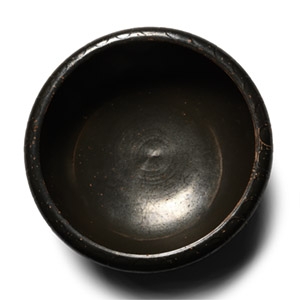
Greek Black-Glazed Terracotta Bowl with Stamped Decoration
Circa 330 B.C.Estimate: £200 - 300 (‡+bp*)
Opening Bid: £90
Flat bowl on a ring-base, convex rim decorated with a flat-profiled tongue-leaf frieze and fine groove beneath. 183 grams, 12.2 cm
with Galerie Gilgamesh, prior 2003. Accompanied by a copy of an Art Loss Register certificate no.S00035402. This lot is accompanied by an illustrated lot declaration signed by the Head of the Antiquities Department, Dr Raffaele D’Amato. -
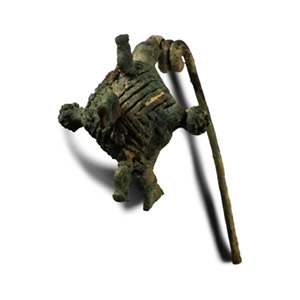
Italic Navicella Bronze Fibula with Figural Decoration
7th century B.C.Sold for (Inc. bp): £52
With navicella-shaped bow decorated with incised parallel lines, three miniature appliqués in the form of stylised monkeys and two lateral knops, foot preserved, pin tip absent. 29.4 grams, 68 mm
W. Rosenbaum, Ascona, before 1984. Accompanied by a copy of an Art Loss Register certificate no.S00091284. This lot is accompanied by an illustrated lot declaration signed by the Head of the Antiquities Department, Dr Raffaele D’Amato.
