
Loading, please wait...
LOT 0565
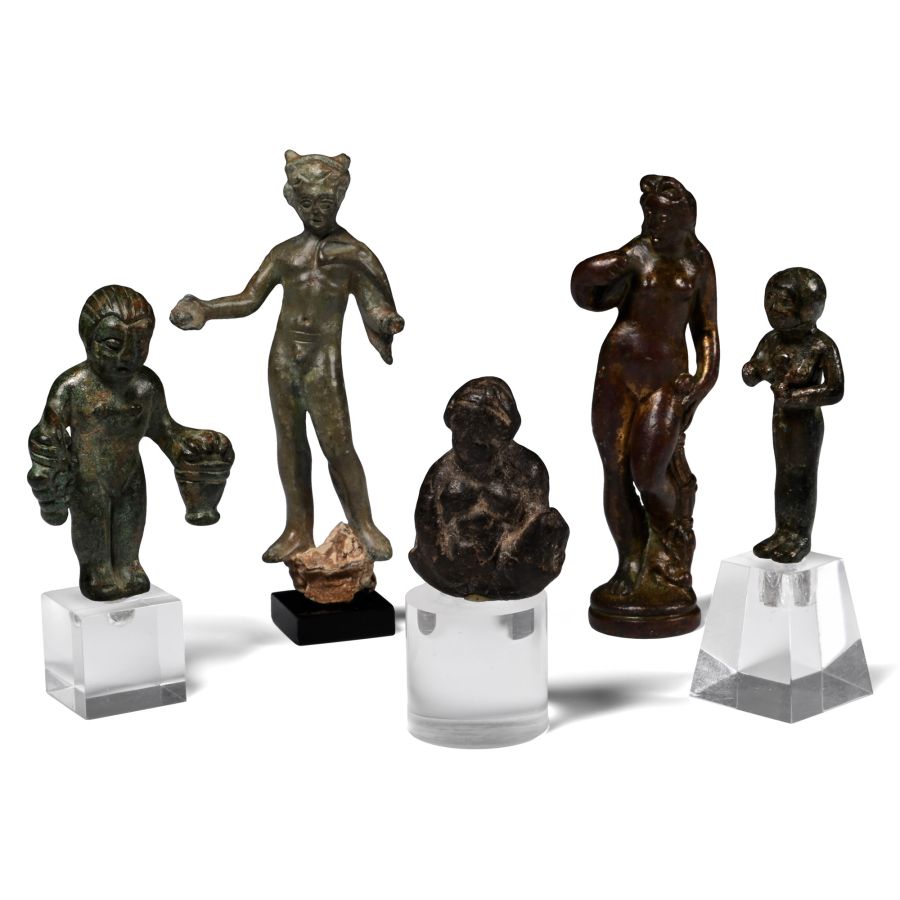
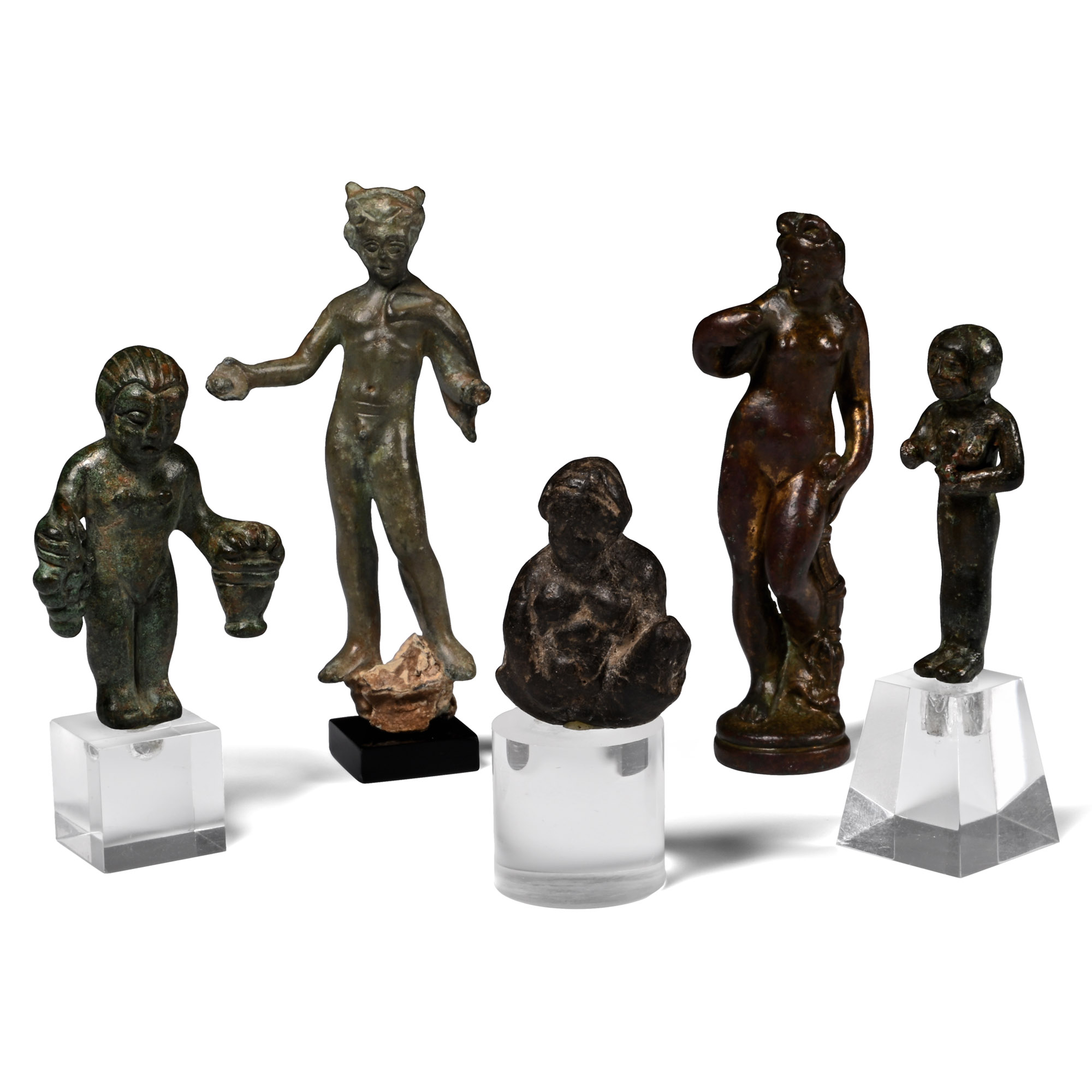
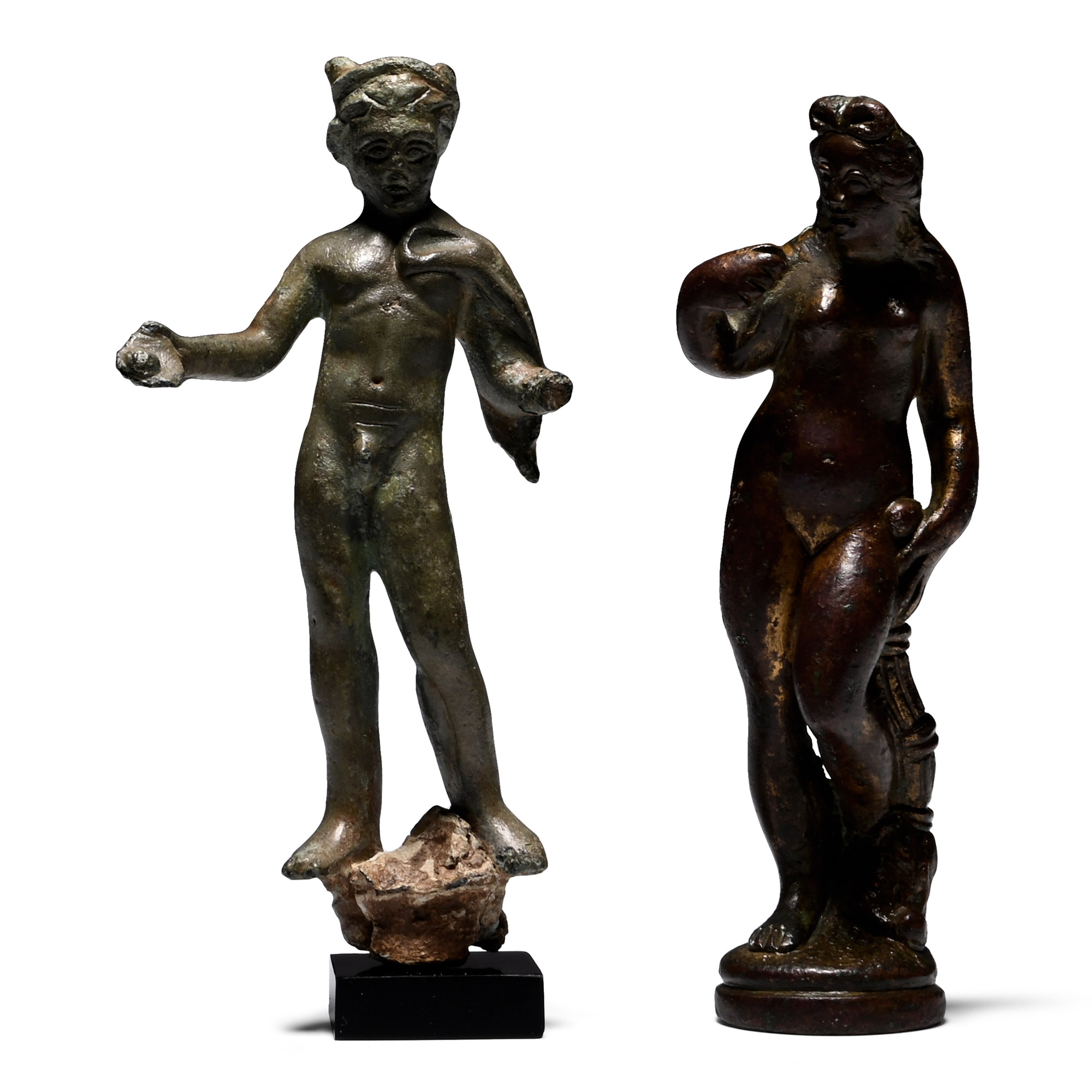
Greek and Roman Bronze Statue Collection
4TH CENTURY B.C.-4TH CENTURY A.D.
2 1/2 - 3 3/4 in. (352 grams total, 63-96 mm).
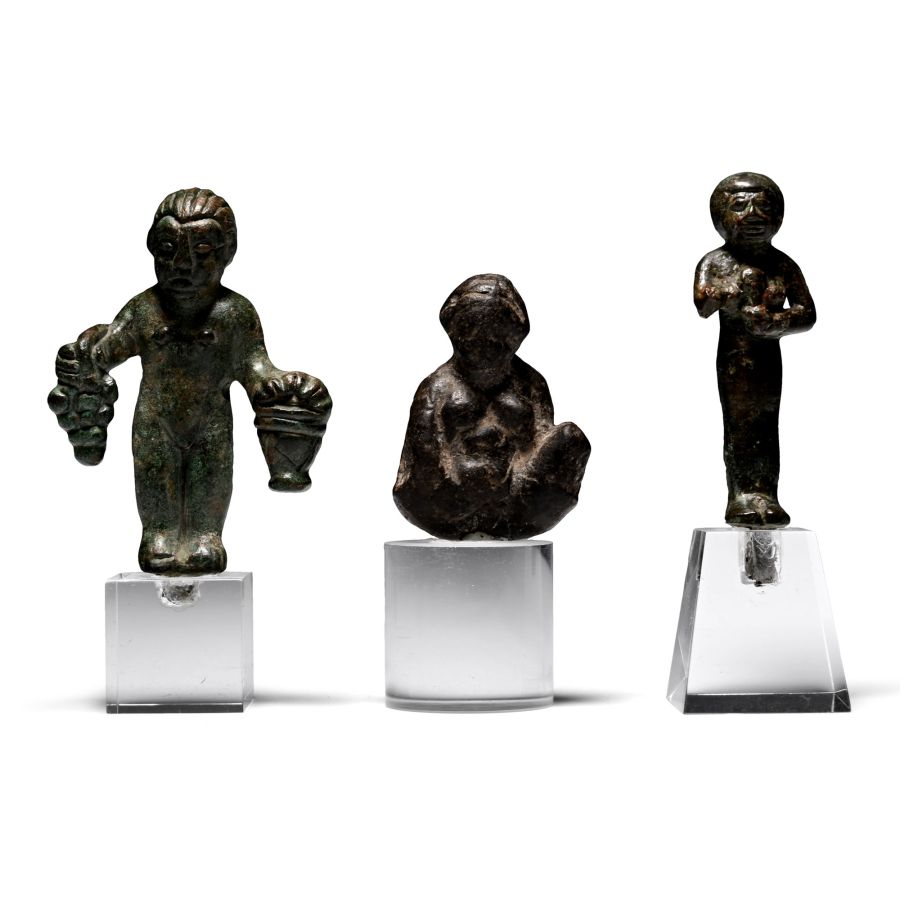
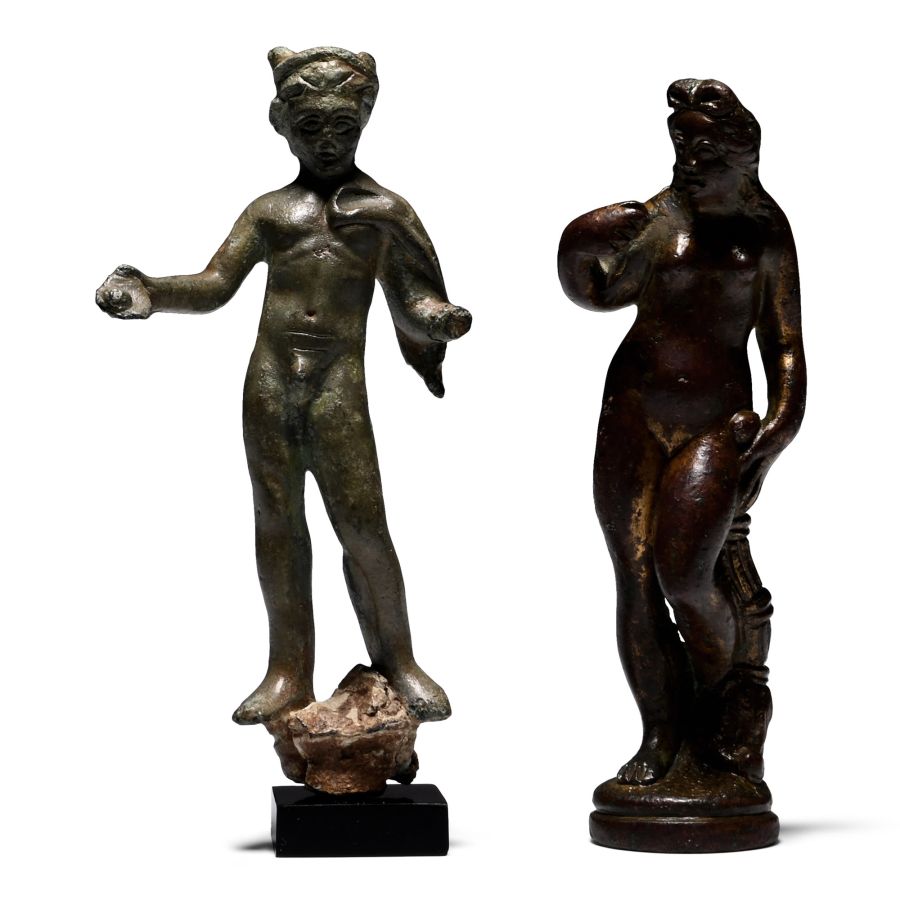
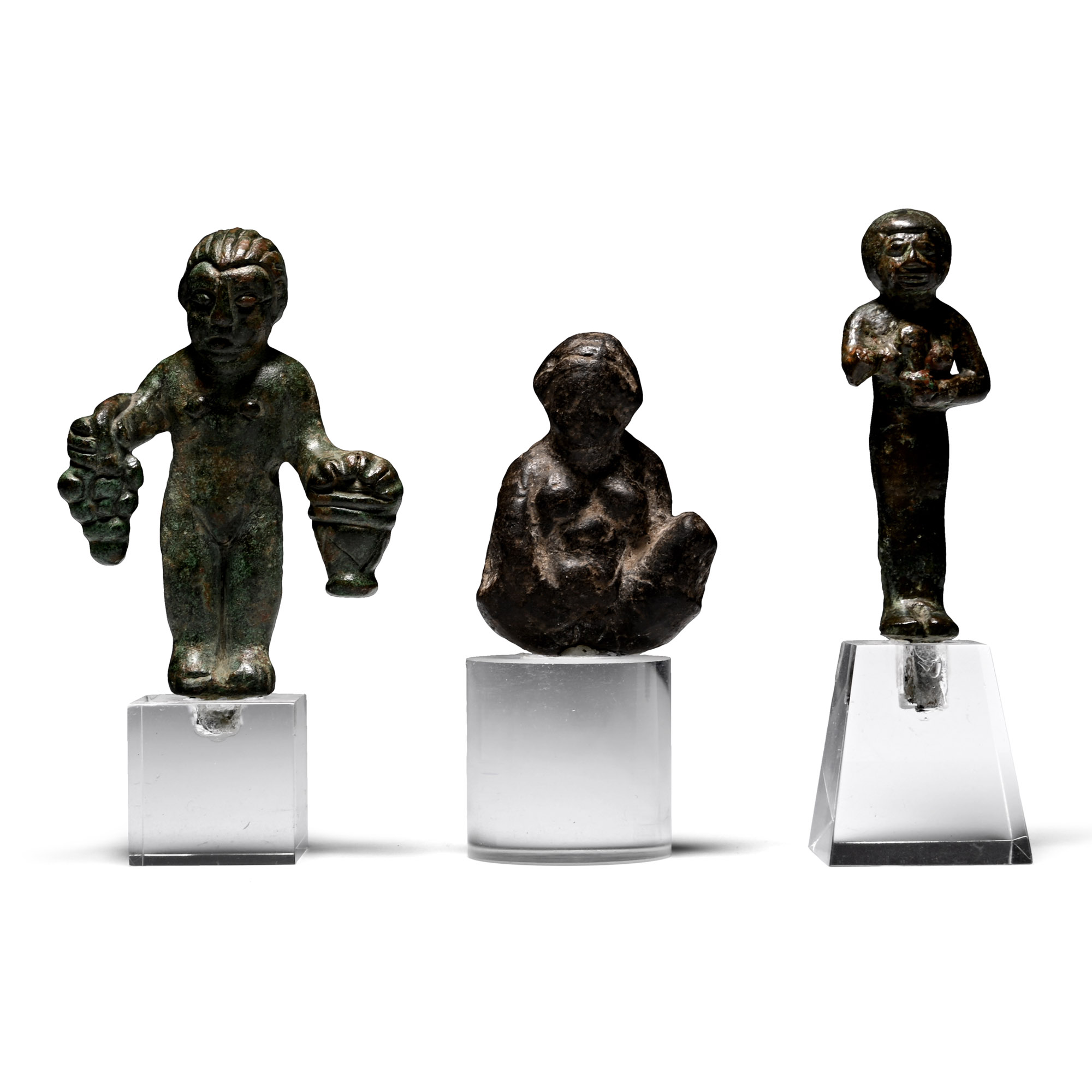
Comprising: an Etruscan figure of Turms (Greek Hermes), standing and holding a patera in his right hand, original lead mounting beneath; a standing figure of nude Aphrodite, possibly later; a figure of Baubo with her legs bent and right hand touching her genitals; two standing bronze figures holding offerings. [5, No Reserve]
ProvenanceHermes from the estate of a Swiss gentleman, Ticino, before 1970.
Sardinian figure ex private collection of Prof. Dr Hans (1918-1984) and Dr Ines (1922-2013) Jucker, classical archaeologists, Bern, Switzerland.
with Galerie Rhéa, Zurich, Switzerland.
This lot has been checked against the Interpol Database of stolen works of art and is accompanied by a search certificate number no.12669-236450.
Cf. similar bronze statuettes of Augur in Torelli, M., Gli Etruschi, Monza, 2000, p.180, Turms, idem, p.372; cf. Rolland, H., Bronzes Antiques de Haute Provence, Paris, 1965, items 27, for the type of Hermes; for Baubo’s statuettes see Nagwa Abdelnaby, A.I., ‘Two unpublished Figurines of Women Purifying themselves in the Greco-Roman Museum of Alexandria’ in Bulletin of the Center Payrological, 38 (1), November 2021, pp.645-664, figs.3, lett. A and D.
FootnotesBaubo was a minor divinity of Greek mythology, linked to the cult of Demeter and Persephone. The Egyptian Baubo figures are split into two groups. In some of these figurines her right hand is touching her genitalia. All these statuettes were votive offerings to the gods, and many of them were used as amulets.
CONDITIONTimeLine Auctions follows a vetting process to ensure the authenticity and legality of all items, reinforcing our commitment to integrity and responsible trading. Each antiquity, antique, and coin lot undergoes thorough examination by a vetting committee of at least ten external specialists, professional trade association members, scientists, and archaeologists: Our Vetting Process
AUCTIONS:
TimeLine is a leading auction house specialising in antiquities, ancient art, collectables, natural history, coins, medals, and books. Our auctions offer museums, collectors, historians, and enthusiasts the opportunity to acquire unique and historically significant pieces.
-
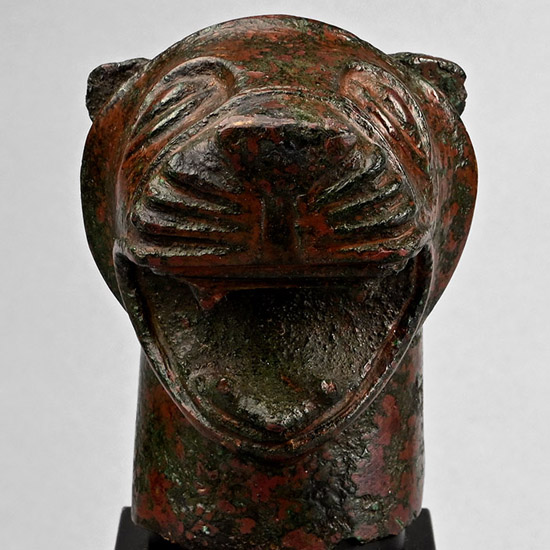
Etruscan Bronze Lion Head
Central Italy, late 6th century B.C.Estimate: £7,000 - 9,000 (‡+bp*)
Opening Bid: £3,600
A decorative fitting with roaring mouth and protruding fangs and tongue, the whiskers depicted in raised radiating ridges, with lidded, elongated almond-shaped eyes and small, round ears; mounted on a custom-made display stand. 1.11 kg total, 17.5 cm including stand
with Christie’s, New York, 8 June 2001, no.58. Donati collection, Lugano, prior to 1982. Collection of Banca della Svizzera Italiana, Lugano, prior to 1986. Formerly in the Bourgknecht collection, Switzerland. Accompanied by Art Loss certificate no.S00123227. This lot has been checked against the Interpol Database of stolen works of art and is accompanied by a search certificate number no.13230-249992.
This head was probably, as was the parallel head of the Barberini Tomb, originally attached to a magnificent bronze cauldron. These large cauldrons of hammered bronze were realised with the heads and necks of two lions and two gryphons attached to the rim. The cauldrons were spherical in form and rested on a stand. -
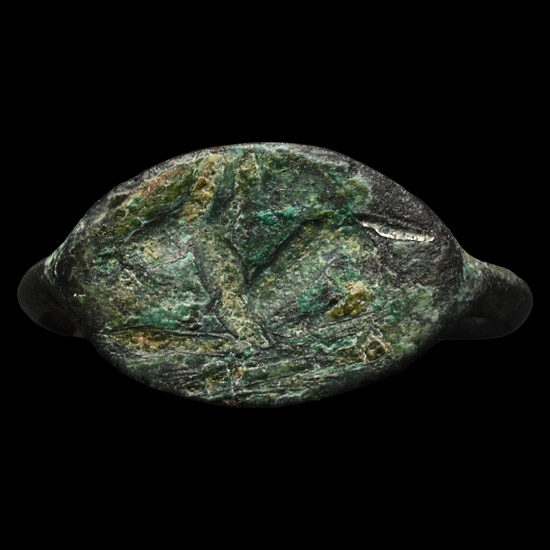
Greek Bronze Zoomorphic Ring
Circa 4th-2nd century B.C.Sold for (Inc. bp): £39
Comprising a slender hoop and a lentoid bezel with a leaping quadruped. 1.89 grams, 18.18 mm overal, 16.29 mm internal diameter (approximate size British K 1/2, USA 5 1/2, Europe 10.58, Japan 10)
From the private collection of a European gentleman (1942-2024), formed since the 1970s. -
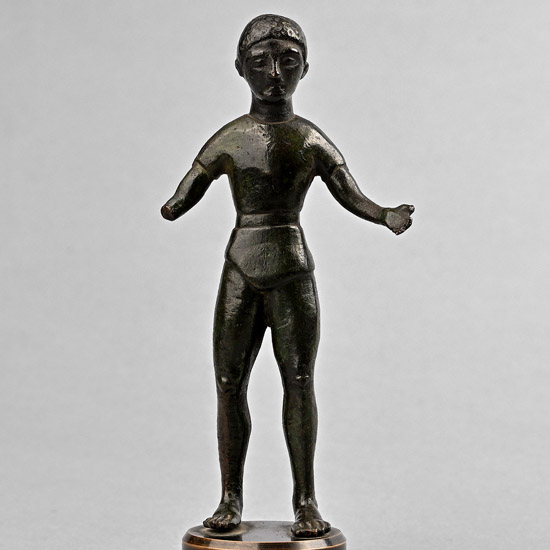
Iberian Bronze Statuette of Youth
6th-4th century B.C.Estimate: £2,500 - 3,500 (‡+bp*)
Opening Bid: £1,333
Youthful male standing, wearing a belted tunic with apron, arms spread wide, barefoot, bare-headed with short textured hair; mounted on a custom-made base. 215 grams total, 11.8 cm high including stand
Private collection, Paris, France, assembled in the 1950s-1960s. with Tessier-Sarrou & Associés, Paris, 2015. European private collection. Accompanied by a copy of an Art Loss Register certificate, no.S00107108. Accompanied by a copy of French cultural export passport no.167803. This lot has been checked against the Interpol Database of stolen works of art and is accompanied by a search certificate number no.12650-264612.
