
Loading, please wait...
LOT 1118
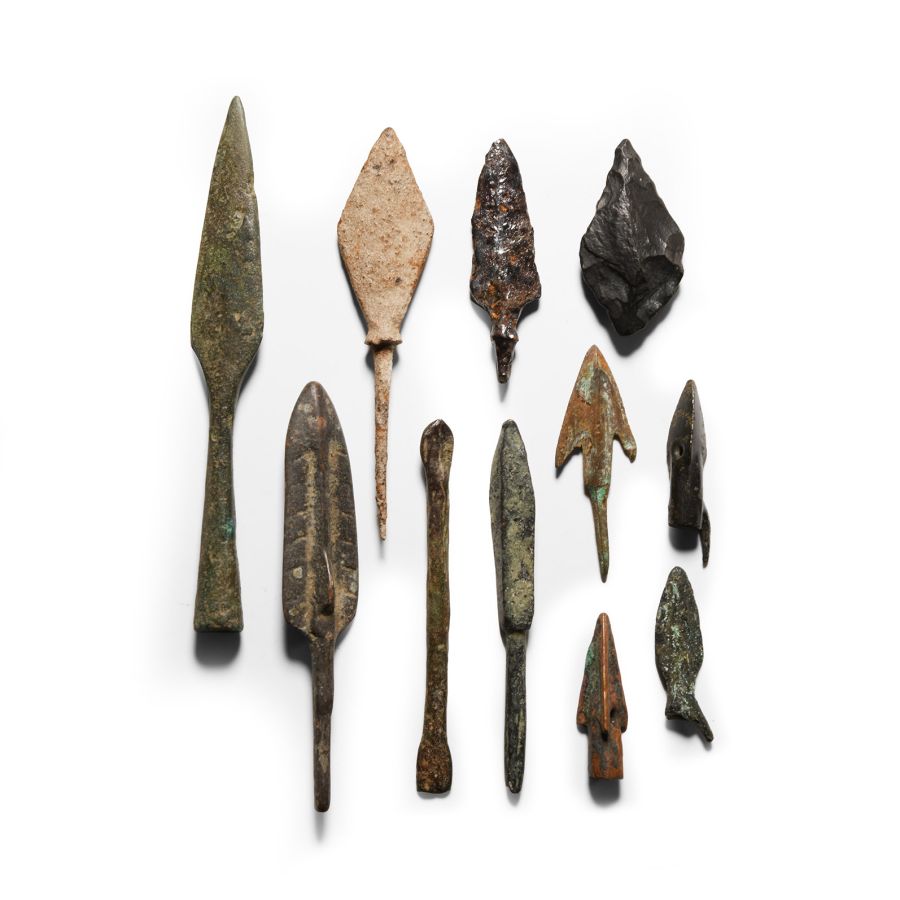
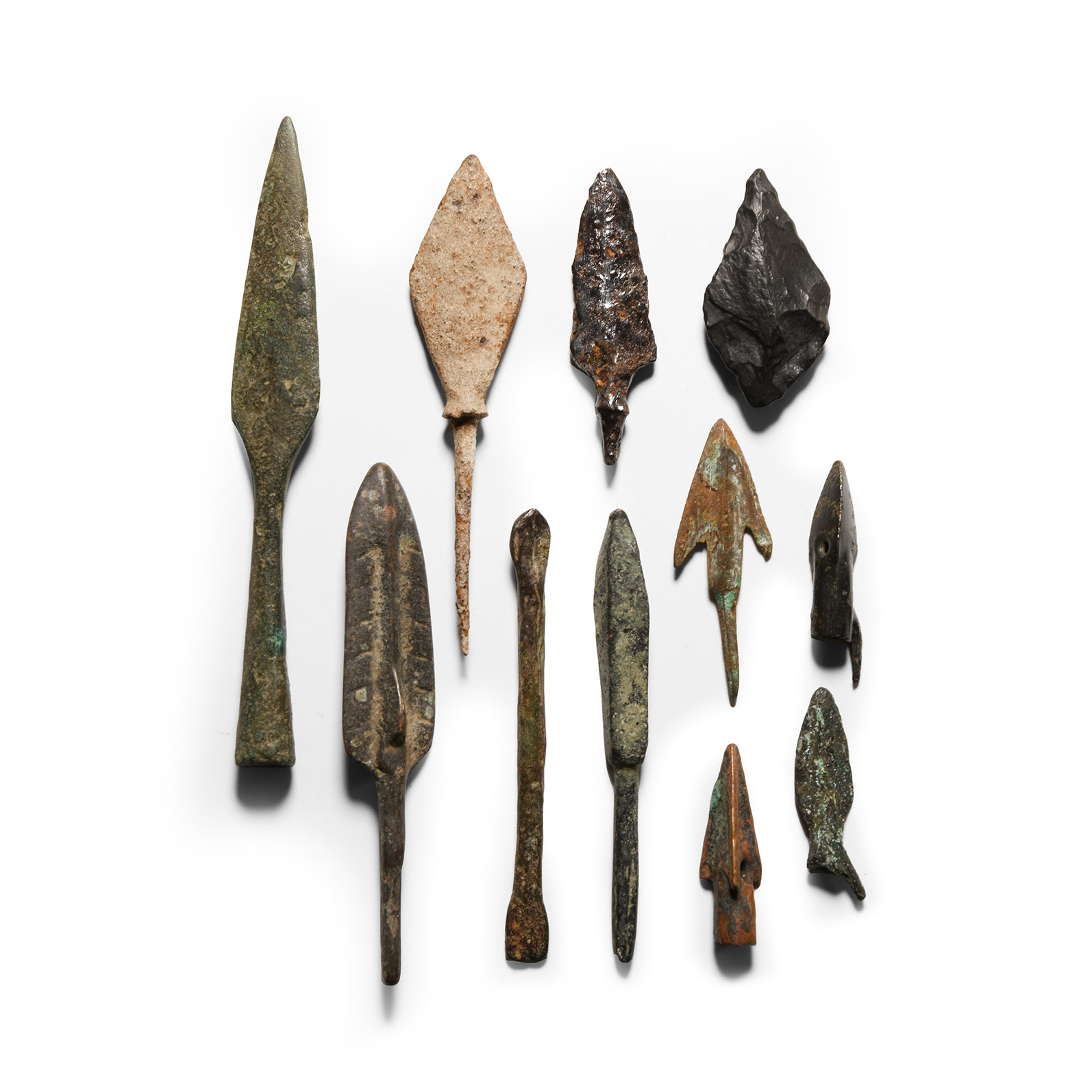
Greek and Other Mixed Arrowhead Collection
CIRCA 17TH MILLENNIUM B.C.-6TH CENTURY A.D.
1 1/4 - 3 3/4 in. (75 grams total, 32-96 mm).
Comprising a Mesolithic flint arrowhead of triangular form; a paddle shaped arrowhead with a flat, comparatively wide mid-rib (Elamite or Old Babylonian); a fully developed bronze arrowhead with a large lozenge-section midrib and triangular barbed blade; an arrowhead with a long slender blade with rounded shoulders and wide flat mid-rib (both Luristan); two bronze arrowheads with slender lozenge-shaped blade and socket extending near the tip, with a side lug (Scythian); a lozenge form blade with a wide socket and high mid-rib (Greek); a large arrowhead with leaf-shaped blade and thin stop ridge collar; a sub-triangular arrowhead with the blade running diagonally to the stop ridge collar at its base; a lozenge-shaped arrowhead with a flat blade, circular stop ridge and long spiked tang (all three Roman); a bronze votive arrow. [11, No Reserve]
ProvenanceAcquired on the UK art market.
Property of a Ruislip, UK, gentleman, by inheritance.
Cf. similar Graeco-Persian arrowheads in Head, D., The Achaemenid Persian Army, Stockport, 1992, fig.13.
FootnotesIn the Greek warfare, archers were mainly employed by Scythians and Cretans. Both used composite bows made of wood, horn, bone and sinew. This explains the great range of Scythian arrowheads also found on the Greek sites.
CONDITIONTimeLine Auctions follows a vetting process to ensure the authenticity and legality of all items, reinforcing our commitment to integrity and responsible trading. Each antiquity, antique, and coin lot undergoes thorough examination by a vetting committee of at least ten external specialists, professional trade association members, scientists, and archaeologists: Our Vetting Process
AUCTIONS:
TimeLine is a leading auction house specialising in antiquities, ancient art, collectables, natural history, coins, medals, and books. Our auctions offer museums, collectors, historians, and enthusiasts the opportunity to acquire unique and historically significant pieces.
-
Greek and Other Mixed Arrowhead Collection
Circa 17th millennium B.C.-6th century A.D.Sold for (Inc. bp): £78
Comprising a Mesolithic flint arrowhead of triangular form; a paddle shaped arrowhead with a flat, comparatively wide mid-rib (Elamite or Old Babylonian); a fully developed bronze arrowhead with a large lozenge-section midrib and triangular barbed blade; an arrowhead with a long slender blade with rounded shoulders and wide flat mid-rib (both Luristan); two bronze arrowheads with slender lozenge-shaped blade and socket extending near the tip, with a side lug (Scythian); a lozenge form blade with a wide socket and high mid-rib (Greek); a large arrowhead with leaf-shaped blade and thin stop ridge collar; a sub-triangular arrowhead with the blade running diagonally to the stop ridge collar at its base; a lozenge-shaped arrowhead with a flat blade, circular stop ridge and long spiked tang (all three Roman); a bronze votive arrow. 75 grams total, 32-96 mm
Acquired on the UK art market. Property of a Ruislip, UK, gentleman, by inheritance.
In the Greek warfare, archers were mainly employed by Scythians and Cretans. Both used composite bows made of wood, horn, bone and sinew. This explains the great range of Scythian arrowheads also found on the Greek sites. -
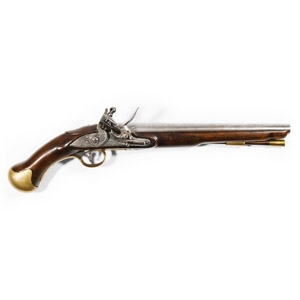
Tower Long Sea Service Flintlock Pistol
1800 A.D.Estimate: £2,000 - 3,000 (+bp*)
Opening Bid: £1,111
Napoleonic era with 30cm (12") round smooth bore barrel of .56" bore with London proof marks, the lock with 'TOWER', 'crown-over-GR' and 'crown-over-broad-arrow' marks fitted with brass-tipped wood ramrod and wood full stock and butt with brass butt cap, trigger guard, side plate and ferrule with steel belt hook; action working to half and full cock. 1.40 kg, 49 cm
Acquired from Andrew Bottomley, UK. The Kusmirek Collection, UK. Accompanied by a copy of the Bottomley listing. This lot has been checked against the Interpol Database of stolen works of art and is accompanied by search certificate no.204079.
Sold as an exempt item under Section 58 (2) of the Firearms Act, 1968, to be held as a curiosity or ornament. No license required but buyer must be over 18 years of age. Overseas bidders should note that, due to UK regulations governing export of all firearms, overseas buyers will need to make arrangements for shipping this lot out of the UK directly, by air freight, with a specialist company or agent. -
.jpg)
Large Byzantine Silver Archer's Ring
14th-15th century A.D.Sold for (Inc. bp): £520
Comprising a hoop with reserved triangular ornament on the edges and triangular plaque with foliage motifs, raised central panel with frond motif. 22.61 grams, 34.77 mm overall, 25.16 mm internal diameter
Acquired in the 1990s. Ex Cambridgeshire, UK, collection.
Archer rings in Late Byzantium and the medieval Balkans were connected with the employment of the powerful composite bow, but very often, in the 14th century they served as insignia of rank for aristocratic noblemen. Archaeological findings of archers’ rings originate mainly from fortified towns, including mining centres. Many were made in bone, simple in design and undecorated. In contrast, the ones made in bronze and silver were usually decorated in rather uniform style, consisting of floral motifs on the head, mostly tulip and foliage, and linear motifs around the edges. This decoration combined Turkish, Central European and Eastern Roman traditional patterns.
