
Loading, please wait...
LOT 1174
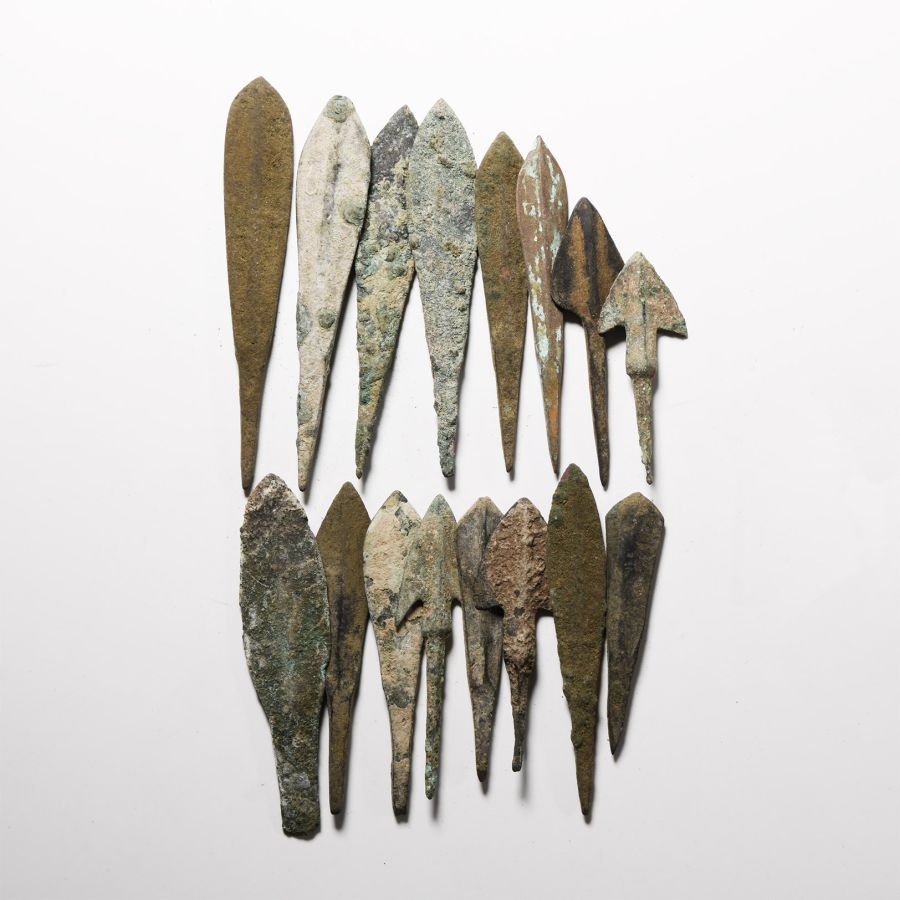
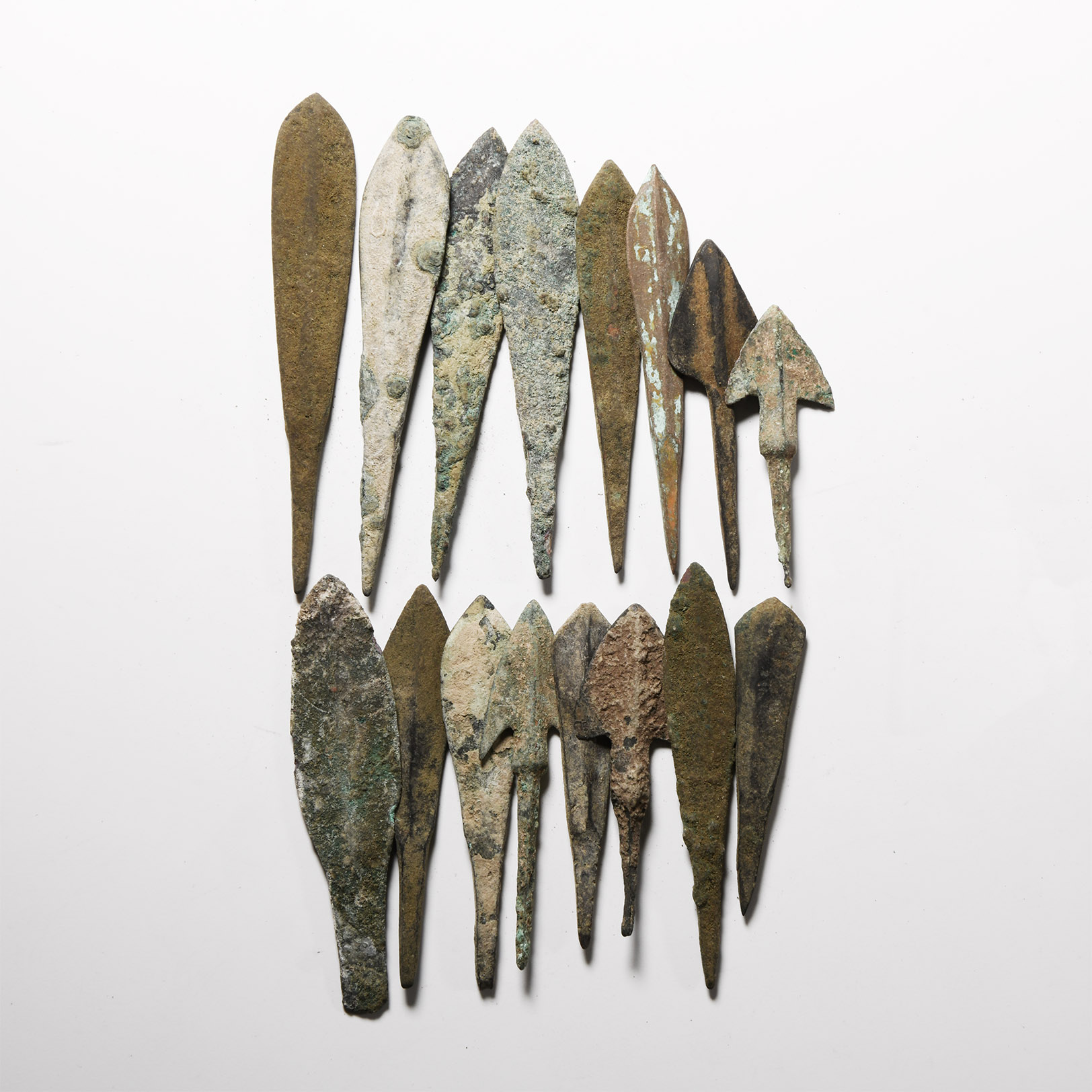
Greek and Other Bronze Tanged Arrowhead Collection
CIRCA 12TH-4TH CENTURY B.C.
2 - 3 3/8 in. (141 grams total, 49-85 mm).
Comprising three tanged Luristan arrowheads, having elongated triangular blades and raised midrib, sharp central groove, cylindrical stem with handle for the shaft and barbed shoulders; eleven Greek paddle-shaped arrowheads with a flat and wide mid-rib, the blade shaped to a point; a small Persian or Greek foliate arrowhead with a long tang; a flat and foliate bronze arrowhead. [16]
ProvenanceAcquired 1980-2015.
Ex Abelita family collection.
Cf. Metropolitan Museum of Art, accession no. 26.199.291, for the Greek arrowheads; for the three Luristan examples see Khorasani, M.M., Arms and Armour from Iran. The Bronze Age to the End of the Qajar Period, Tübingen, 2006, fig.467.
FootnotesIn Greek warfare, archers were mainly employed by Scythians and Cretans. Both used composite bows made of wood, horn, bone and sinew. The Luristan examples seem to belong to the type V, subcategory C of triangular arrowheads according to the classification of Khorasani and Negahban.
CONDITIONTimeLine Auctions follows a vetting process to ensure the authenticity and legality of all items, reinforcing our commitment to integrity and responsible trading. Each antiquity, antique, and coin lot undergoes thorough examination by a vetting committee of at least ten external specialists, professional trade association members, scientists, and archaeologists: Our Vetting Process
AUCTIONS:
TimeLine is a leading auction house specialising in antiquities, ancient art, collectables, natural history, coins, medals, and books. Our auctions offer museums, collectors, historians, and enthusiasts the opportunity to acquire unique and historically significant pieces.
LOT 1174
Greek and Other Bronze Tanged Arrowhead Collection
Estimate £100 - 140€120 - 160 (for guidance only)$140 - 190 (for guidance only)
-
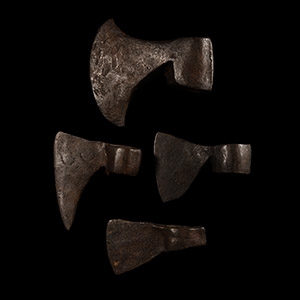
Medieval Iron Axehead Collection
Circa 14th-16th century A.D.Sold for (Inc. bp): £186
Composed of a variety of axehead types, each with a roughly circular socket, including one example with punched crescents to one face. 1.5 kg total, 9.1 - 12.8 cm
Ex property of B.C., previously in a 1970s collection. Property of a Ruislip, UK, gentleman, by inheritance. Accompanied by a previous dealer's certificate of authenticity. -
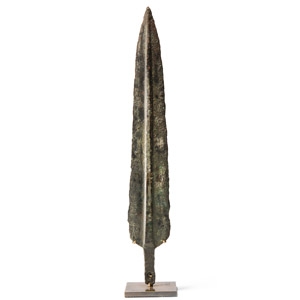
North-West Persian Bronze Dagger
Early 1st millennium B.C.Sold for (Inc. bp): £468
With long tapered blade, rounded shoulders and broad flattened mid-rib, tapered square sectioned tang pierced at the tip. 298 grams total, 29.2 cm high including stand
Dr. T.J. Arne, Sweden, 1934. Private collection, Sweden, late 1930s. with Stockholm Auktionsverk, Stockholm, Sweden, 9 June 2014, lot 2613.
This tanged bronze blade from Luristan belongs to a category of Luristan swords still in use in the Achaemenid Period, as proved from a blade with a perished handle (probably bone or wood) of the same type, in the National Museum of Iran (2694/15633). Examples without inscriptions like our model have been classified by Grotkamp-Schepers in the Solingen Museum as pieces from Luristan. -
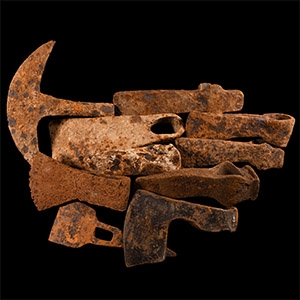
Viking Age and Later Iron Axehead Group
12th-18th century A.D.Sold for (Inc. bp): £260
Mainly comprising socketted axeheads and hammer-butt adzes, together with other weapons. 9.5 kg total, 16-23.5 cm
Acquired 1990s-early 2000s. East Anglian private collection.
On type of axehead here presented, with similar specimens found in the territories of the Teutonic Order, was by far the most popular form of axe which remains unchangeable and continues to be used in the Baltic to this day. It appears in East European territories as early as the mid 13th century A.D.
