
Loading, please wait...
_900x900.jpg "Greek and Other Artefact Group")
_200x200.jpg "Greek and Other Artefact Group")
.jpg "Greek and Other Artefact Group")
LOT 0580
Greek and Other Artefact Group
CIRCA 7TH-2ND CENTURY B.C.
1 1/8 - 1 1/4 in. (8.55 grams total, 29-33 mm).
A group of two silver artefacts comprising: a brooch element with catchplate and decorative ribbing; a possible earring with coiled closures. [2, No Reserve]
ProvenanceEssex gallery, early 2000s.
CONDITIONTimeLine Auctions follows a vetting process to ensure the authenticity and legality of all items, reinforcing our commitment to integrity and responsible trading. Each antiquity, antique, and coin lot undergoes thorough examination by a vetting committee of at least ten external specialists, professional trade association members, scientists, and archaeologists: Our Vetting Process
AUCTIONS:
TimeLine is a leading auction house specialising in antiquities, ancient art, collectables, natural history, coins, medals, and books. Our auctions offer museums, collectors, historians, and enthusiasts the opportunity to acquire unique and historically significant pieces.
-
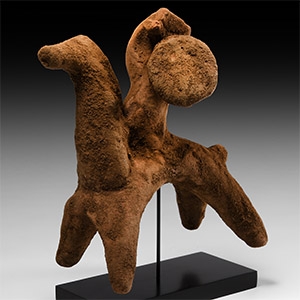
Archaic Greek Mounted Warrior with Shield
7th-5th century B.C.Sold for (Inc. bp): £338
A terracotta figure modelled in the round as a mounted warrior, the stylised horse modelled standing on stub legs, with a long neck and detailing to its eyes; the warrior holding a shield in his left hand, right hand and arm raised to eye level, wearing a crested helmet; restored and mounted on a custom-made display stand. 410 grams total, 16 cm high including stand
Acquired before 1990. From an old German collection.
Terracotta figurines of horse and rider were common grave offerings in Boeotia, northwest of Attica, particularly during the 6th century B.C. Representations of warriors on horseback were already widespread in the Geometric Period, and also widely employed in Cyprus in this same period. The image of our rider, although influenced by Cypriot designs, does not show typical Cypriot characteristics, and indeed his kausia cap suggests a northern Greek origin. -
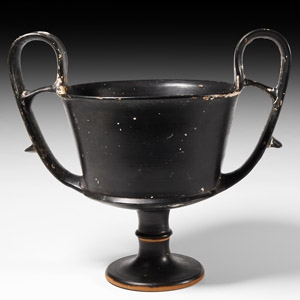
Greek Black Ware Kantharos
5th century B.C.Sold for (Inc. bp): £5,200
A black-glazed terracotta kantharos with two integral ear-shaped handles with internal bridges and ledges to the exterior, collar to stem and discoid foot; possibly Boeotian. 565 grams, 23 cm wide
Acquired 1980s-1990s. H.N. collection, Milton Keynes, UK.
A kantharos is a drinking cup with two handles. -
.jpg)
Greek Decorated Spiral Bracelet
8th century B.C.Estimate: £700 - 900 (‡+bp*)
Opening Bid: £350
A bronze bracelet formed as a spiral D-section rod with waisted profile, hatched and notched ornament to the edges. 685 grams, 11.5 cm
Private Swiss collection, acquired 2002.
