Loading, please wait...

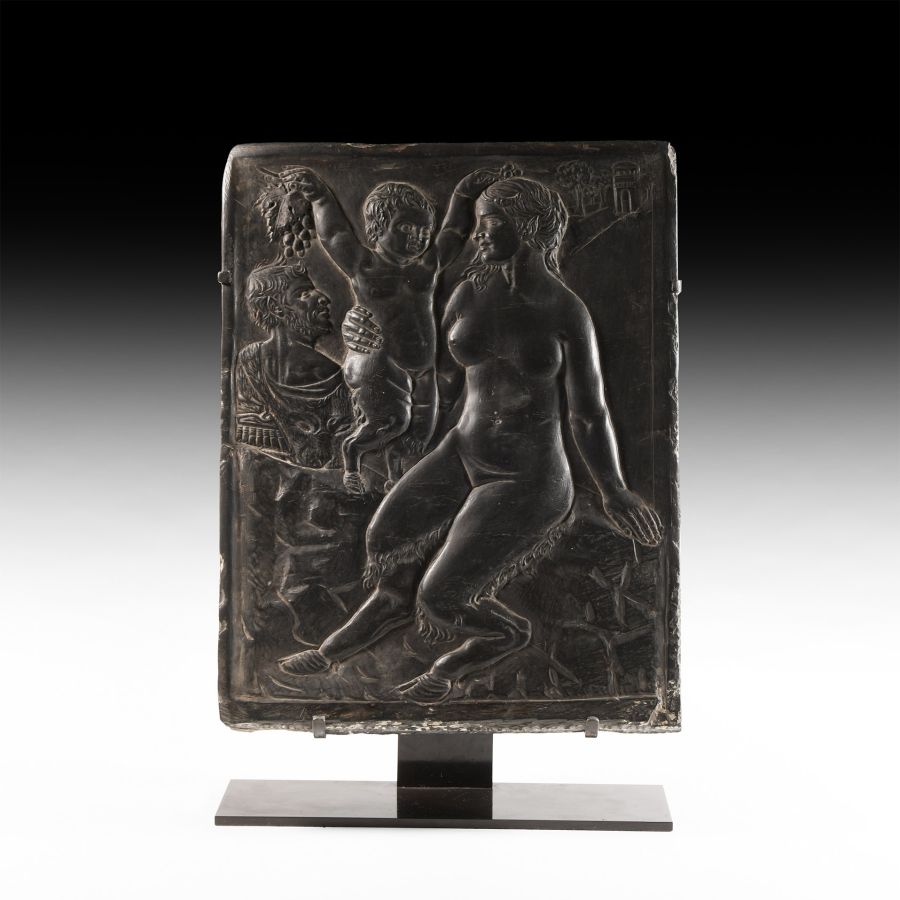
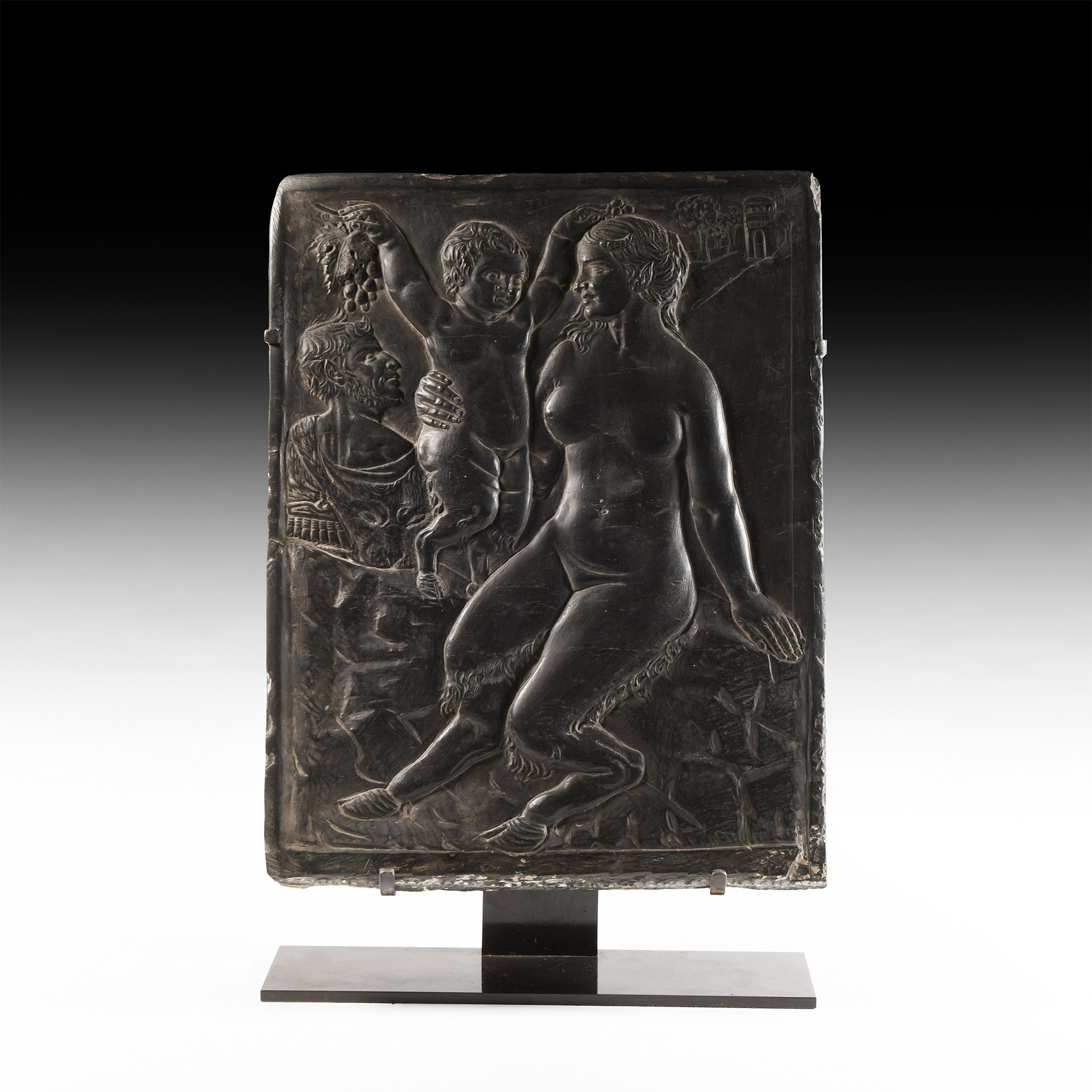
Grand Tour Relief with Satyrs Grand Tour Relief with Satyrs Grand Tour Relief with Satyrs
Use mousewheel to zoom in and out, click to enlarge
Details

LOT 0381

Grand Tour Relief with Satyrs

18TH-19TH CENTURY A.D.

14 1/2 in. (5.7 kg total, 37 cm high including stand).

A satyr Bacchus themed plaque featuring a nude woman and child with goat's legs and hooves, set in a formal landscape, the child holding bunches of grapes, a bearded male figure dressed in animal skins beside them; wax seal applied to the reverse; mounted on a custom-made display stand.

Provenance

English private collection.

This lot has been checked against the Interpol Database of stolen works of art and is accompanied by search certificate number no.11685-199804.

Footnotes

Possibly loosely based on C.M. Clodion's works.

CONDITION
VETTING:

TimeLine Auctions follows a vetting process to ensure the authenticity and legality of all items, reinforcing our commitment to integrity and responsible trading. Each antiquity, antique, and coin lot undergoes thorough examination by a vetting committee of at least ten external specialists, professional trade association members, scientists, and archaeologists: Our Vetting Process


AUCTIONS:

TimeLine is a leading auction house specialising in antiquities, ancient art, collectables, natural history, coins, medals, and books. Our auctions offer museums, collectors, historians, and enthusiasts the opportunity to acquire unique and historically significant pieces.

LOT 0381

Grand Tour Relief with Satyrs

Estimate £4,000 - 6,000€4,640 - 6,960 (for guidance only)$5,400 - 8,100 (for guidance only)

Print page

RELATED LOTS
  • Renaissance Gold Ring with Ruby and Enamelling
    Renaissance Gold Ring with Ruby and Enamelling
    Late 16th century A.D.

    Sold for (Inc. bp): £14,300

    A classic, Renaissance era gold ring composed of a slender D-section hoop, widening at the shoulders, fashioned as architectural capitals with strapwork and elaborate projecting scrolls in opaque white and blue enamel, embellished with red and green enamelled detailing; square bezel with box setting set with a table-cut ruby, pairs of blue enamelled cusplets to each of the four faces, stepped base below ornamented with a black enamelled bead moulded collar, bezel reverse of flat inverted pyramidal form and divided into four triangles, two with black enamelled hatching; retaining the majority of the original enamelling; accompanied by a Les Enluminures presentation box. 4.66 grams, 22.94 mm overall, 16.90 mm internal diameter (approximate size British H, USA 3 3/4, Europe 6.18, Japan 6)


    Acquired from Les Enluminures Ltd, Illinois, USA, 2016. Property of an East Sussex collector. Accompanied by a Les Enluminures certificate of authenticity. Accompanied by a copy of the Les Enluminures invoice. This lot has been checked against the Interpol Database of stolen works of art and is accompanied by search certificate no.11670-197580.

    Rubies were a potent symbol of status and social distinction in later medieval Europe, frequently adorning royal crowns. In the Renaissance, however, they conveyed a personal, more intimate message, their red colour, like the rose, emblematic of love. The intensity of the red colour was often enhanced with a foil lining to the setting and were popular as betrothal and wedding rings. It is believed that rubies symbolised the virtues of marriage and eternal matrimonial love. Such rings held an international appeal, making attribution to specific workshops or countries very difficult. The V & A Museum explains that 'Renaissance, the ring developed from the simple forms of the medieval period into a miniature work of art, combining the skills of the chaser, engraver and enameller as well as the stone cutter.'

    Lot Details

  • Italian Virgin of Tenderness Icon
    Italian Virgin of Tenderness Icon
    Circa 19th century A.D.

    Estimate: £700 - 900 (+bp*)

    Opening Bid: £300

    A painting on wood of the Virgin of Tenderness, copying an earlier work, depicting Mary dressed in blue robe ornamented with gold stars with an off-white veil delicately framing her face; gently supporting the Child dressed in red tunic; both figures nimbate and affectionately leaning towards each other with their cheeks touching; the scene enclosed in a gilt pseudo-Gothic crenelated frame, an inscription in new Gothic uncial style to the bottom reading 'AVE GRATIA PLENA' for 'hail full of grace'; mounted on a 19th century crenelated wooden pedestal fitted with candle holder to each side in the shape of a flower. 279 grams, 29.5 cm high


    Property of a London lady, part of her family's collection.

    The panel has many stylistic similarities with that of Icilio Federico Joni (1866-1946) assigned to the style of Sano di Pietro. Compared to that, the head of the Virgin has been realised in a more archaic Gothic style. With their faces gently pressed together, the interaction between the Virgin and the Child evokes a tender intimacy. This motif appears in numerous works by Sano di Pietro and his workshop (for example, in another painting in the Lehman Collection in MET, 975.1.39). The particular manner of concealing the Child’s right cheek behind the Virgin’s face was probably inspired by Madonna painted by the Sienese master Ambrogio Lorenzetti (Pinacoteca Nazionale, Siena).

    Lot Details

  • Medieval Seal Matrix Reproduction Group
    Medieval Seal Matrix Reproduction Group
    19th century A.D.

    Sold for (Inc. bp): £52

    A mixed group of bronze reproduction vesica-shaped seal matrices each with a legend to the border and central figure. 108 grams total, 38-48 mm


    Ex Baldwins basement, London, UK. From the collection of G.M.R.H., London, UK.

    Lot Details

Stay up-to-date with the latest from TimeLine Auctions by joining our mailing list