
Loading, please wait...
LOT 0767
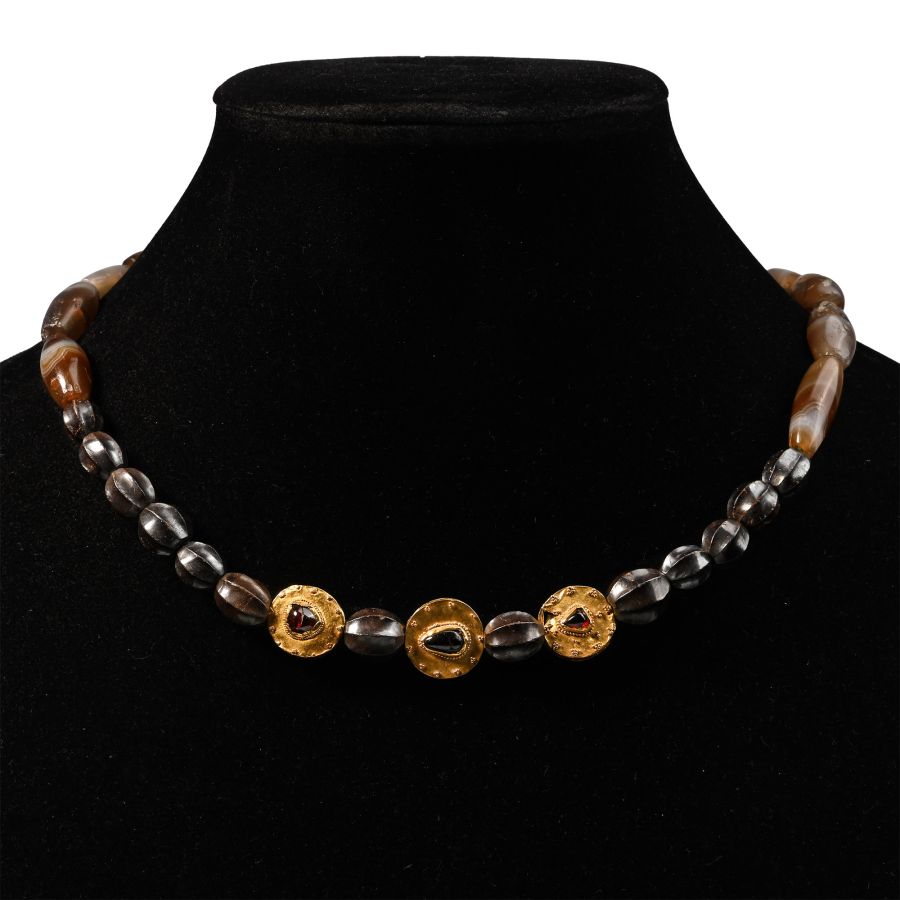
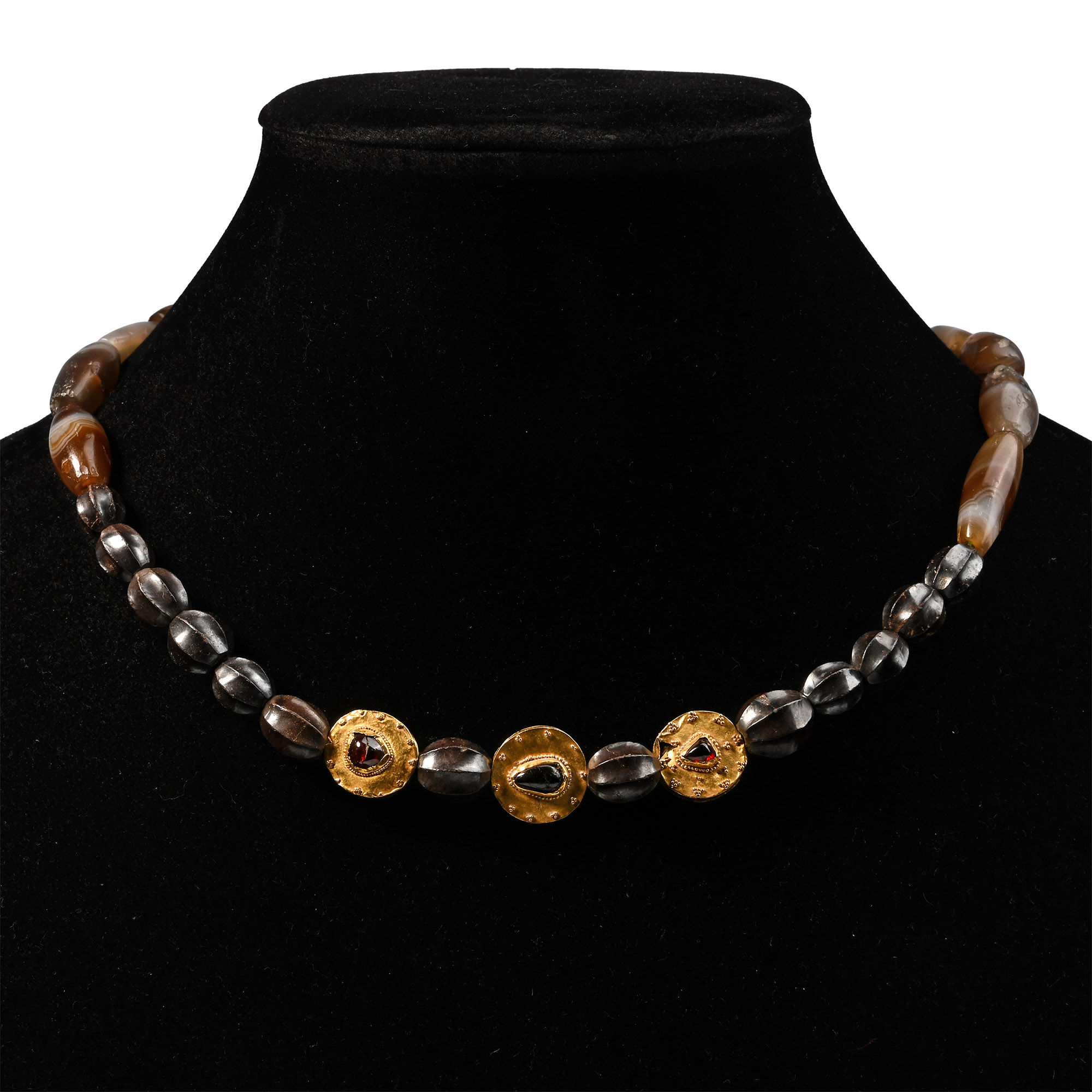
Graeco-Roman Necklace with Gold Beads
1ST CENTURY B.C. AND LATER
13 3/8 in. (46.45 grams, 34 cm).
Restrung group of fluted melon and other beads with three later hollow-formed gold drum-shaped panels, each with an inset cabochon garnet to the upper face, and granule clusters.
ProvenancePrivate collection, Jerusalem, assembled in the 1960s.
with Holy Land Antiquities, Jerusalem.
European private collection, acquired 2001.
This lot has been checked against the Interpol Database of stolen works of art and is accompanied by search certificate number no.13141-246774.
Cf. similar tubular carnelian beads and turquoise spacer beads in Then-Obluska, J., ‘Beads and pendants from the Hellenistic to early Byzantine Red Sea port of Berenike, Egypt, Seasons 2014 and 2015’ in Polish Archaeology in the Mediterranean, pp.203–234, figs.3a.
FootnotesIn the Hellenistic and Roman periods there was a strong formal and chromatic diversity of glass beads used for necklaces and bracelets. The most common beads in forms were small biconical (lenticular), barrel-shaped, spherical and annular; the most common colours were dark blue, followed by green and yellow, and red. The succession of glass beads often imitates jewellery made of costly materials (gold, silver, semi-precious and precious stones).
CONDITIONTimeLine Auctions follows a vetting process to ensure the authenticity and legality of all items, reinforcing our commitment to integrity and responsible trading. Each antiquity, antique, and coin lot undergoes thorough examination by a vetting committee of at least ten external specialists, professional trade association members, scientists, and archaeologists: Our Vetting Process
AUCTIONS:
TimeLine is a leading auction house specialising in antiquities, ancient art, collectables, natural history, coins, medals, and books. Our auctions offer museums, collectors, historians, and enthusiasts the opportunity to acquire unique and historically significant pieces.
LOT 0767
Graeco-Roman Necklace with Gold Beads
Estimate £2,500 - 3,500€2,900 - 4,060 (for guidance only)$3,380 - 4,730 (for guidance only)
Opening Bid
£1,250 (EUR 1,450; USD 1,688) ‡+BP*
-

Greek Painted Pottery Aryballos
Corinthian, circa 6th century B.C.Estimate: £250 - 350 (‡+bp*)
Opening Bid: £125
With a narrow neck and a broad rim to the mouth, a short strap handle to the rear; painted concentric rings around the mouth. 212 grams, 75 mm
Private collection, acquired in 1994; thence by descent.
From the 8th century B.C., Corinthian pottery vessels were exported to Greek colonies in South Italy and the coast of Asia Minor. They were used to hold perfumed oil, an essential item for the wealthy middle classes of the time. In Italy, especially in Etruria, local workshops produced imitations of Corinthian vessel types for a clientele of Greek settlers and local populations with a taste for Greek fashions. -

Graeco-Persian Gold Ram-Shaped Amulet
3rd-2nd century B.C.Estimate: £12,000 - 17,000 (‡+bp*)
Opening Bid: £6,000
Modelled in the round in the form of a ram lying with its legs folded beneath the body, head turned with hooked horns, collar to the neck with a large pellet pendant; ribbed suspension loop behind the shoulders, mounting lug beneath the trunk. 12.87 grams, 30 mm
Private collection, acquired on the European art market in 2002. Accompanied by a copy of an Art Loss Register certificate, 8 June 2004. This lot has been checked against the Interpol Database of stolen works of art and is accompanied by search certificate number no.13204-249215.
The ram, a male symbol, was associated with various divinities. Turned into a ram as a child by Zeus, and a common sacrifice to the god, the ram was a symbol of Dionysus, which he shared with Aphrodite. Ram heads and pendants frequently occur in jewellery. In the animal kingdom, Eros favours the cockerel and the ram, both of which are indicative of sexual potency. -

Greek Core-Formed Glass Amphoriskos
5th-3rd century B.C.Estimate: £1,500 - 2,000 (+bp*)
Opening Bid: £833
Elongated piriform amphora shape, tubular neck and everted rim, decorated with polychrome festooning and trails, applied amber-green handles and knop foot. 152 grams, 18 cm high
Acquired in the early 1990s. Ex private American collection; thence by descent. Private collection since 1998. This lot has been checked against the Interpol Database of stolen works of art and is accompanied by search certificate no.12206-222129.
