
Loading, please wait...
_900x900.jpg "Graeco-Persian Chalcedony Stamp Seal with Striding Boar")
_200x200.jpg "Graeco-Persian Chalcedony Stamp Seal with Striding Boar")
_900x900.jpg "Graeco-Persian Chalcedony Stamp Seal with Striding Boar")
_200x200.jpg "Graeco-Persian Chalcedony Stamp Seal with Striding Boar")
.jpg "Graeco-Persian Chalcedony Stamp Seal with Striding Boar")
.jpg "Graeco-Persian Chalcedony Stamp Seal with Striding Boar")
LOT 0076
Graeco-Persian Chalcedony Stamp Seal with Striding Boar
5TH-4TH CENTURY B.C.
1 in. (7.09 grams, 25.3 mm).
Plano-convex seal with incuse boar image; Bivar notes in his description: 'Boar, charging to the left. The convexity of the bezel surface is rather untypical. The stone may have been resurfaced. Probably 5th to 4th century B.C.'; accompanied by a museum-quality impression.
ProvenanceUK private collection, acquired 1980-1983.
Accompanied by a copy of a scholarly note typed and signed by A.D.H. (David) Bivar.
This lot has been checked against the Interpol Database of stolen works of art and is accompanied by a search certificate number no.12520-230315.
This lot has been cleared against the Art Loss Register database, and is accompanied by an illustrated lot declaration signed by the Head of the Antiquities Department, Dr Raffaele D’Amato.
TimeLine Auctions follows a vetting process to ensure the authenticity and legality of all items, reinforcing our commitment to integrity and responsible trading. Each antiquity, antique, and coin lot undergoes thorough examination by a vetting committee of at least ten external specialists, professional trade association members, scientists, and archaeologists: Our Vetting Process
AUCTIONS:
TimeLine is a leading auction house specialising in antiquities, ancient art, collectables, natural history, coins, medals, and books. Our auctions offer museums, collectors, historians, and enthusiasts the opportunity to acquire unique and historically significant pieces.
LOT 0076
Graeco-Persian Chalcedony Stamp Seal with Striding Boar
Estimate £1,800 - 2,400€2,090 - 2,780 (for guidance only)$2,430 - 3,240 (for guidance only)
-
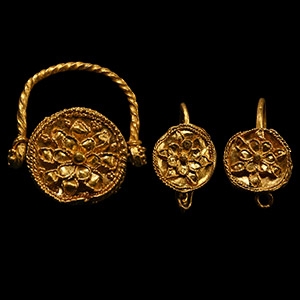
Greek Gold Ring and Earring Set with Rosettes
4th century B.C.Estimate: £3,000 - 4,000 (+bp*)
Opening Bid: £1,500
Comprising: finger ring with twisted-rod hoop ending in loops with granule ornament, swivelling hollow-formed drum-shaped plaque with applied filigree and granule clusters in a rosette motif; two earrings, each with a smaller version of the ring's plaque mounted on a hooked wire with fastener. 14.6 grams total, earrings: 23-24 mm, ring: 23.59 mm overall, 21.52 x 17.44 internal diameter (approximate size British P 1/2, USA 7 3/4, Europe 16.86, Japan 16)
Acquired on the UK art market 1971-1974. Private collection, London. Accompanied by an academic report by Dr Raffaele D'Amato. This lot has been checked against the Interpol Database of stolen works of art and is accompanied by search certificate no.12493-230329. This lot has been cleared against the Art Loss Register database, and is accompanied by an illustrated lot declaration signed by the Head of the Antiquities Department, Dr Raffaele D’Amato. -
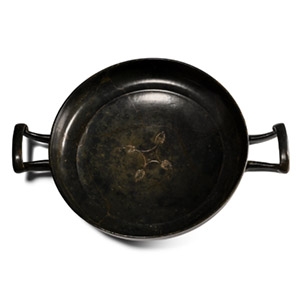
Greek Terracotta Black-Glazed Stemless Cup
Campanian, 4th century B.C.Sold for (Inc. bp): £572
Comprising a low foot of rare profile, with two toruses; traces of red paint inside foot; four interconnected palmettes to the tondo; accidental imprint of the bowl stacked above it in the kiln; concentric rib on the interior, looped handles; restored. 323 grams, 25.4 cm
Estate of Philippe Stoll, Strasbourg. Accompanied by a copy of an Art Loss Register certificate no.S00044863. This lot is accompanied by an illustrated lot declaration signed by the Head of the Antiquities Department, Dr Raffaele D’Amato. -
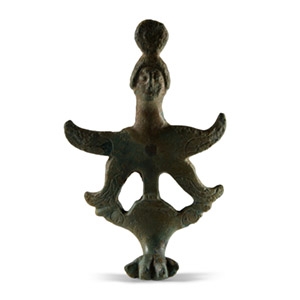
Etruscan Bronze Harpy Finial
5th century B.C.Sold for (Inc. bp): £286
In the form of a harpy, comprising a facing female mask with lobed headdress on a tapering neck, crescentic lateral wings and tails with feather detailing, central column with claw foot; beneath, a scrolled panel developing to a four-toed claw; hollow to reverse of mask and claw, fixing stud and mounting ledge to reverse. 55 grams, 96 mm
Acquired in Germany, before 2000. English private collection. with Bertolami Fine Arts Ltd, Auction 88, no.162. This lot is accompanied by an illustrated lot declaration signed by the Head of the Antiquities Department, Dr Raffaele D’Amato.
