
Loading, please wait...


LOT 0514
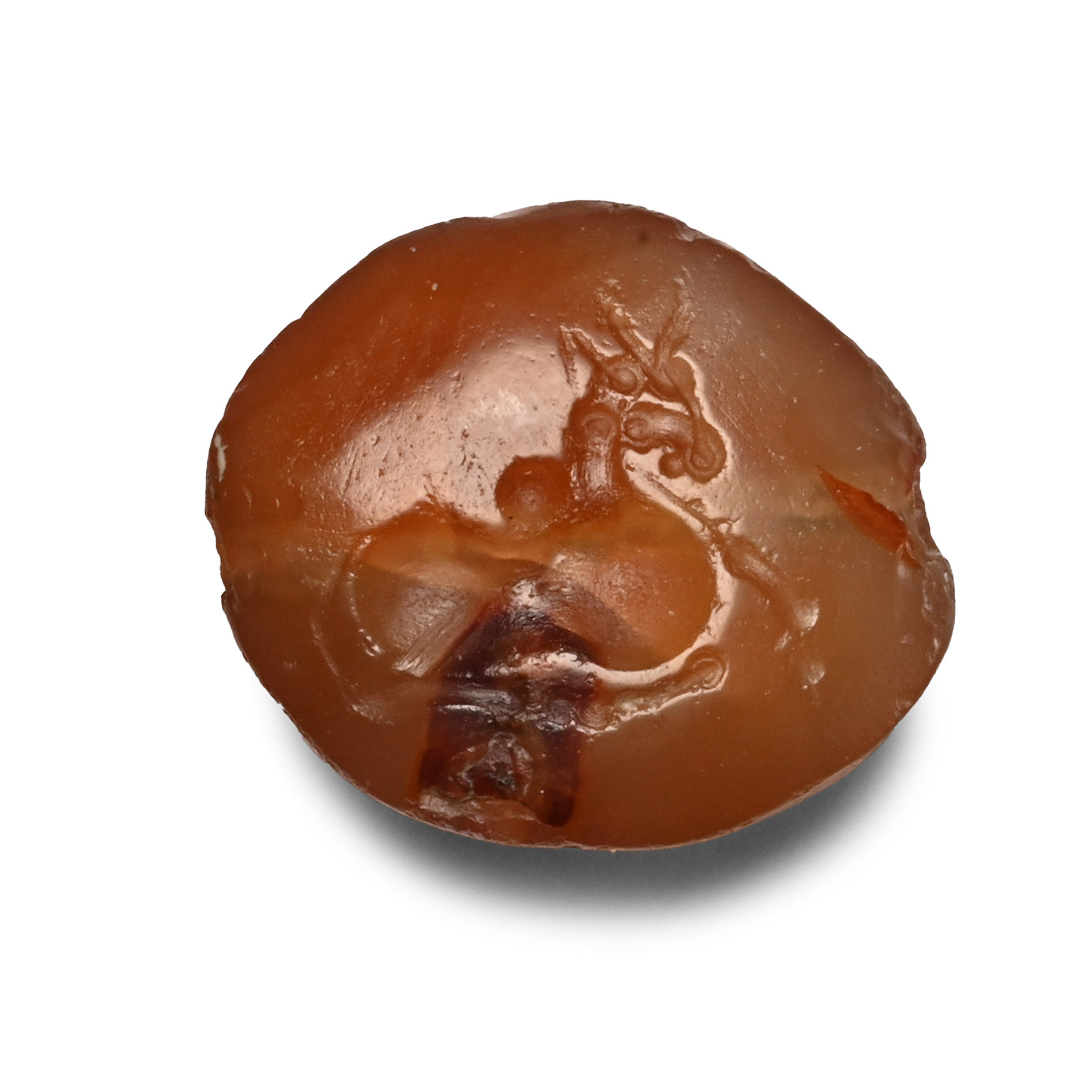
Graeco-Persian Agate Scaraboid with Recumbent Zebu
LATE 4TH-3RD CENTURY B.C.
5/8 in. (1.83 grams, 15 mm).
Engraved to the underside with a reclining zebu facing right with short protruding horns and a pointed ear; smooth, curved top and a narrow longitudinal perforation.
Provenancewith Herbert A. Cahn, Basel, 1990s.
Accompanied by a copy of an Art Loss Register certificate no.S00075367.
This lot is accompanied by an illustrated lot declaration signed by the Head of the Antiquities Department, Dr Raffaele D’Amato.
Cf. Boardman, J., Greek Gems and Finger Rings, Early Bronze Age to Late Classical, London, 1970 (2001), nos.985, for the type.
FootnotesThe body, head and joints are rendered in the “globolo” drilling technique, in which circular recesses of different sizes are carved into the stone, whilst fine cuts are used to depict the horns, ear and tail. In the Achaemenid period, ‘globolo’ style visible on some gemstones, mainly with animal motifs, developed in Syria-Phoenicia, but the gems did not carry specific Persian motifs, except perhaps this series with a zebu bull.
CONDITIONTimeLine Auctions follows a vetting process to ensure the authenticity and legality of all items, reinforcing our commitment to integrity and responsible trading. Each antiquity, antique, and coin lot undergoes thorough examination by a vetting committee of at least ten external specialists, professional trade association members, scientists, and archaeologists: Our Vetting Process
AUCTIONS:
TimeLine is a leading auction house specialising in antiquities, ancient art, collectables, natural history, coins, medals, and books. Our auctions offer museums, collectors, historians, and enthusiasts the opportunity to acquire unique and historically significant pieces.
-
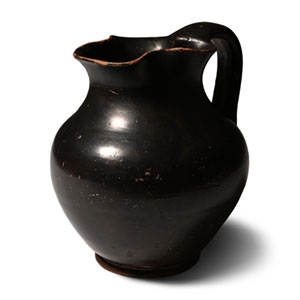
Greek Black-Glazed Trefoil Oinochoe
5th-4th century B.C.Sold for (Inc. bp): £624
With pinched three-lobe mouth and strap handle, old collector's label 'N3521' to underside. 332 grams, 14.8 cm
with Galerie Gilgamesh, prior 2003. Accompanied by a copy of an Art Loss Register certificate no.S00075441. This lot is accompanied by an illustrated lot declaration signed by the Head of the Antiquities Department, Dr Raffaele D’Amato. -
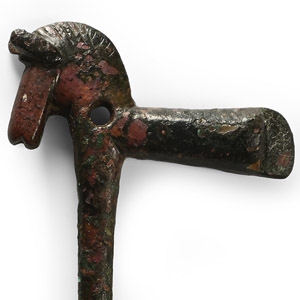
Greek Geometric Pin with Horse Terminal
Circa 900-700 B.C.Estimate: £300 - 400 (+bp*)
Opening Bid: £100
Comprising a long tapering shank with a flattened tip, horse-shaped finial set perpendicular to the shank, pierced through the centre and a flat-section short tang to the rear. 39 grams, 14 cm
UK private collection before 2000. Acquired on the UK art market. Property of a London gentleman. This lot is accompanied by an illustrated lot declaration signed by the Head of the Antiquities Department, Dr Raffaele D’Amato. -
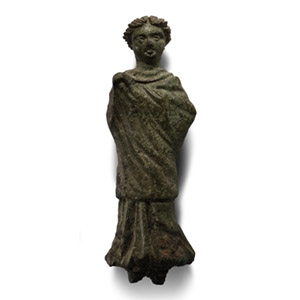
Etruscan Bronze Ceres Statuette
3rd-2nd century B.C.Estimate: £800 - 1,000 (‡+bp*)
Opening Bid: £400
Female with hair drawn up in a chignon, palla wrapped tightly around the upper body hiding the right arm bent with the hand at the shoulder, lower hem of robe flared; fixing lug to underside. 86 grams, 71 mm
Acquired in the mid 1980s-1990s. Private collection, Switzerland, thence by descent. Private collection, since the late 1990s. This lot is accompanied by an illustrated lot declaration signed by the Head of the Antiquities Department, Dr Raffaele D’Amato.
This is a figurine of a deity of difficult interpretation representing an ex-voto. This typology is widespread in the votive offerings of Etrusco-Roman sanctuaries, and by analogy with various statuettes could represent Ceres.
