
Loading, please wait...
_900x900.jpg "Graeco-Parthian Bronze Mirror with Animals")
_200x200.jpg "Graeco-Parthian Bronze Mirror with Animals")
.jpg "Graeco-Parthian Bronze Mirror with Animals")
LOT 0491
Graeco-Parthian Bronze Mirror with Animals
2ND-1ST CENTURY B.C.
6 1/2 in. (516 grams total, 16.6 cm).
Discoid flat mirror with piriform attachment bracket developing to an addorsed pair of animal heads, equine but with a single curved plume or horn between the ears; mounted on a custom-made stand.
ProvenanceUK private collection before 2000.
UK art market.
Ex property of a London gentleman.
This lot is accompanied by an illustrated lot declaration signed by the Head of the Antiquities Department, Dr Raffaele D’Amato.
TimeLine Auctions follows a vetting process to ensure the authenticity and legality of all items, reinforcing our commitment to integrity and responsible trading. Each antiquity, antique, and coin lot undergoes thorough examination by a vetting committee of at least ten external specialists, professional trade association members, scientists, and archaeologists: Our Vetting Process
AUCTIONS:
TimeLine is a leading auction house specialising in antiquities, ancient art, collectables, natural history, coins, medals, and books. Our auctions offer museums, collectors, historians, and enthusiasts the opportunity to acquire unique and historically significant pieces.
LOT 0491
Graeco-Parthian Bronze Mirror with Animals
Estimate £500 - 700€580 - 810 (for guidance only)$680 - 950 (for guidance only)
-
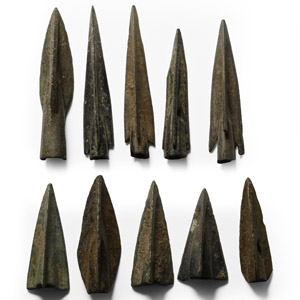
Greek Period Bronze Arrowhead Collection
5th-3rd century B.C.Sold for (Inc. bp): £98
High-quality, triangular in section, with flanges and socket. 19.3 grams total, 24-36 mm
From an English collection formed before 2000. This lot is accompanied by an illustrated lot declaration signed by the Head of the Antiquities Department, Dr Raffaele D’Amato. -
.jpg)
Apulian Red-Figure Askos with Panthers
4th century B.C.Estimate: £2,500 - 3,500 (‡+bp*)
Opening Bid: £1,250
With an arching strap handle and a wide spout; either side of the body painted with a crouching panther, one playing with a ball and the other depicted facing; repaired. 149 grams, 12 cm
Acquired from Gallery Gryphos, Munich, 1992. European private collection. Accompanied by an academic report by Dr Raffaele D’Amato. This lot has been checked against the Interpol Database of stolen works of art and is accompanied by a search certificate number no.12001-211879. This lot has been cleared against the Art Loss Register database, and is accompanied by an illustrated lot declaration signed by the Head of the Antiquities Department, Dr Raffaele D’Amato.
Painted askoi in different forms were produced and been in use in Athens since the middle and second quarter of the 5th century B.C., but they were also made in southern Italy. The askoi painted with a pair of animal figures were realised in Magna Graecia after the Attic continental production of similar models, with the representation of griffins, sphinxes and laconic hounds. The function of the askos as a vessel was clearly linked to wine, and therefore it is not anomalous to see it decorated with panther motifs, an animal connected with Dionysus, the god of wine and drinking. -
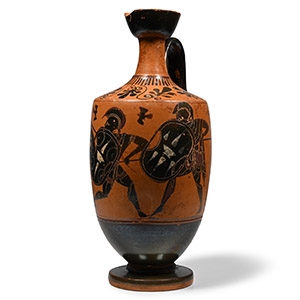
Greek Attic Black-Figure Lekythos with Combat Scene
Circa 520 B.C.Estimate: £20,000 - 30,000 (‡+bp*)
Opening Bid: £10,000
The ovoid body decorated with a combat scene, band of tendrils and leaves to the shoulder and vertical bands to the slender neck, trumpet-shaped mouth, strap handle and discoid foot; the scene comprising three Hoplites, the first in tall-crested Corinthian helmet, cuirass and greaves, xiphos hanging on his right side, thrusting with his long spear over his ellipsoid shield towards the middle figure, running forwards but with his helmetted head turned towards his attacker, using his Boeotian shield to ward off the blow while manoeuvring his own spear which is blocked by the third figure advancing against him, with spear held underarm, with birds in flight above. 481 grams, 26.5 cm
Private collection, Southern Germany, acquired in 1960s. with Paul-Francis Jacquier, Numismatique Antique, Münzen und Kunst der Antique, 13 September 2013. Acquired by the present owner at the above sale. This lot has been checked against the Interpol Database of stolen works of art and is accompanied by search certificate number no.12189-222313. This lot has been cleared against the Art Loss Register database, and is accompanied by an illustrated lot declaration signed by the Head of the Antiquities Department, Dr Raffaele D’Amato.
The clothing and weapons of the hoplites are detailed copies of hoplites of late decades of 6th century B.C. The left warrior wears a Corinthian helmet with a high crest, a richly decorated robe and greaves. His round Attic shield, from which a richly pleated chlamys hangs down, is decorated with large circles. The middle and the right hoplite wear Corinthian helmets with a lower crest, and also beautifully decorated robes and greaves. They hold very large, Boeotian-shaped shields with striking bundles of lightning and 'flames'. As a beautiful counterpart to the left fighter, the right warrior carries a chlamys with long folds over his shoulder.
