
Loading, please wait...
Details
LOT 256507
Gold Ring with Elliptical Garnet
ROMAN, 1ST CENTURY B.C.-1ST CENTURY A.D. OR LATER
1 in. (8.36 grams, 25.87 mm overall, 19.48 mm internal diameter (approximate size British P 1/2, USA 7 3/4, Europe 16.86, Japan 16)).
Comprising a substantial keeled hoop and raised bezel set with a garnet, the garnet with a central lozenge flanked by two transverse lines, the ring shape is characteristic of Augustan rings.
Provenance
Private English collection.
Private collection, UK.
This lot has been checked against the Interpol Database of stolen works of art and is accompanied by search certificate number no.12955-245984.
Literature
Cf. Chadour, A.B., Rings. The Alice and Louis Koch Collection, volume I, Leeds, 1994, item 163, for a similar type.
Footnotes
The ring type is characteristic of the Augustan Period, and two further examples are documented by the Romisch-Germanisches Zentralmuseum in Mainz.
CONDITIONVETTING:
TimeLine Auctions follows a vetting process to ensure the authenticity and legality of all items, reinforcing our commitment to integrity and responsible trading. Each antiquity, antique, and coin lot undergoes thorough examination by a vetting committee of at least ten external specialists, professional trade association members, scientists, and archaeologists: Our Vetting Process
AUCTIONS:
TimeLine is a leading auction house specialising in antiquities, ancient art, collectables, natural history, coins, medals, and books. Our auctions offer museums, collectors, historians, and enthusiasts the opportunity to acquire unique and historically significant pieces.
LOT 256507
Gold Ring with Elliptical Garnet
Estimate £2,000 - 3,000€2,320 - 3,480 (for guidance only)$2,700 - 4,050 (for guidance only)
Opening Bid
£1,000 (EUR 1,160; USD 1,350) +BP*
RELATED LOTS
-
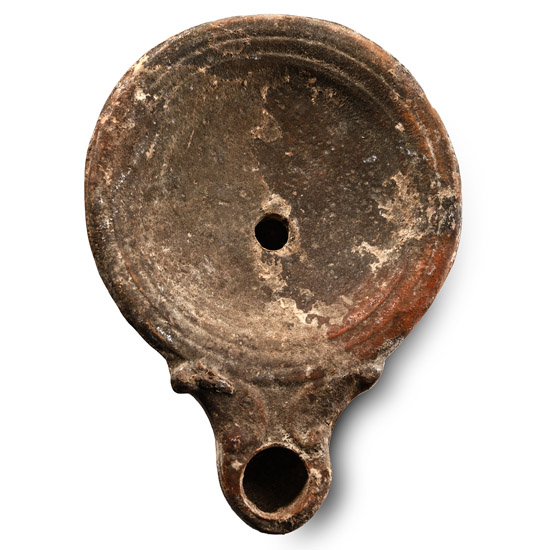
Roman Voluted Terracotta Oil Lamp
1st-2nd century A.D.Estimate: £50 - 70 (+bp*)
Opening Bid: £5
Piriform in plan with short spout flanked by volutes, segmented shoulder and dished discus, basal ring. 39.4 grams, 91 mm
From a UK private collection since at least 1946. Property of a West London, UK, gentleman. -
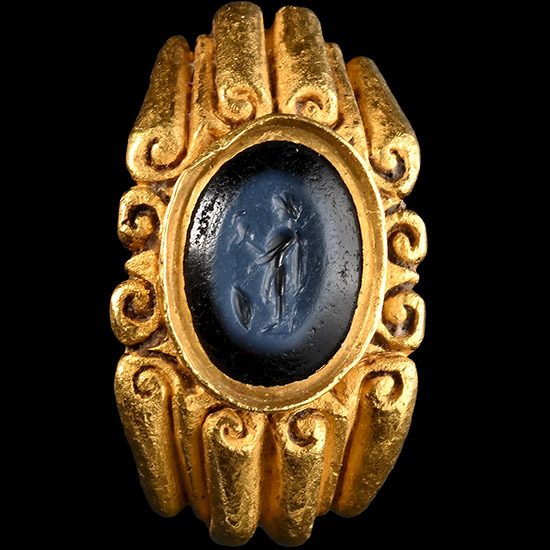
Heavy Roman Gold Ring with Nicolo Gemstone with Minerva
3rd century A.D.Estimate: £7,000 - 9,000 (+bp*)
Opening Bid: £3,500
A substantial and finely worked ring with a solid hoop broadening at the shoulders into elegant voluted scrolls, the oval bezel set with a layered nicolo agate intaglio, the dark upper stratum revealing a paler blue beneath, the intaglio finely engraved with a standing figure holding a crested helmet. 26.56 grams, 27.90 mm overall, 19.66 x 16.90 mm internal diameter (approximate size British O, USA 8, Europe 17.49, Japan 16)
Private collection, France. -
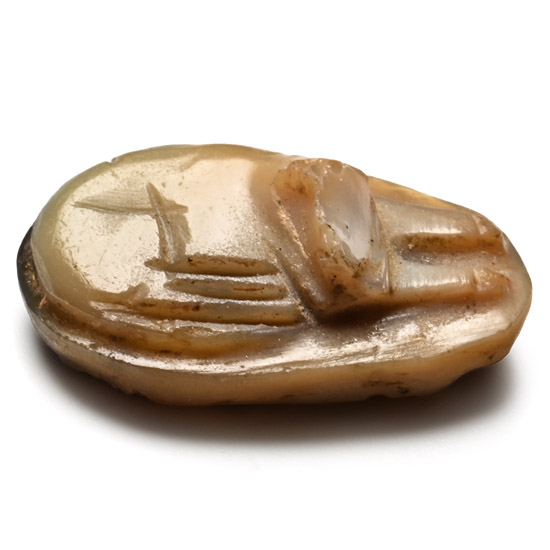
Roman Agate Cameo with Sleeping Dog
Circa 2nd century A.D.Estimate: £300 - 400 (+bp*)
Opening Bid: £5
Pear-shaped cameo with a raised image of a reclining hound resting its head on its front paws. 0.84 grams, 15 mm
From the private collection of a European gentleman (1942-2024), formed since the 1970s.
